
1.146.854
kiadvánnyal nyújtjuk Magyarország legnagyobb antikvár könyv-kínálatát

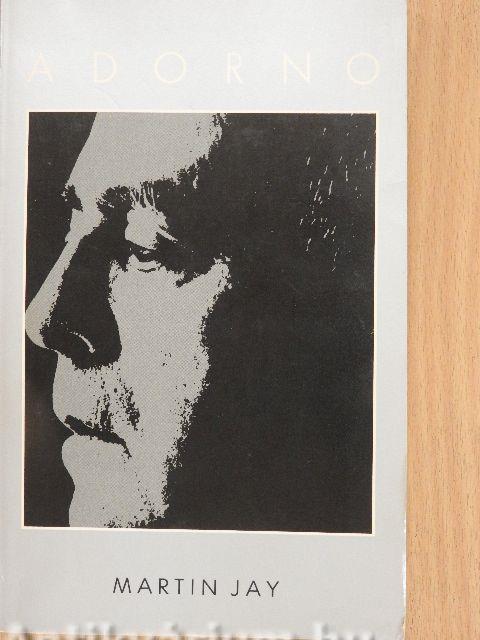
Adorno
Cambridge
| Kiadó: | Harvard University Press |
|---|---|
| Kiadás helye: | Cambridge |
| Kiadás éve: | |
| Kötés típusa: | Ragasztott papírkötés |
| Oldalszám: | 199 oldal |
| Sorozatcím: | |
| Kötetszám: | |
| Nyelv: | Angol |
| Méret: | 23 cm x 14 cm |
| ISBN: | 0-674-00515-5 |
Értesítőt kérek a kiadóról
A beállítást mentettük,
naponta értesítjük a beérkező friss
kiadványokról
naponta értesítjük a beérkező friss
kiadványokról
A beállítást mentettük,
naponta értesítjük a beérkező friss
kiadványokról
naponta értesítjük a beérkező friss
kiadványokról
Előszó
Tovább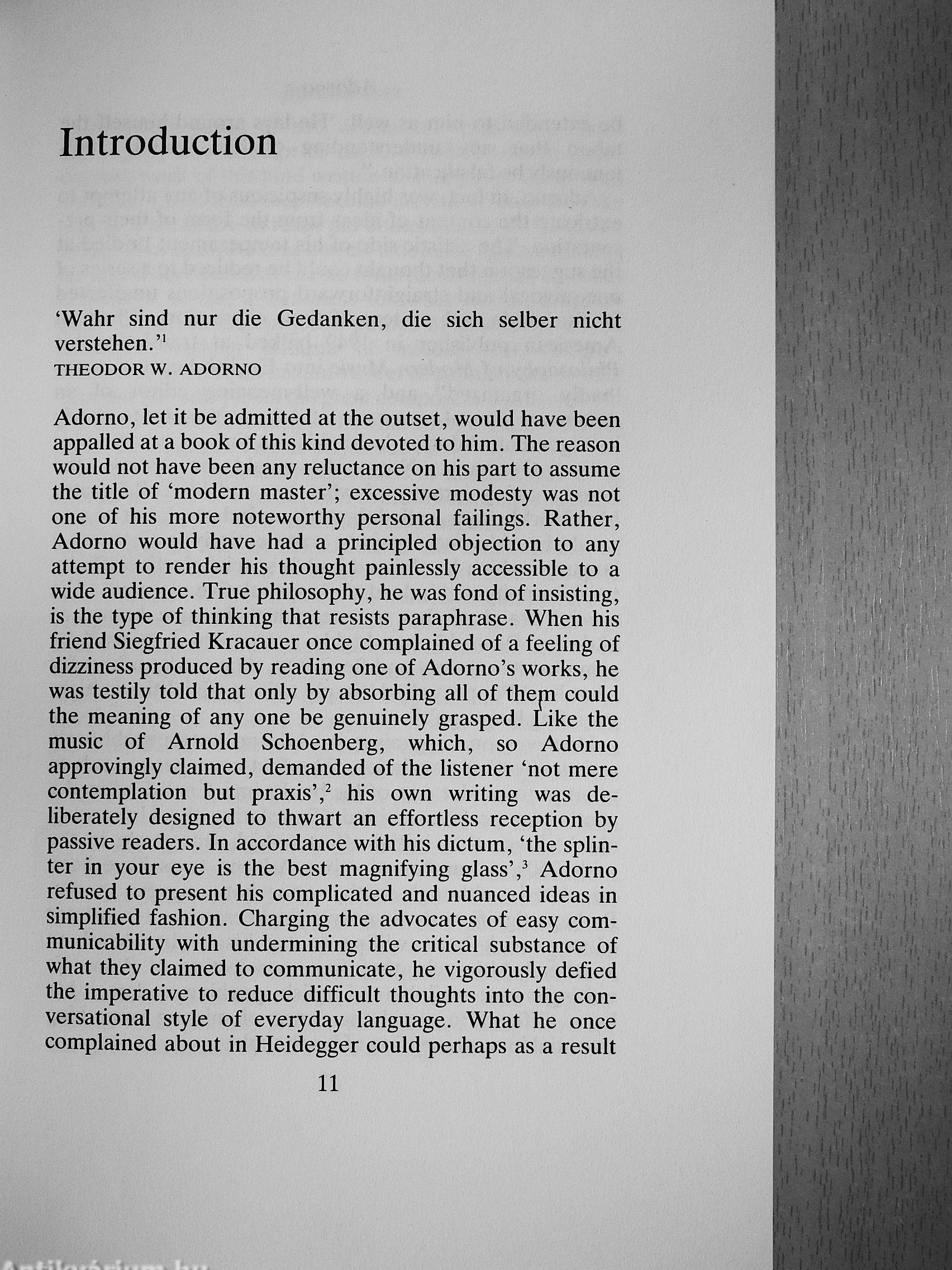
Fülszöveg
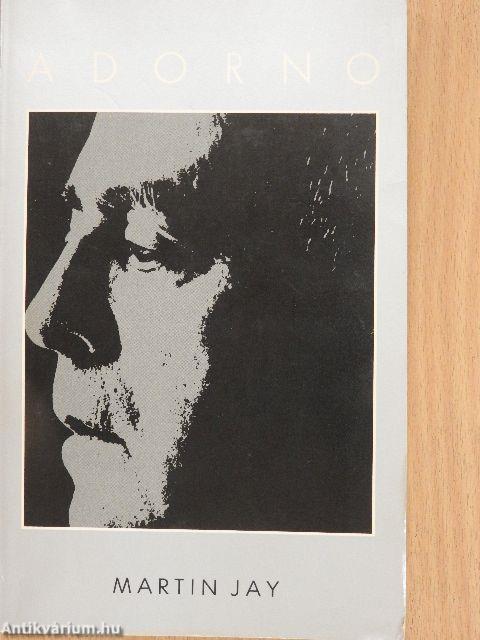
ADORNO
MARTIN JAY
$5.95
i i , '1/
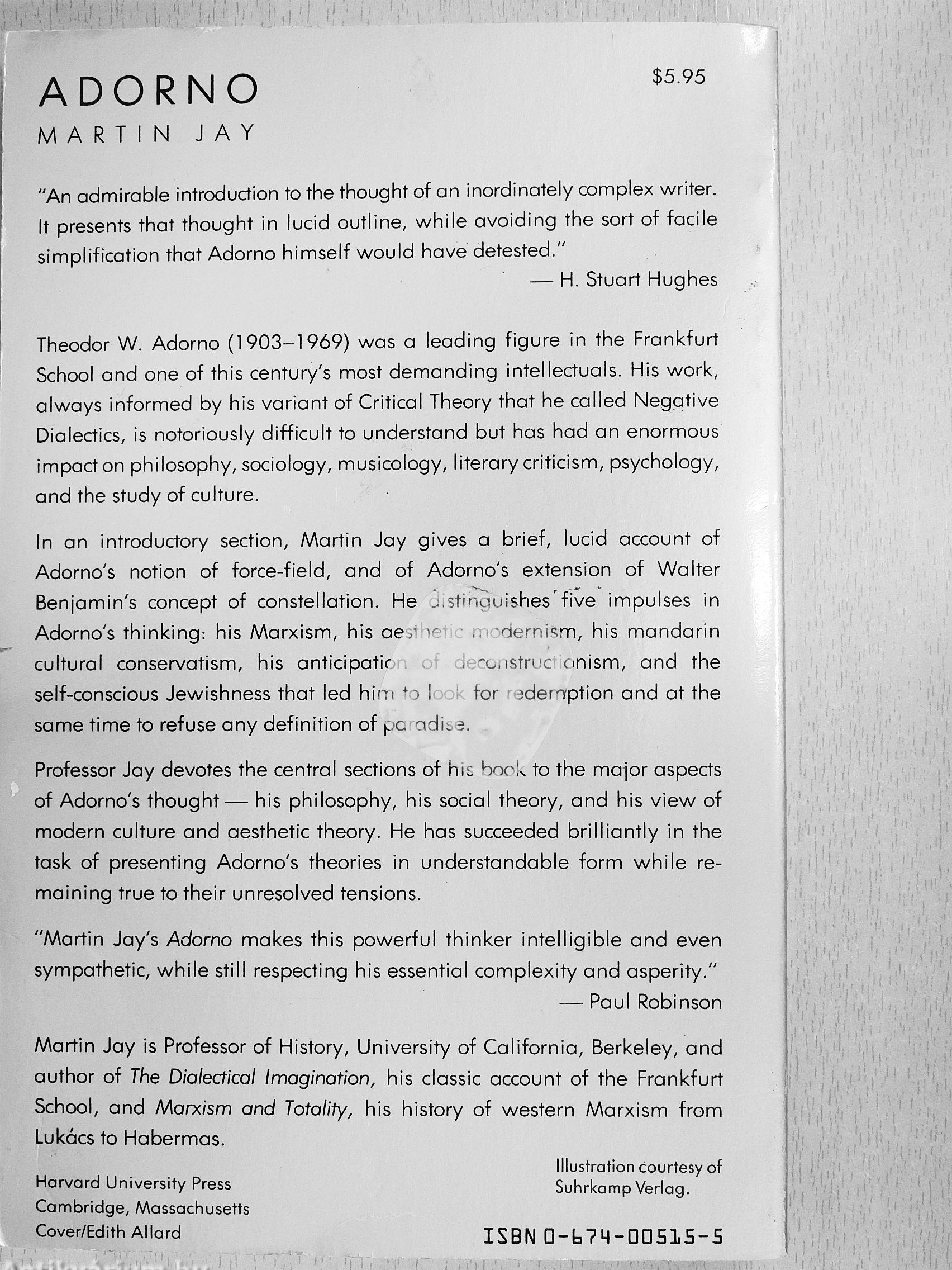
"An admirable introduction to the thought of an inordinately complex writer. It presents that thought in lucid outline, while avoiding the sort of facile simplification that Adorno himself would have detested."
— H. Stuart Hughes
Theodor W. Adorno (1903-1969) was a leading figure in the Frankfurt School and one of this century's most demanding intellectuals. His work, always informed by his variant of Critical Theory that he called Negative Dialectics, is notoriously difficult to understand but has had an enormous impact on philosophy, sociology, musicology, literary criticism, psychology, and the study of culture.
In an introductory section, Martin Joy gives a brief, lucid account of Adorno's notion of force-field, and of Adorno's extension of Walter Benjamin's concept of constellation. He j.stinouishes'five impulses in Adorno's thinking: his Marxism, his oeji le' n' derni<im, his mandorin cultural conservatism, his anticipatir... Tovább
Fülszöveg
ADORNO
MARTIN JAY
$5.95
i i , '1/
"An admirable introduction to the thought of an inordinately complex writer. It presents that thought in lucid outline, while avoiding the sort of facile simplification that Adorno himself would have detested."
— H. Stuart Hughes
Theodor W. Adorno (1903-1969) was a leading figure in the Frankfurt School and one of this century's most demanding intellectuals. His work, always informed by his variant of Critical Theory that he called Negative Dialectics, is notoriously difficult to understand but has had an enormous impact on philosophy, sociology, musicology, literary criticism, psychology, and the study of culture.
In an introductory section, Martin Joy gives a brief, lucid account of Adorno's notion of force-field, and of Adorno's extension of Walter Benjamin's concept of constellation. He j.stinouishes'five impulses in Adorno's thinking: his Marxism, his oeji le' n' derni<im, his mandorin cultural conservatism, his anticipatir iv.'o.istruc^ fmism, and the
self-conscious Jewishness that led him ^o I for jdenption and at the same time to refuse any definition of pc adisa.
Professor Jay devotes the central sections of hi: bocl^ to the major aspects of Adorno's thought— his philosophy, his social theory, and his view of modern culture and aesthetic theory. He has succeeded brilliantly in the task of presenting Adorno's theories in understandable form while remaining true to their unresolved tensions.
"Martin Jay's Adorno mokes this powerful thinker intelligible and even sympathetic, while still respecting his essential complexity and asperity."
— Paul Robinson
Martin Jay is Professor of History, University of California, Berkeley, and author of The Dialectical Imagination, his classic account of the Frankfurt School, and Marxism and Totality, his history of western Marxism from Lukács to Habermas.
Illustration courtesy of Harvard University Press Suhrkamp Verlag.
Cambridge, Massachusetts
Cover/Edith Allard ISBN D"b7M"DO51S"5 Vissza
Témakörök
- Filozófia > Témaköre szerint > Esztétika (művészetfilozófia)
- Filozófia > Témaköre szerint > Életrajz
- Életrajz > Filozófusok
- Idegennyelv > Idegennyelvű könyvek > Angol > Filozófia > Témaköre szerint > Esztétika (művészetfilozófia)
- Idegennyelv > Idegennyelvű könyvek > Angol > Filozófia > Témaköre szerint > Életrajz
- Idegennyelv > Idegennyelvű könyvek > Angol > Életrajz > Filozófusok
- Filozófia > Témaköre szerint > Filozófiatörténet > Irányzatok
- Idegennyelv > Idegennyelvű könyvek > Angol > Filozófia > Témaköre szerint > Filozófiatörténet > Irányzatok
- Filozófia > Témaköre szerint > Társadalomfilozófia > Egyéb
- Idegennyelv > Idegennyelvű könyvek > Angol > Filozófia > Témaköre szerint > Társadalomfilozófia > Egyéb
Martin Jay
Martin Jay műveinek az Antikvarium.hu-n kapható vagy előjegyezhető listáját itt tekintheti meg: Martin Jay könyvek, művekMegvásárolható példányok
Nincs megvásárolható példány
A könyv összes megrendelhető példánya elfogyott. Ha kívánja, előjegyezheti a könyvet, és amint a könyv egy újabb példánya elérhető lesz, értesítjük.
 Folytatás Microsoft-tal