Fülszöveg
African Art
An Introduction
FRANK WILLETT
It is only in comparatively recent times that the arts of the Yoruba Bushman, Benin and other cultures of Africa have, by universal agreement, taken their place among the great creative achievements of mankind. Their extraordinary vigour, their suggestive symbolic power, and their expressive use of geometric forms have not only come to be appreciated for their own sakes, but have exercised a crucial influence on the development of twentieth-century Western art. Indeed, the response of Picasso, Braque, Modigliani and other great modern masters to African sculpture, and to its ways of representing form, has played a major part in making African art familiar to the whole world. And yet the subject is still hedged about with ignorance and misconceptions (such as the false notion that African sculpture, the product of thousands of years of tradition, is primitive). In this book Frank Willett, Professor of African Art at Northwestern...
Tovább
Fülszöveg
African Art
An Introduction
FRANK WILLETT
It is only in comparatively recent times that the arts of the Yoruba Bushman, Benin and other cultures of Africa have, by universal agreement, taken their place among the great creative achievements of mankind. Their extraordinary vigour, their suggestive symbolic power, and their expressive use of geometric forms have not only come to be appreciated for their own sakes, but have exercised a crucial influence on the development of twentieth-century Western art. Indeed, the response of Picasso, Braque, Modigliani and other great modern masters to African sculpture, and to its ways of representing form, has played a major part in making African art familiar to the whole world. And yet the subject is still hedged about with ignorance and misconceptions (such as the false notion that African sculpture, the product of thousands of years of tradition, is primitive). In this book Frank Willett, Professor of African Art at Northwestern University, Illinois, reviews the astonishing variety and expressive power of the art of a continent which contains, as he points out, 'more distinct peoples and cultures than any other'. In his examination of the sources and manifestations of African art (its modes, its meanings, and its complex religious, social and practical functions), he provides the overall historical view which is needed, dispels false notions, and offers a fascinating introduction to a field so rich that it presents objects for study ranging from the Stone Age to the i96os^
ON THE jacket: 'i'S.í'ÍJ R
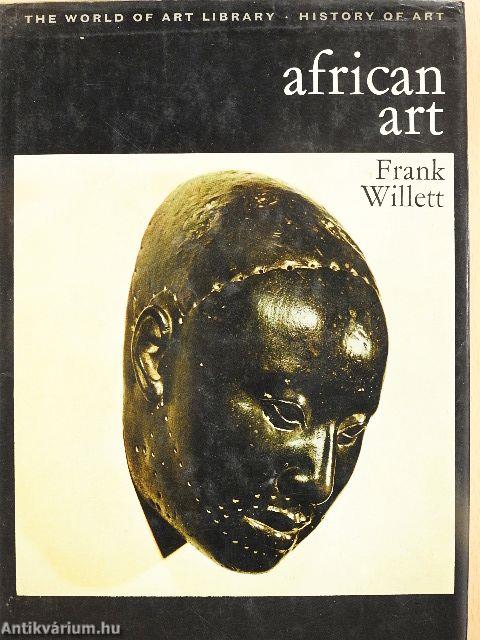
Cast Metal Mask (Ifc). VP940S70
with 261 illustrations
About the author
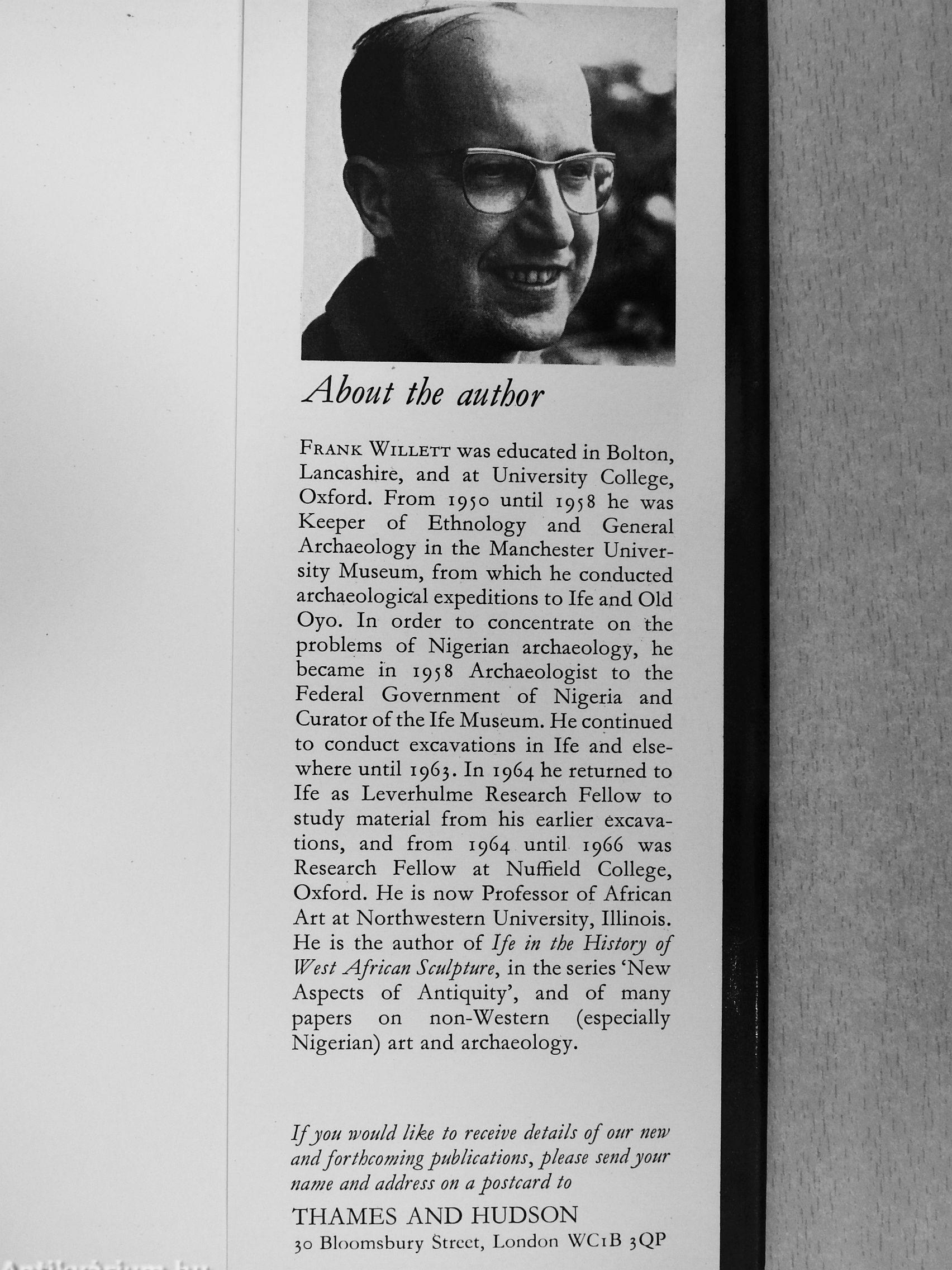
Frank Willett was educated in Bolton, Lancashire, and at University College, Oxford. From 1950 until 1958 he was Keeper of Ethnology and General Archaeology in the Manchester University Museum, from which he conducted archaeological expeditions to Ife and Old Oyo. In order to concentrate on the problems of Nigerian archaeology, he became in 1958 Archaeologist to the Federal Government of Nigeria and Curator of the Ife Museum. He continued to conduct excavations in Ife and elsewhere until 1963. In 1964 he returned to Ife as Leverhulme Research Fellow to study material from his earlier excavations, and from 1964 until 1966 was Research Fellow at Nuffield College, Oxford. He is now Professor of African Art at Northwestern University, Illinois. He is the author of Ife in the History of West African Sculpture, in the series 'New Aspects of Antiquity', and of many papers on non-Western (especially Nigerian) art and archaeology.
If jou would like to receive details of our new and forthcoming publications, please send jour name and address on a postcard to
THAMES AND HUDSON
30 Bloomsbury Street, London WCiB jQP
Vissza 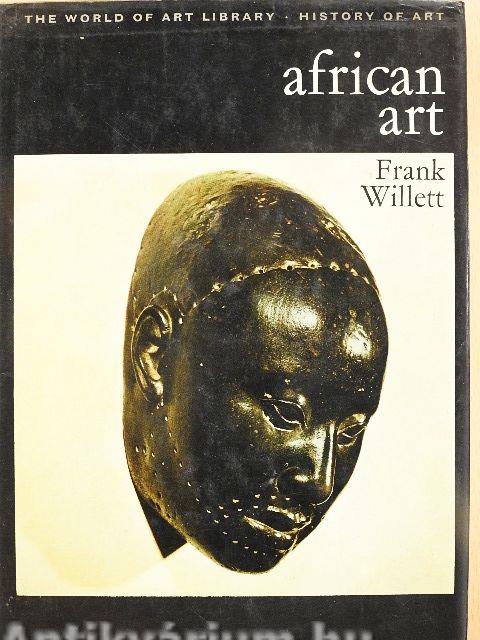


 Folytatás Microsoft-tal