This book deepens and defends Maclntyre's claim that genuinely rational enquiry requires membership in a particular type of moral community. He offers the most persuasive recent restatement of the Thomist position on the relation of metaphysics to morality.
—Richard Rorty, University of Virginia
. . [Maclntyre] must be the past, present, future and all-time philosophical historians' historian of philosophy."
—The New York Times Book Review
- Also by Alasdair Maclntyre -
Whose Justice? Which Rationality?
Maclntyre expands his line of reasoning to the concepts of justice and rationality. Despite a rhetoric of consensus, he contends that in our society there remain unresolved fundamental conflicts about what justice requires. Those who look for practical answers to these questions face the problem of radical disagreement on what the rational justification is for acting one way or another.
"Maclntyre has eminently succeeded in doing what is all too rare in our time—he compels...
Tovább
Fülszöveg
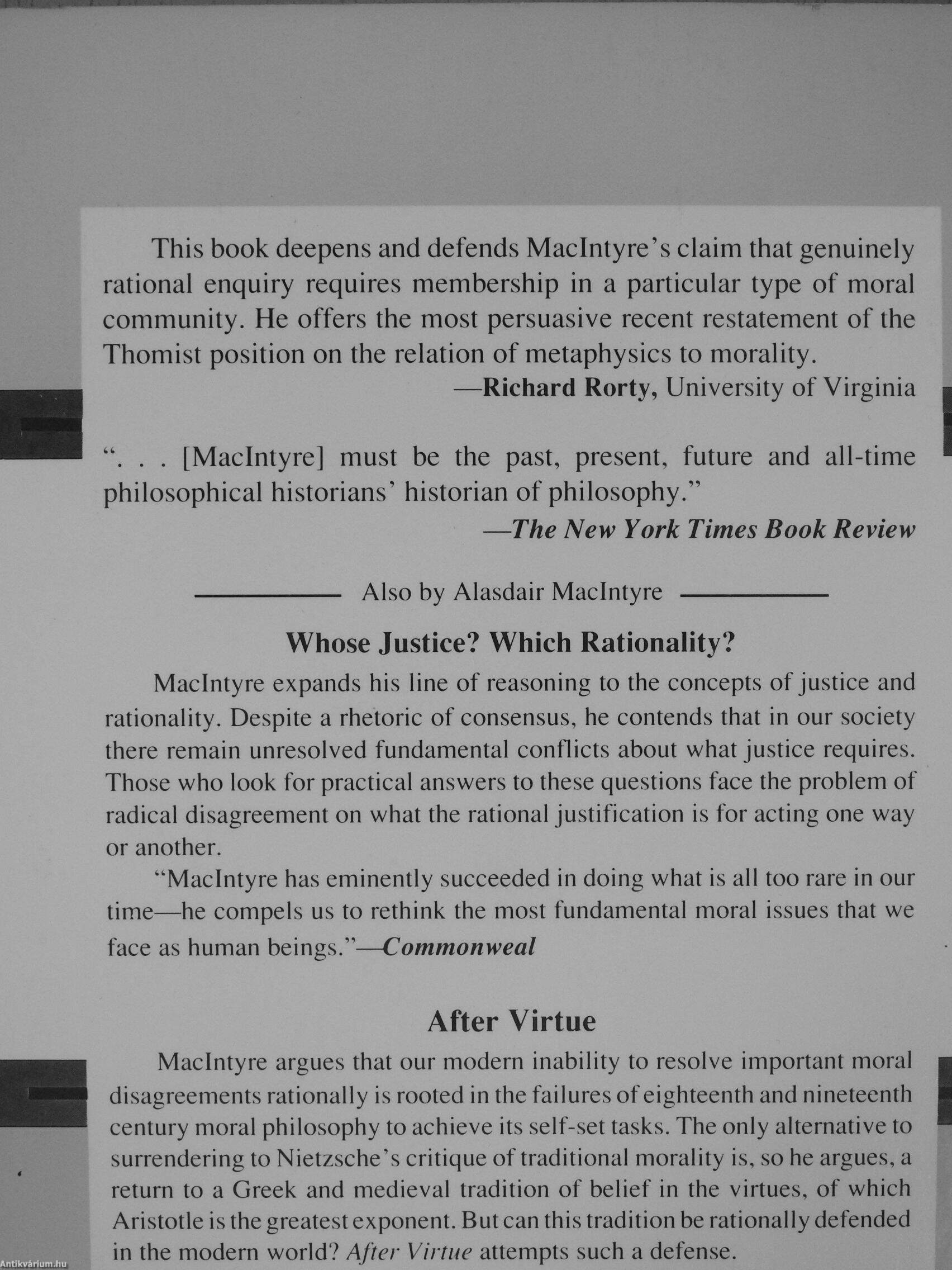
This book deepens and defends Maclntyre's claim that genuinely rational enquiry requires membership in a particular type of moral community. He offers the most persuasive recent restatement of the Thomist position on the relation of metaphysics to morality.
—Richard Rorty, University of Virginia
. . [Maclntyre] must be the past, present, future and all-time philosophical historians' historian of philosophy."
—The New York Times Book Review
- Also by Alasdair Maclntyre -
Whose Justice? Which Rationality?
Maclntyre expands his line of reasoning to the concepts of justice and rationality. Despite a rhetoric of consensus, he contends that in our society there remain unresolved fundamental conflicts about what justice requires. Those who look for practical answers to these questions face the problem of radical disagreement on what the rational justification is for acting one way or another.
"Maclntyre has eminently succeeded in doing what is all too rare in our time—he compels us to rethink the most fundamental moral issues that we face as human beings."—Commonweal
After Virtue
Maclntyre argues that our modern inability to resolve important moral disagreements rationally is rooted in the failures of eighteenth and nineteenth century moral philosophy to achieve its self-set tasks. The only alternative to surrendering to Nietzsche's critique of traditional morality is, so he argues, a return to a Greek and medieval tradition of belief in the virtues, of which Aristotle is the greatest exponent. But can this tradition be rationally defended in the modern world? After Virtue attempts such a defense.
Vissza
Google, Facebook, Apple, Microsoft fiókkal való belépés/regisztráció eseténautomatikusan elfogadja az Általános Szerződési Feltételeket.
Elfelejtett jelszó
Kérjük, adja meg azonosítóját, és a hozzá tartozó email címet, hogy jelszavát elküldhessük Önnek!
A *-gal jelölt mezők kitöltése kötelező!
Azonosító név/E-mail cím* Azonosító és e-mail cím megegyező
E-mail cím*
(2009 március óta a regisztrált ügyfelek azonosító neve megegyezik az email címmel)
Ha az azonosítóját sem tudja megadni, kérjük, hívja az ügyfélszolgálati vonalat:
+36-62-452-833
1
2
3
Regisztráció
Regisztráció
Regisztrációja sikeresen megtörtént.
Megadott e-mail címére megerősítő e-mailt küldtünk. Ahhoz, hogy a regisztrációja véglegesedjen, és le tudja adni rendeléseit, kérjük, kattintson a levélben található linkre. A megerősítő link a kiküldéstől számított 48 óráig érvényes, ezután a regisztrációs adatok törlésre kerülnek.
Kérjük, jelölje meg az érdeklődési körébe tartozó témaköröket!
Regisztráció
Az ön által megjelölt témakörök:
Temakor_1
Beállíthatja, hogy emailben értesítőt kapjon az újonnan beérkezett példányokról a bejelölt témaköröknek megfelelően.
Beállított értesítőit belépés után bármikor módosíthatja az Értesítő menüpont alatt:
létrehozhat új témaköri értesítőt
inaktiválhatja értesítőjét, ha éppen nem kíván a megadott témában értesítőt kapni
törölheti véglegesen az adott értesítőjét
szerkesztheti jelenlegi értesítőjét, ha még részletesebben szeretné megadni mi érdekli.
Az Ön választása alapján naponta vagy 3 naponta kap tőlünk emailt a beállított értesítőjéről.



 Folytatás Microsoft-tal