
1.125.519
kiadvánnyal nyújtjuk Magyarország legnagyobb antikvár könyv-kínálatát

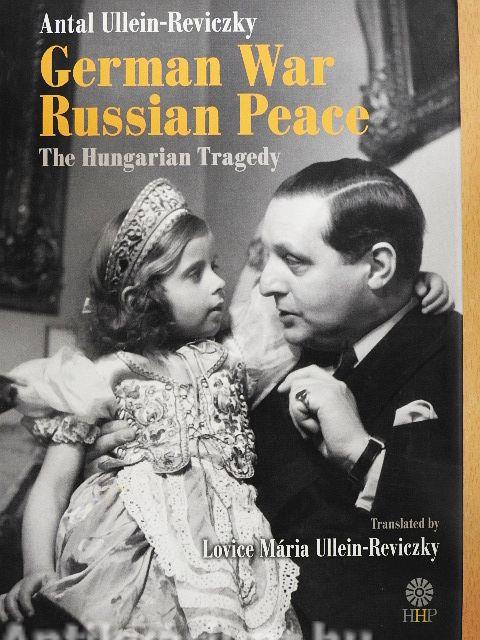
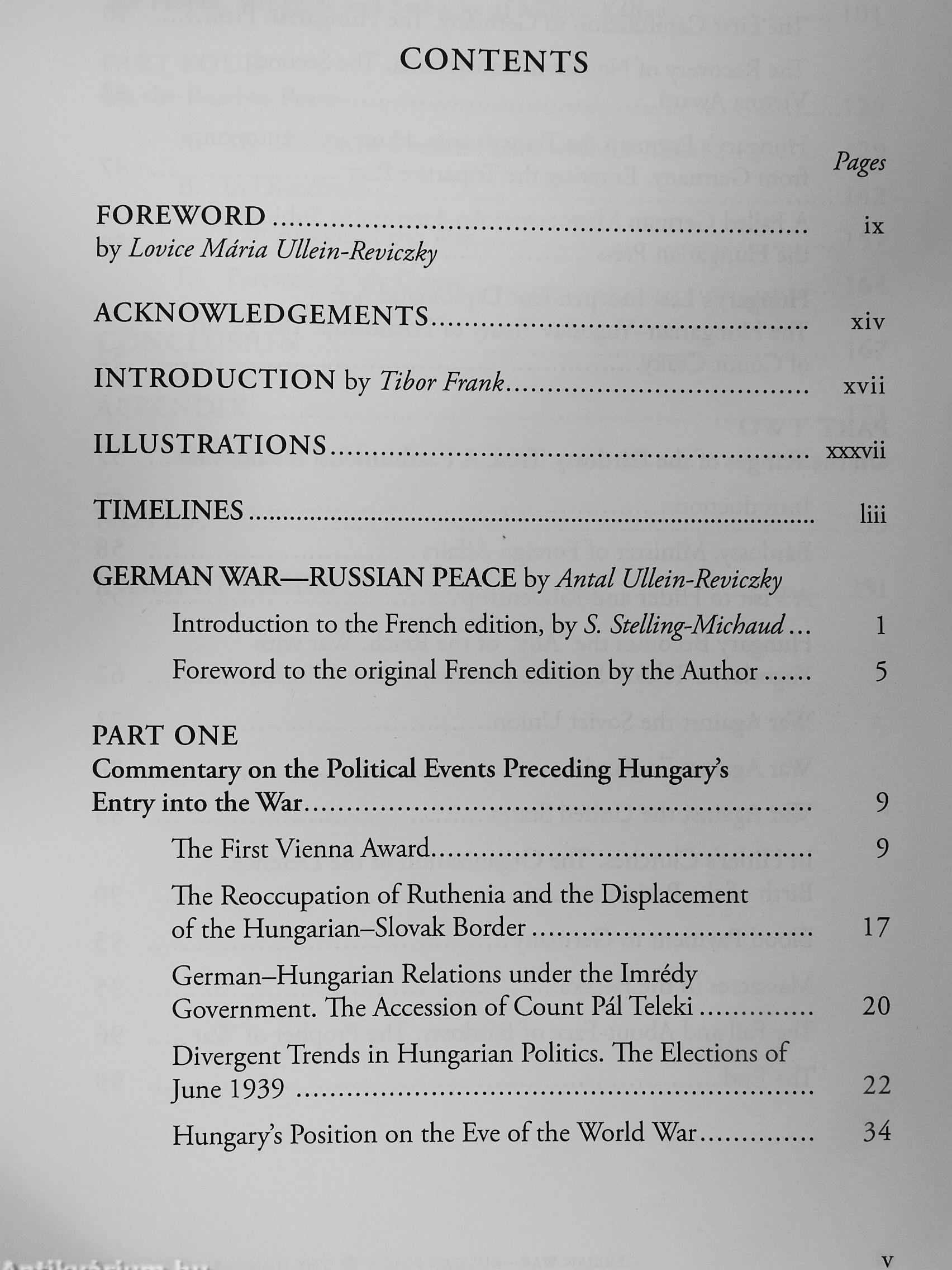
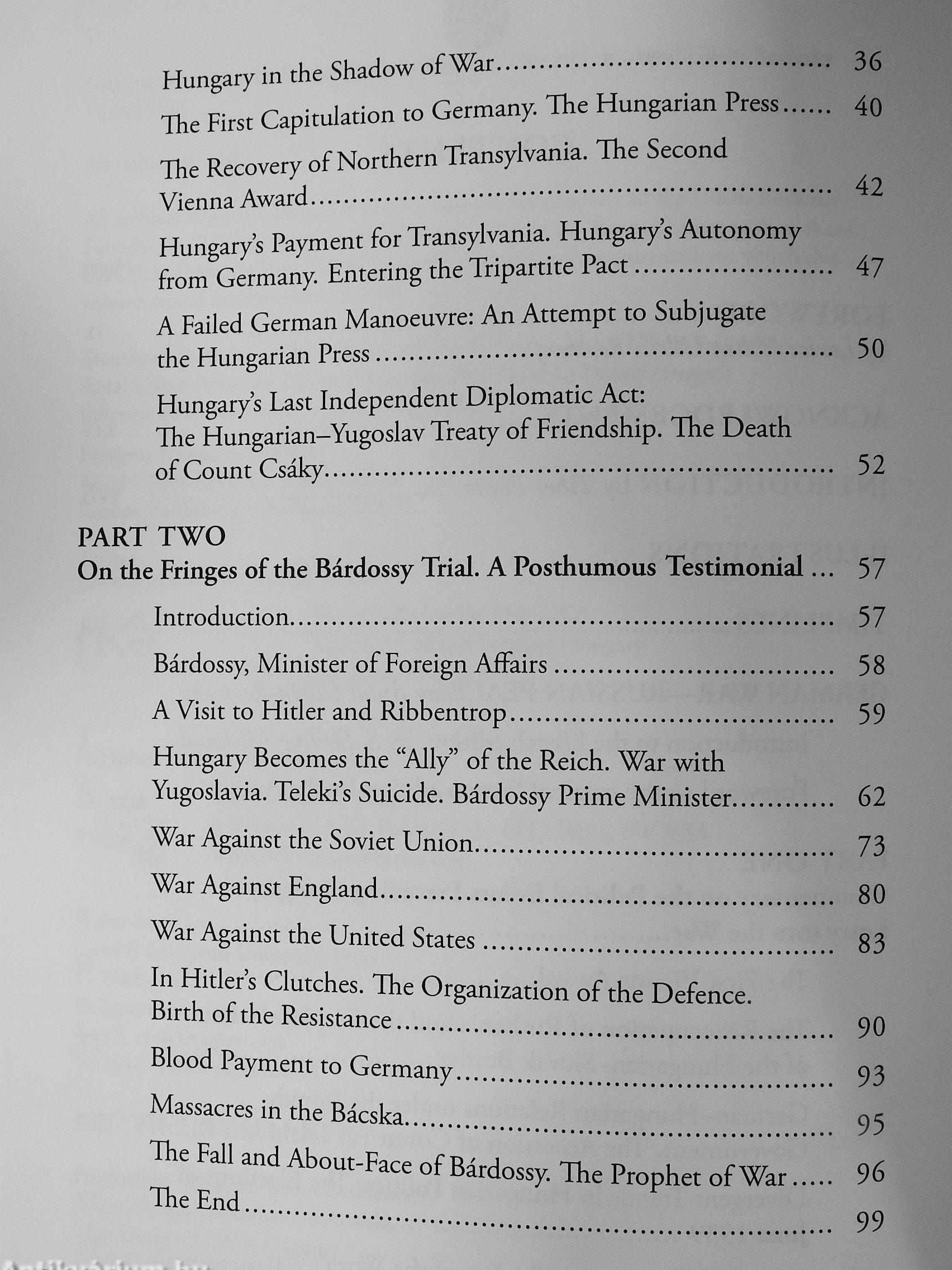
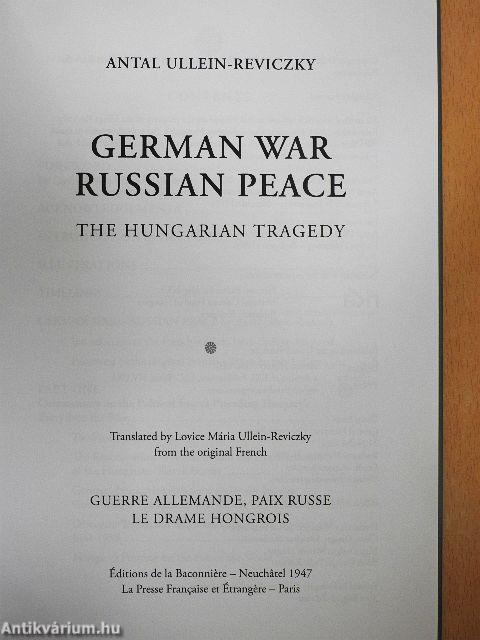
German War - Russian Peace
The Hungarian Tragedy/Guerre Allemande, Paix Russe - Le Drame Hongrois
Neuchatel-Párizs
| Kiadó: | Éditions de la Boconniére-La Presse Francaise et Étrangére |
|---|---|
| Kiadás helye: | Neuchatel-Párizs |
| Kiadás éve: | |
| Kötés típusa: | Fűzött keménykötés |
| Oldalszám: | 303 oldal |
| Sorozatcím: | |
| Kötetszám: | |
| Nyelv: | Angol |
| Méret: | 23 cm x 16 cm |
| ISBN: | 978-0-9859433-4-9 |
Értesítőt kérek a kiadóról
A beállítást mentettük,
naponta értesítjük a beérkező friss
kiadványokról
naponta értesítjük a beérkező friss
kiadványokról
A beállítást mentettük,
naponta értesítjük a beérkező friss
kiadványokról
naponta értesítjük a beérkező friss
kiadványokról
Előszó
Tovább
Fülszöveg
10°e
I i'
TYH
v;« ?J
r'/'i i ,. 1: 1" il
'Ai'
ívSchdai;diplomatao§|||í|t^^
UUein-Rcviczky (1894-19«) ww the pie« chief ^ ¦ of Hungary before and during the government qL Miklós Kállay (i94í-i944) and a« erudite, mut" 'M tilingual spokespws«v«f íjungary !1» the iii^ ® narional iu:6na. As the wartime activities of this : f dedicated opponent of Hider aroused the fury fc^ the German government including the Füh-^ cer h^iDs^ PriiMÉilnister Kálky fqundfept»-f ; l^nt to^nd his loyal supporter to neutral Stockr I" holm v^ete he headed the Hungarian Legation lij Aom late J94} through tEe" German occupa-in~Maicii 1944^1 Married to the daughter qf a British con^ general in Turkey, Ullein-Reviczky became one of those Hungarian diplomats who tamed against the pro-Nazi puppet i^j^eestablishe^b^the Germans jm occupied Hungary and fought against the aggression to the bitter end. He was of course less than enthusiastic about the growing Soviet threat as i. well He^ublished his... Tovább
Fülszöveg
10°e
I i'
TYH
v;« ?J
r'/'i i ,. 1: 1" il
'Ai'
ívSchdai;diplomatao§|||í|t^^
UUein-Rcviczky (1894-19«) ww the pie« chief ^ ¦ of Hungary before and during the government qL Miklós Kállay (i94í-i944) and a« erudite, mut" 'M tilingual spokespws«v«f íjungary !1» the iii^ ® narional iu:6na. As the wartime activities of this : f dedicated opponent of Hider aroused the fury fc^ the German government including the Füh-^ cer h^iDs^ PriiMÉilnister Kálky fqundfept»-f ; l^nt to^nd his loyal supporter to neutral Stockr I" holm v^ete he headed the Hungarian Legation lij Aom late J94} through tEe" German occupa-in~Maicii 1944^1 Married to the daughter qf a British con^ general in Turkey, Ullein-Reviczky became one of those Hungarian diplomats who tamed against the pro-Nazi puppet i^j^eestablishe^b^the Germans jm occupied Hungary and fought against the aggression to the bitter end. He was of course less than enthusiastic about the growing Soviet threat as i. well He^ublished his ^rtio^memoiK Guerre allemande, paix russe. drame hongrois in 1947 jn Switzerland, immediately following the War. first English edition of his l^k is an invalu-J^lejource of Hungry s fate^WoddiWar IL 7iHis book was based pardy on 3ic public and pri-documents he succeeded in saving through-iS'jonrThe War and his long years of exile in Tur-^^^^_Switzedand, France and Britain where V Written by a well-informed uisider and a ^^rewd observer, tfiis book remained essentiat-: ly unknown in the EngUsh-speaking world tcT date. Antal Ullein-Reviczky s memoifs represent an importa4t soitrcelof the history of Hungary from German warthrough Russian peace, giving ^^^^nique insight into "the Hungarian tragedrr
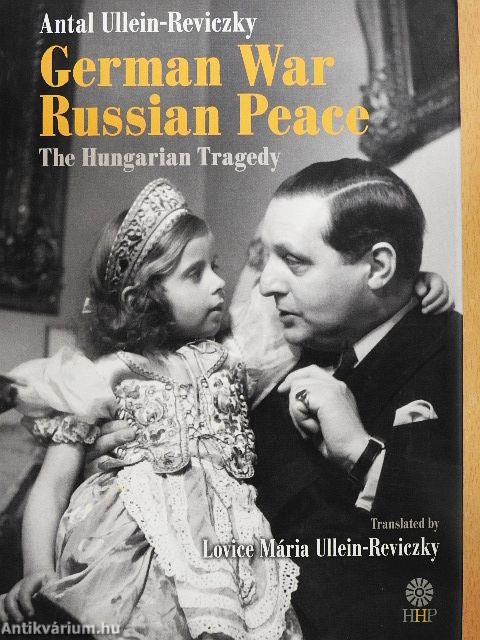
Cover photo
Stockholm. March 1944. F.ither and daughter. In Ullein-Reviczky Antal's handwriting; Tel/inga stoiy to link Lovice about had people who invaded Hnngaiy. "Little" Lovice wears a traditional Hungarian costume and párra (headpiecc).
Trondhe,
fsbyerpo
G E R M-!
Munich"
O-'p, Milan ¦ Venice^ ¦ '1 "Turin To ^
niS ¦¦ ^-.GenoaO .(-^Monacoo- Florence
J O Mnn.____o ^S?
^ cP Bern " éfeilr^. *
- ¦¦ "¦'- ¦ Venice,
,, MONACO O
^Leghorn , " oS ' ,
Co's^ca > VATICAN C.T
Ajacclö° \C
C oOlbia
Sardinia t
Tyrrhe
>oniaoO ,¦ c
° Cagliari '''
¦Liil
Pa
-TUNISIA (FM \
V,
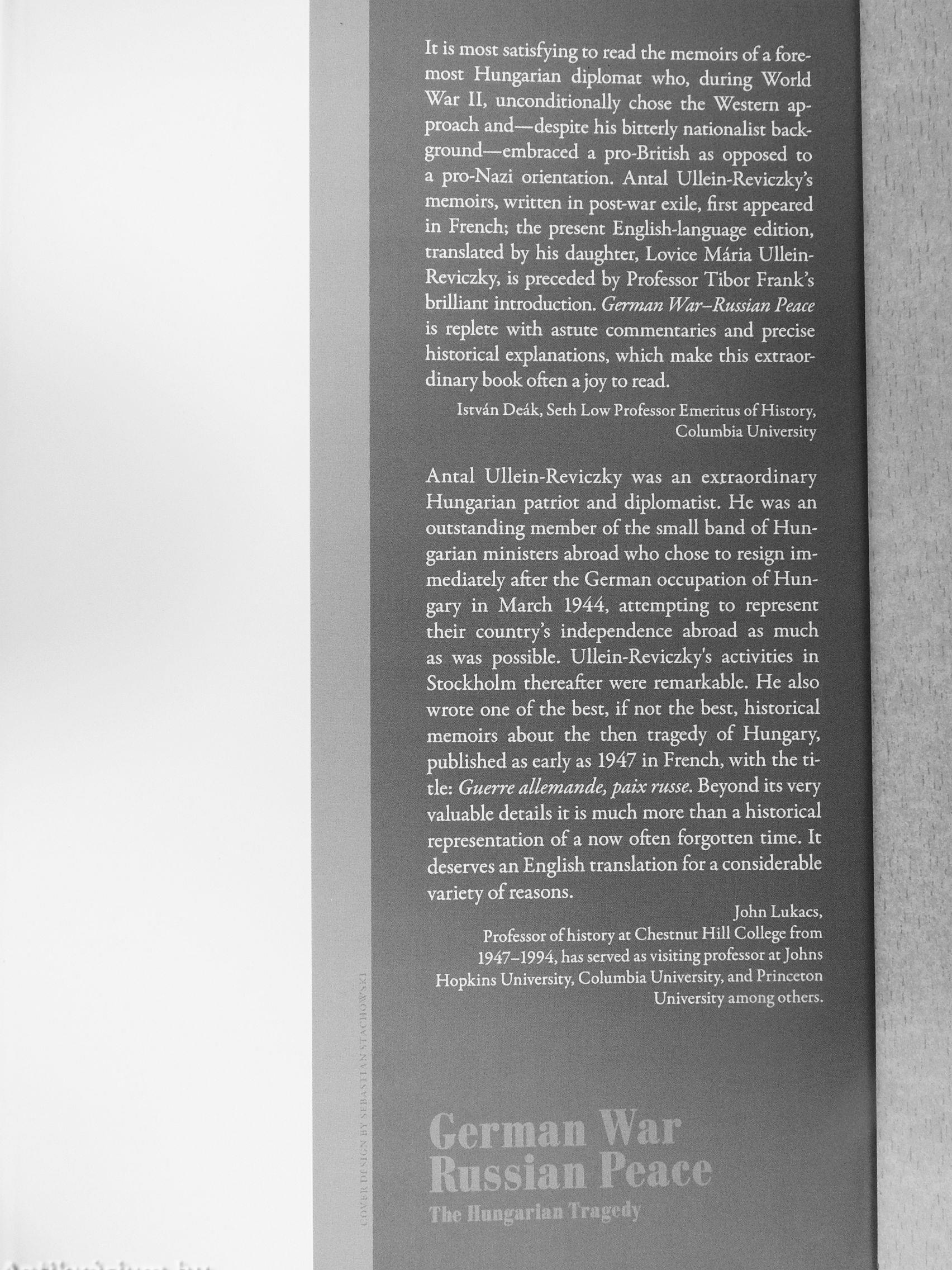
It is most satisfying to read the memoirs of a foremost Hungarian diplomat who, during World War II, unconditionally chose the Western approach and—despite his bitterly nationalist background—embraced a pro-British as opposed to a pro-Nazi orientarion. Antal Ullein-Reviczky s memoirs, written in jjost-war exile, first appeared in French; the present Ei^lish-language edition, translated by his daughter, Lovice Mária UUein-Rcviczky, is preceded by Professor Tibor Frank s brilliant introduction. German War-Russian Peace is replete with astute commentaries and precise historical explanations, which make this extraordinary book often a joy to read.
István Deák, Seth Low Professor Emeritus of History, Columbia University
Antal Ullein-Reviczky was an extraordinary Hungarian patriot and diplomatist. He was an outstandii^ member of the small band of Hungarian ministers abroad who chose to resign immediately after the German occupation of Hungary in March 1944, attempting to represent their country's independence abroad as much as was possible. Ullein-Reviczky's activities in Stockholm thereafter were remarkable. He also wrote one of the best, if not the best, historical memoirs about the then tragedy of Hungary, published as early as 1947 in French, with the title: Guerre allemande, paix russe. Beyond its very valuable details it is much more than a historical representation of a now often forgotten time. It deserves an English translation for a considerable variety of reasons.
John Lukacs,
Professor of history at Chestnut Hill College from 1947-1994, has served as visiting professor at Johns Hopkins University, Columbia University, and Princeton University among others.
German War Russian Peace
Tlie Hungarian Tragedy
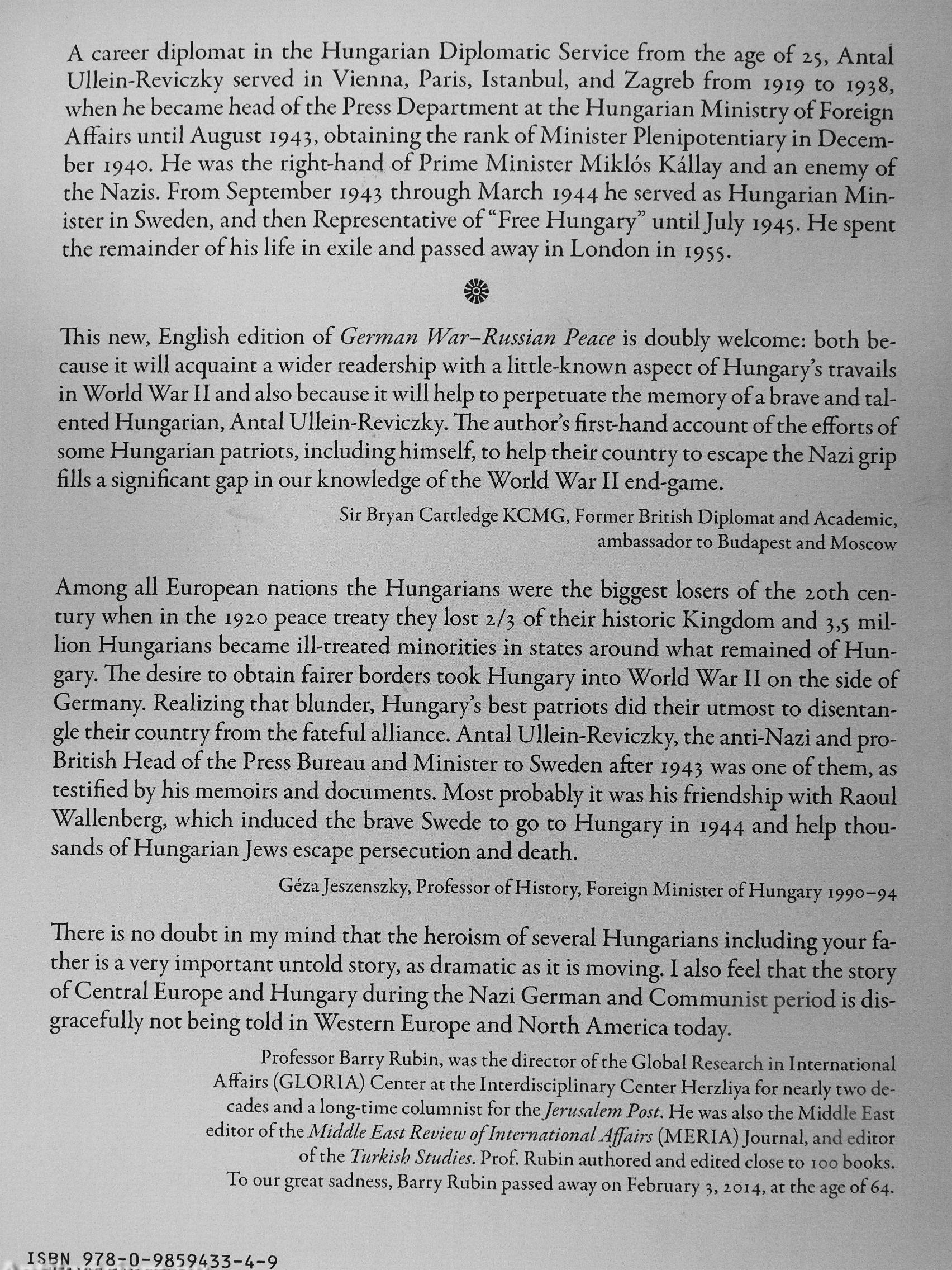
A career diplomat in the Hungarian Diplomatic Service from the age of 1$, Antal Ullein-Reviczky served in Vienna, Paris, Istanbul, and Zagreb from 1919 to 1938, when he became head of the Press Department at the Hungarian Ministry of Foreign Affairs until August 1943, obtaining the rank of Minister Plenipotentiary in December 1940. He was the right-hand of Prime Minister Miklós Kállay and an enemy of the Nazis. From September 1943 through March 1944 he served as Hungarian Minister in Sweden, and then Representative of "Free Hungary" until July 1945. He spent the remainder of his life in exile and passed away in London in 1955.
This new, English edition of German War-Russian Peace is doubly welcome: both because it will acquaint a wider readership with a little-known aspect of Hungary's travails in World War II and also because it will help to perpetuate the memory of a brave and talented Hungarian, Antal Ullein-Reviczky. The author's first-hand account of the efforts of some Hungarian patriots, including himself, to help their country to escape the Nazi grip fills a significant gap in our knowledge of the World War II end-game.
Sir Bryan Cartledge KCMG, Former British Diplomat and Academic, ambassador to Budapest and Moscow
Among all European nations the Hungarians were the biggest losers of the 10th century when in the 1920 peace treaty they lost 2/3 of their historic Kingdom and 3,5 million Hungarians became ill-treated minorities in states around what remained of Hungary. The desire to obtain fairer borders took Hungary into World War II on the side of Germany. Realizing that blunder, Hungary's best patriots did their utmost to disentangle their country from the fateful alliance. Antal Ullein-Reviczky, the anti-Nazi and pro-British Head of the Press Bureau and Minister to Sweden after 1943 was one of them, as testified by his memoirs and documents. Most probably it was his friendship with Raoul Wallenberg, which induced the brave Swede to go to Hungary in 1944 and help thousands of Hungarian Jews escape persecution and death.
Géza Jeszenszky, Professor of History, Foreign Minister of Hungary 1990-94
There is no doubt in my mind that the heroism of several Hungarians including your father is a very important untold story, as dramatic as it is moving. I also feel that the story of Central Europe and Hungary during the Nazi German and Communist period is disgracefully not being told in Western Europe and North America today.
Professor Barry Rubin, was the director of the Global Research in International Affairs (GLORIA) Center at the Interdisciplinary Center Herzliya for nearly two decades and a long-time columnist for úi^ Jerusalem Post. He was also the Middle East editor of the Middle East Review of International Affairs (MERl A) Journal, and editor of the Turkish Studies. Prof. Rubin authored and edited close to 100 books. To our great sadness, Barry Rubin passed away on February 3, Í014, at the age of 64.
ISB_N 978-0-9859433-4-9 Vissza


Témakörök
- Idegennyelv > Idegennyelvű könyvek > Angol > Szépirodalom > Regény, novella, elbeszélés
- Idegennyelv > Idegennyelvű könyvek > Angol > Történelem > Európa története > Egyéb
- Szépirodalom > Regény, novella, elbeszélés > Tartalom szerint > Történelmi regények > Legújabb kor > II. világháború
- Szépirodalom > Regény, novella, elbeszélés > Tartalom szerint > Politikai regények
- Történelem > Idegennyelvű > Angol
- Történelem > Magyarország története és személyiségei > Magyarország a XX. században > II. világháború > Külpolitika
- Történelem > Politika > Külpolitika > Diplomácia
- Szépirodalom > Regény, novella, elbeszélés > Az író származása szerint > Magyarország
- Történelem > Legújabb kor > II. világháború > Egyéb
- Történelem > Hadtörténet > Hadügy, hadviselés
- Szépirodalom > Regény, novella, elbeszélés > Tartalom szerint > Életrajzi regények > Önéletrajzok, naplók, memoárok
- Szépirodalom > Regény, novella, elbeszélés > Tartalom szerint > Háborús történetek
Megvásárolható példányok
Állapotfotók
Állapot:
Jó
5.980 ,-Ft
30
pont kapható
Kosárba
 Folytatás Microsoft-tal