Fülszöveg
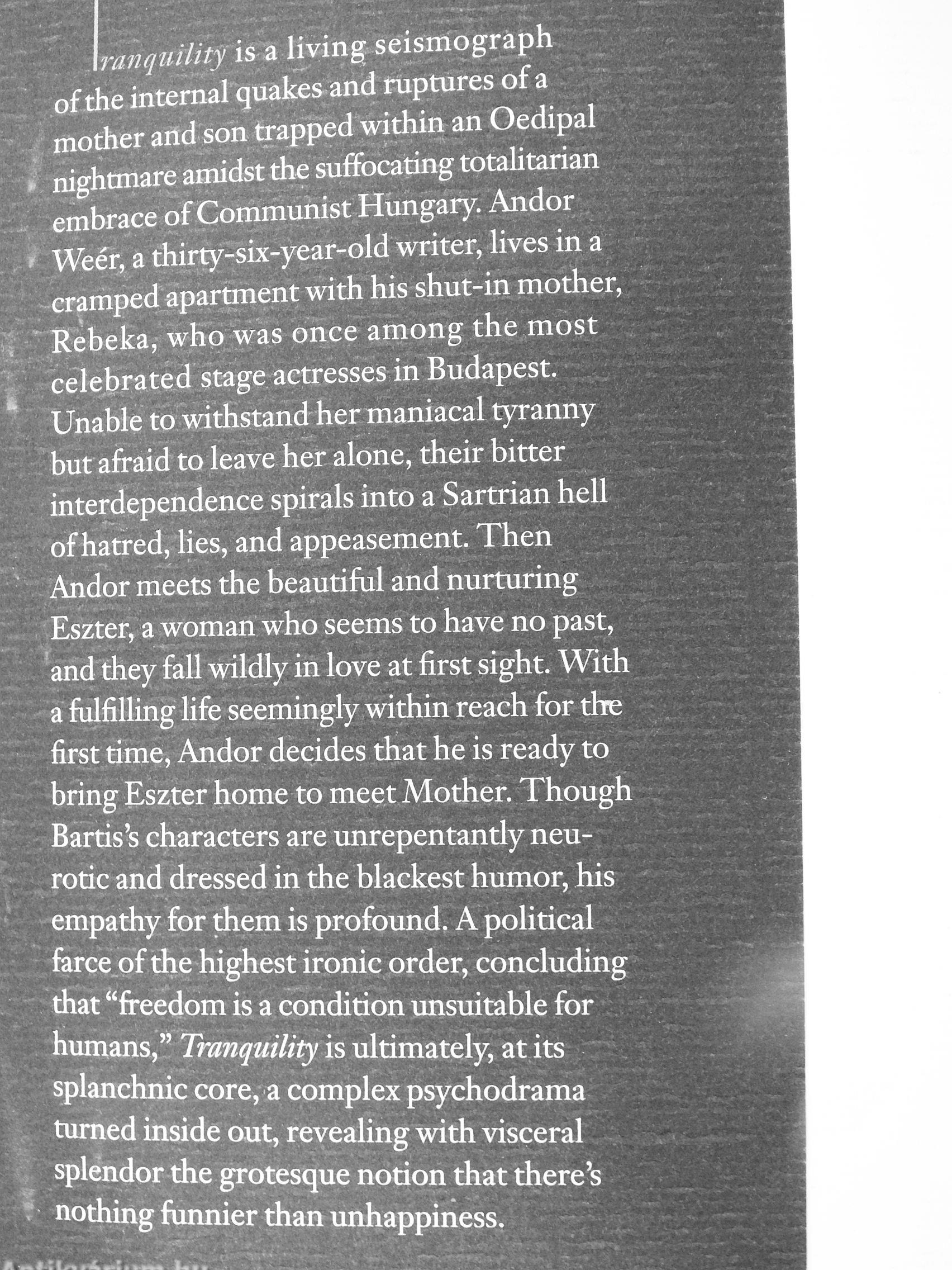
ranquility is a living seismograph of the internal quakes and ruptures of a mother and son trapped within an Oedipal > nightmare amidst the suffocating totalitarian
embrace of Communist Hungary. Andor ' Weer, a thirty-six-year-old writer, lives in a
cramped apartment with his shut-in mother, ' Rebeka, who was once among the most , celebrated stage actresses in Budapest. Unable to withstand her maniacal tyranny but afraid to leave her alone, their bitter interdependence spirals into a Sartrian hell of hatred, Hes, and appeasement. Then Andor meets the beautiful and nurturing Eszter, a woman who seems to have no past, and they fall wildly in love at first sight. With a fulfilling life seemingly within reach for the first time, Andor decides that he is ready to bring Eszter home to meet Mother. Though Bartis's characters are unrepentantly neurotic and dressed in the blackest humor, his empathy for them is profound, A political force of the highest ironic order, concluding that...
Tovább
Fülszöveg
ranquility is a living seismograph of the internal quakes and ruptures of a mother and son trapped within an Oedipal > nightmare amidst the suffocating totalitarian
embrace of Communist Hungary. Andor ' Weer, a thirty-six-year-old writer, lives in a
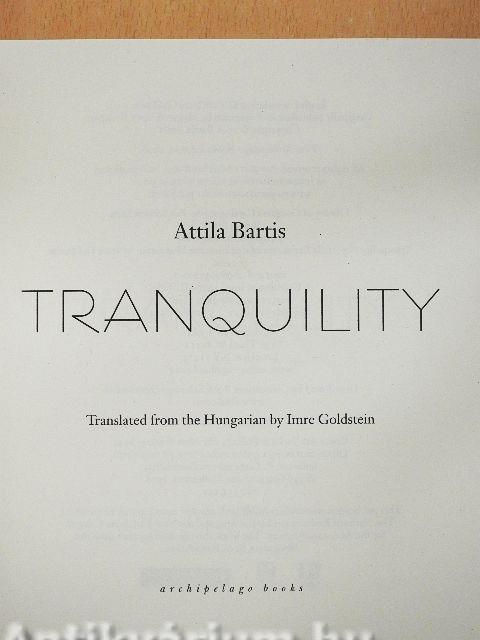
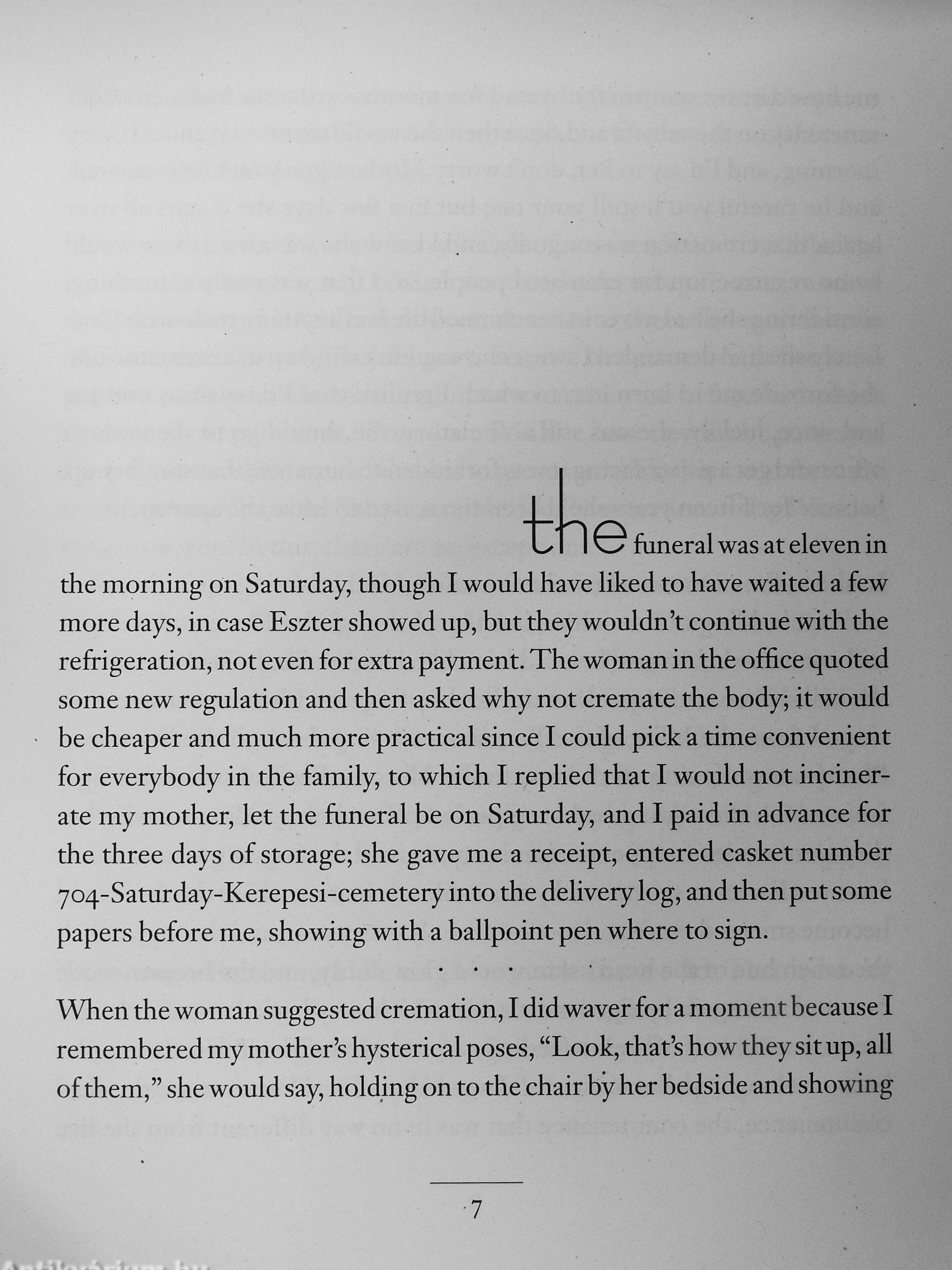
cramped apartment with his shut-in mother, ' Rebeka, who was once among the most , celebrated stage actresses in Budapest. Unable to withstand her maniacal tyranny but afraid to leave her alone, their bitter interdependence spirals into a Sartrian hell of hatred, Hes, and appeasement. Then Andor meets the beautiful and nurturing Eszter, a woman who seems to have no past, and they fall wildly in love at first sight. With a fulfilling life seemingly within reach for the first time, Andor decides that he is ready to bring Eszter home to meet Mother. Though Bartis's characters are unrepentantly neurotic and dressed in the blackest humor, his empathy for them is profound, A political force of the highest ironic order, concluding that "freedom is a condition unsuitable for humans," Tranquility is ultimately, at its splanchnic core, a complex psychodrama turned inside out, reveahng with visceral splendor die grotesque notion tiiat there's nothing ftmnier than unhappiness.
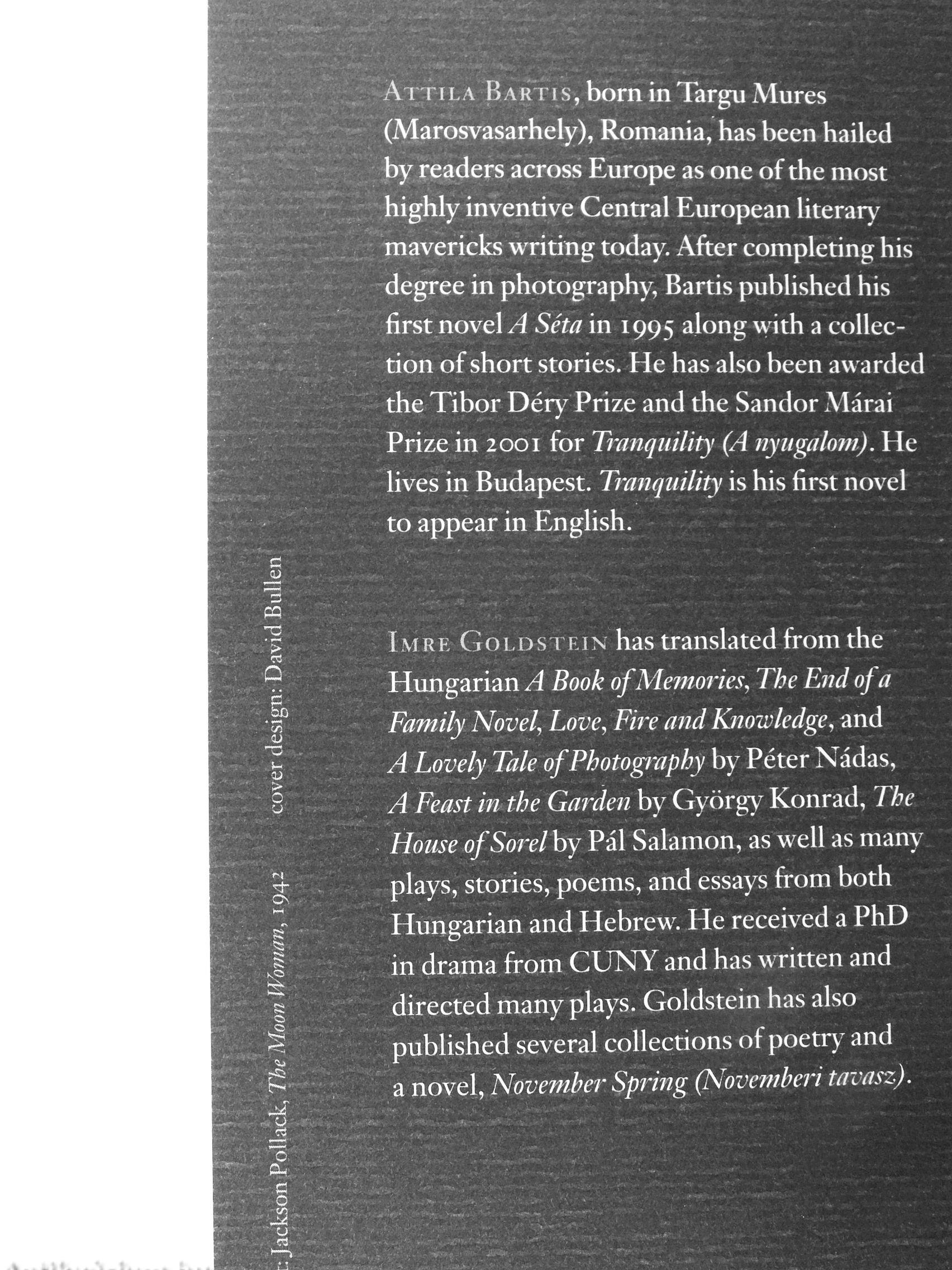
Attila Bartis, born inTargu Mures (Marosvásárhely), Romania, has been hailed by readers across Europe as one of the most highly inventive Central European literary mavericks writing today. After completing his degree in photography, Bartis published his first novel A Séta in 1995 along with a collection of short stories. He has also been awarded the Tibor Déry Prize and the Sandor Márai Prize in 2001 for Tranquility (A nyugalom). He hves in Budapest. Tranquility is his first novel to appear in English.
IM R E G o L D s r EIN has translated from the Hvmgarian/i Book of Memories, The End of a Family Novel, Love, Fire and Knowledge, and A Lovely Tale of Photography by Péter Nádas, A Feast in the Garden by György Konrád, The House of Sorel by Pál Salamon, as well as many plays, stories, poems, and essays from both Hungarian and Hebrew. He received a PhD in drama from CUNY and has written and directed many plays. Goldstein has also published several collections of poetry and a novel, November Spring (Novemberi tavasz).
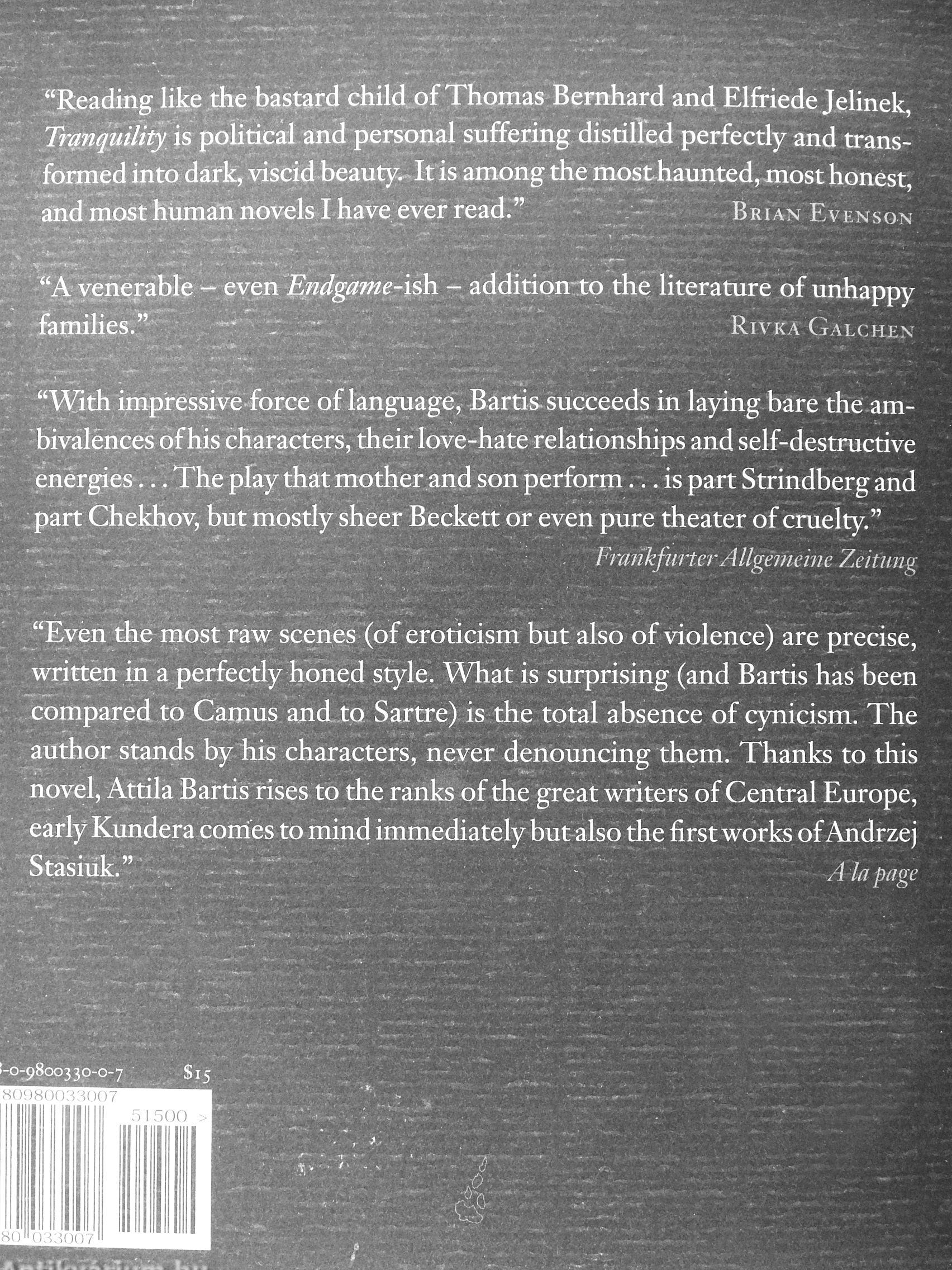
"Reading like die bastard child of Thomas Bernhard and, Elfriede Jelinek, Tranquility js political and personal suffering distilled perfectiy and transformed into dark, viscid beauty. It is among the mos t haunted, most honest, and most human novels I have ever read." " Bri an Evenson
"A venerable - evcnEndgame-ish - addition to the literature of unhappy families." , Rivka Galchje^'
"With impressive force of language, Bartis succeeds in laying bare the .ambivalences of his characters, their love-hate relationships and self-destructive energies The play that mother and son perform is part Strindberg and : part Chekhov, but mosdy sheer Beckett or even pure theater of cruelty."
' . ¦ Fra?ihfnrterAllgemeineZeitwig
"Even the most raw scenes (of eroticism but also of violence) are precise, written in a perfectiy honed style. What is surprising (and Bartis has been compared to Camus and to Sartre) is the total absence of cynicism. The author stands by his characters, never denouncing them. Thanks to this novel, Attila Bartis rises to the ranks of the great writers of Central Europe, early Kundera corries to mind immediately but also the firstworks of Andrzej Stasiuk." : - - A la page
!-0-9800330-0-7 $15
Vissza 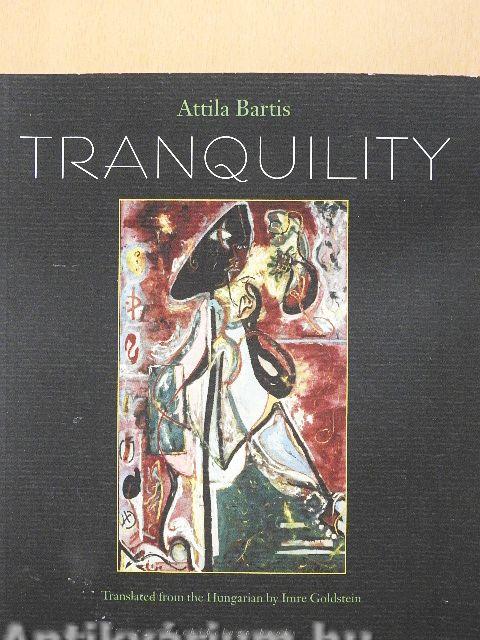


 Folytatás Microsoft-tal