Fülszöveg
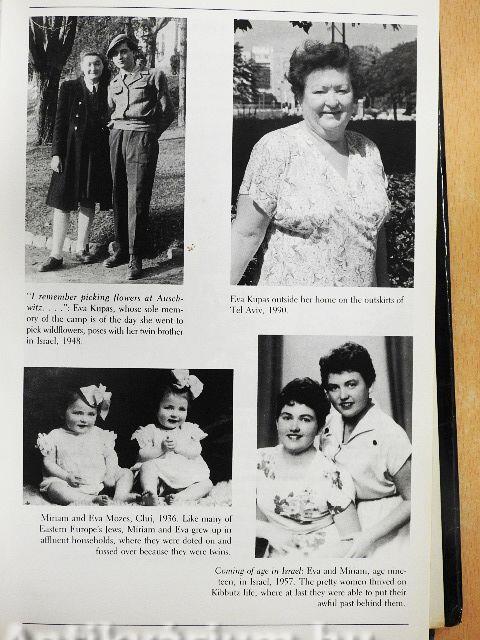
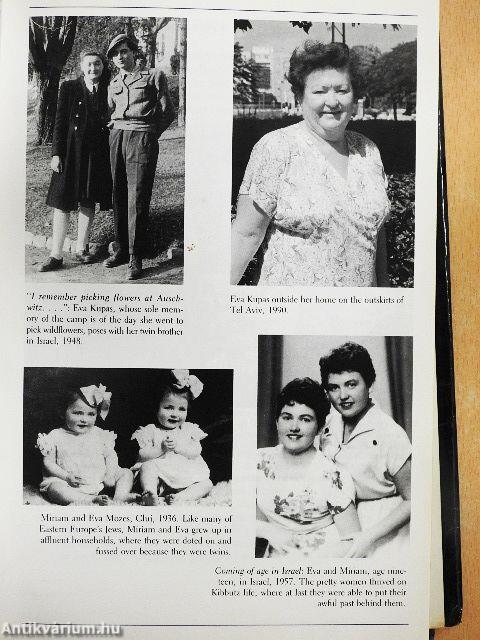
EVA KUPÁS: 'I remember picking flowers at Auschwitz. One day a warden took me and a group of twin girls to a nearby field. We picked all sorts of wild flowers. Then we walked around the camp holding bunches of flowers for everyone to see.'
ZVI THE SAILOR: 'AU my life, I have tried to run away from Auschwitz. I have sailed everywhere, from the North Sea to the Tropic of Cancer, the Great Lakes of Michigan to Madagascar. But wherever I went, thoughts of the death camp came back to me. I try to forget. I try to erase the memories. But I can't seem to leave,Auschwitz behind, no matter how far I go.'
HEDVAH AND LEAH STERN: 'Mother was determined to hold on to us. She hid us under her skirt. But at the last minute, she told us: 'Go to Dr Mengele. He is asking for twins. Go and we will meet by the gate. Wait for me, children, wait for me,' she cried. 'We will meet by the gate.'
EVA MOZES: 'Once the SS guard knew we were twins, my sister and I were taken away from our mother, without...
Tovább
Fülszöveg
EVA KUPÁS: 'I remember picking flowers at Auschwitz. One day a warden took me and a group of twin girls to a nearby field. We picked all sorts of wild flowers. Then we walked around the camp holding bunches of flowers for everyone to see.'
ZVI THE SAILOR: 'AU my life, I have tried to run away from Auschwitz. I have sailed everywhere, from the North Sea to the Tropic of Cancer, the Great Lakes of Michigan to Madagascar. But wherever I went, thoughts of the death camp came back to me. I try to forget. I try to erase the memories. But I can't seem to leave,Auschwitz behind, no matter how far I go.'
HEDVAH AND LEAH STERN: 'Mother was determined to hold on to us. She hid us under her skirt. But at the last minute, she told us: 'Go to Dr Mengele. He is asking for twins. Go and we will meet by the gate. Wait for me, children, wait for me,' she cried. 'We will meet by the gate.'
EVA MOZES: 'Once the SS guard knew we were twins, my sister and I were taken away from our mother, without any warning or explanation. Our screams fell on deaf ears. I remember looking back and seeing my mother's arms stretched out in despair as we were led away by a soldier. That was the last
time I ever saw her.'
PETER SOMOGYI: 'When my son was bar mitzvahed, it was supposed to be a very happy event for me — after all, he was my firstborn son. But I could not stop crying. We were all crying.'
MIRIAM MOZES: 'When I went back to Auschwitz I felt strangely free. At last I had found my mother's resting place. I could speak to my mother there. It was the only place in the world I felt close to her. Our liberation had happened in 1945, but I felt personally liberated for the first time in 1985. I felt I could stop looking for my mother. I knew I had found her
resting place.'
¦ In''' i'l'
i' 'I
i ¦ ; I hi,"
,v.ii
"i - /l,
1 J ::!. I'
! 'I . |l li ^
i'l M."!
' i f
I ' . 1
I / i'
I r . I
(Il
:'¦) r;, I,i
I il - ¦ ¦¦
I'll,. Hi>
Several years after the discovery of the alleged remains of Dr Josef Mengele in a Brazilian cemetery, the long-lost victims of his notorious medical experiments continue to grapple with his tortuous legacy. For the most part, Mengele's subjects were twins who, until now, have kept silent, rarely discussing their death camp ordeals, not even with their families and loved ones.
In this remarkable narrative, the life of Auschwitz's 'Angel of Death' is told in counterpoint to the lives of the surviving twins, who are themselves now inching into middle or old age. In stories that abound with ambiguity, anger, and redemptive hope, we encounter them first as children beginning their descent into Auschwitz by witnessing their entire families being led away to be killed. Later, we see the twins grateful for the soup and bread Mengele procured for them and reassured by his moments of seemingly genuine affection, yet terrified always by what he forced them to endure.
But the heart of this compelling book centres on the years following the Liberation. After the war had destroyed their lives we follow the survivors as they struggle to rebuild their future as best they can. Some are tormented by what twin siblings who didn't survive the experiments experienced; others bear a terrible residual guilt for having been born a twin, which conferred upon them a privileged status that assured their survival. And all of them are condemned to live with a terrible double-edged sword: the hell they suffered because of Mengele, and the life they owe him as 'his' children.
Children of the Flames climaxes with a historic reunion of the surviving twins of Auschwitz on the fortieth anniversary of their liberation.
Here is an entirely new story about the Holocaust and its aftermath - and of the men and women who have achieved a fragile and hard-won triumph over the past. It is a work of unsurpassed poignancy and enduring historical interest that expresses the continuing paradox surrounding the infamous Angel of Death.
Lucette Matalon Lagnado was educated at Vassar College and Johns Hopkins University School for Advanced International Studies. The story of the Auschwitz twins is one she has covered since 1984. A former associate of syndicated columnist Jack Anderson, Lagnado was also an investigative reporter for the New York Post. Now a columnist with The Village Voice, she lives in New York City.
Sheila Cohn Dekel is a writer, lyricist, and educator. She is the widow of Alex Dekel, whose story is recounted in this book. She has collaborated with him on many projects, including his long pursuit of Josef Mengele. She lives in New York City.
Vissza 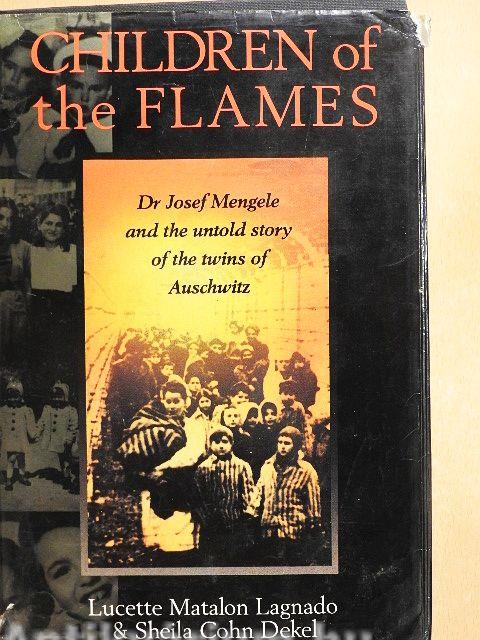


 Folytatás Microsoft-tal