
1.150.377
kiadvánnyal nyújtjuk Magyarország legnagyobb antikvár könyv-kínálatát

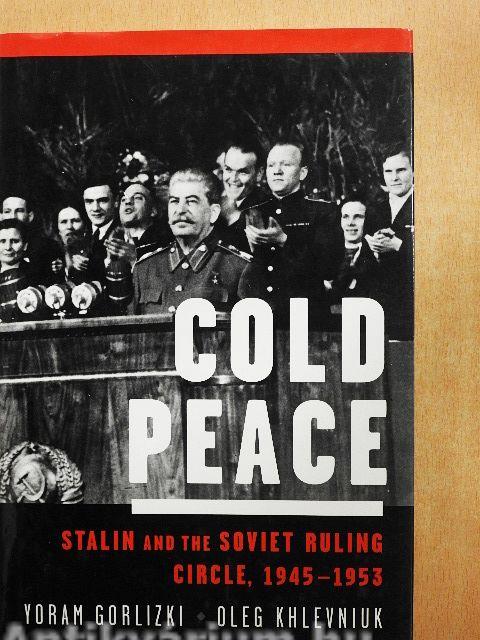
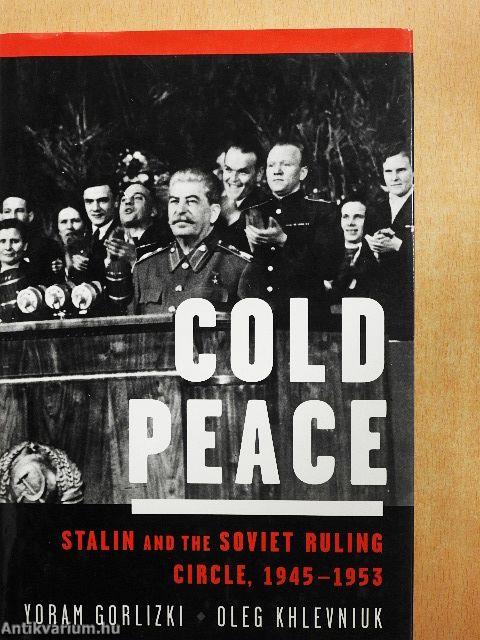
Cold Peace
Stalin and the Soviet Ruling Circle, 1945-1953
Oxford
| Kiadó: | Oxford University Press |
|---|---|
| Kiadás helye: | Oxford |
| Kiadás éve: | |
| Kötés típusa: | Ragasztott kemény kötés |
| Oldalszám: | 248 oldal |
| Sorozatcím: | |
| Kötetszám: | |
| Nyelv: | Angol |
| Méret: | 24 cm x 16 cm |
| ISBN: | 0-19-516581-0 |
| Megjegyzés: | Fekete-fehér fotókkal. |
Értesítőt kérek a kiadóról
A beállítást mentettük,
naponta értesítjük a beérkező friss
kiadványokról
naponta értesítjük a beérkező friss
kiadványokról
A beállítást mentettük,
naponta értesítjük a beérkező friss
kiadványokról
naponta értesítjük a beérkező friss
kiadványokról
Előszó
Tovább
Fülszöveg
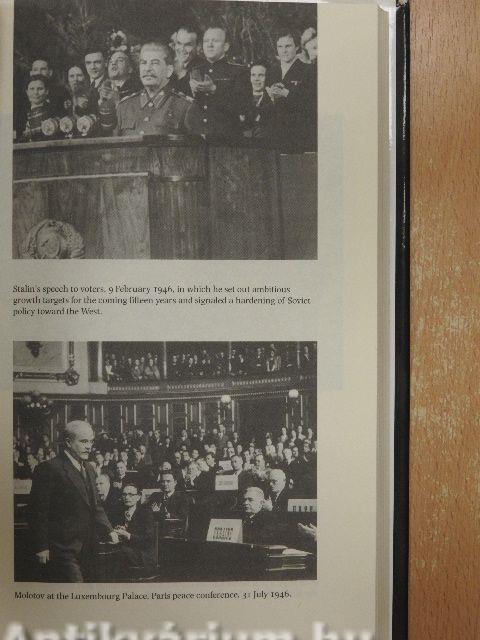
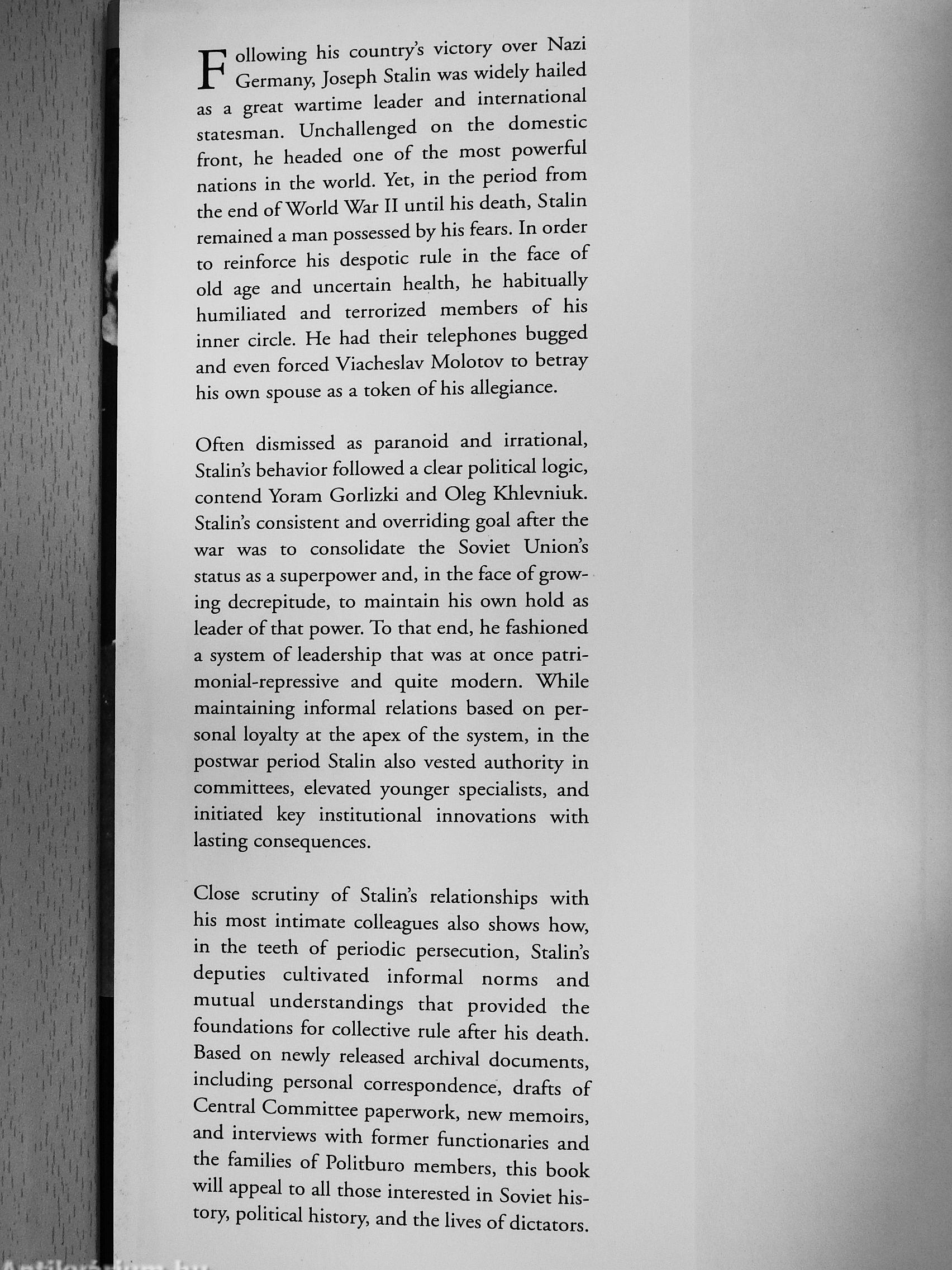
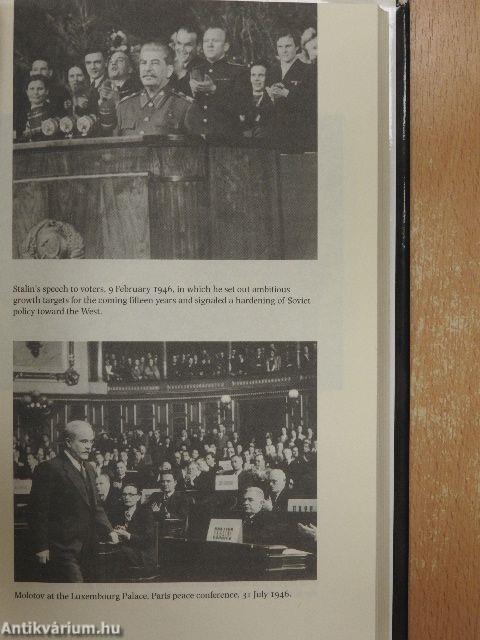
Following his country's victory over Nazi Germany, Joseph Stalin was widely haded as a great wartime leader and international statesman. Unchallenged on the domestic front, he headed one of the most powerful nations in the world. Yet, in the period from the end of World War II until his death, Stalin remained a man possessed by his fears. In order to reinforce his despotic rule in the face of old age and uncertain health, he habitually humiliated and terrorized members of his inner circle. He had their telephones bugged and even forced Viacheslav Molotov to betray his own spouse as a token of his allegiance.
Often dismissed as paranoid and irrational, Stalin's behavior followed a clear political logic, contend Yoram Gorlizki and Oleg Khlevniuk. Stalin's consistent and overriding goal after the war was to consolidate the Soviet Union's status as a superpower and, in the face of growing decrepitude, to maintain his own hold as leader of that power. To that end, he fashioned a... Tovább
Fülszöveg
Following his country's victory over Nazi Germany, Joseph Stalin was widely haded as a great wartime leader and international statesman. Unchallenged on the domestic front, he headed one of the most powerful nations in the world. Yet, in the period from the end of World War II until his death, Stalin remained a man possessed by his fears. In order to reinforce his despotic rule in the face of old age and uncertain health, he habitually humiliated and terrorized members of his inner circle. He had their telephones bugged and even forced Viacheslav Molotov to betray his own spouse as a token of his allegiance.
Often dismissed as paranoid and irrational, Stalin's behavior followed a clear political logic, contend Yoram Gorlizki and Oleg Khlevniuk. Stalin's consistent and overriding goal after the war was to consolidate the Soviet Union's status as a superpower and, in the face of growing decrepitude, to maintain his own hold as leader of that power. To that end, he fashioned a system of leadership that was at once patrimonial-repressive and quite modern. While maintaining informal relations based on personal loyalty at the apex of the system, in the postwar period Stalin also vested authority in committees, elevated younger specialists, and initiated key institutional innovations with lasting consequences.
Close scrutiny of Stalin's relationships with his most intimate colleagues also shows how, in the teeth of periodic persecution, Stalin's deputies cultivated informal norms and mutual understandings that provided the foundations for collective rule after his death. Based on newly released archival documents, including personal correspondence, drafts of Central Committee paperwork, new memoirs, and interviews with former functionaries and the families of Politburo members, this book will appeal to all those interested in Soviet history, political history, and the lives of dictators.
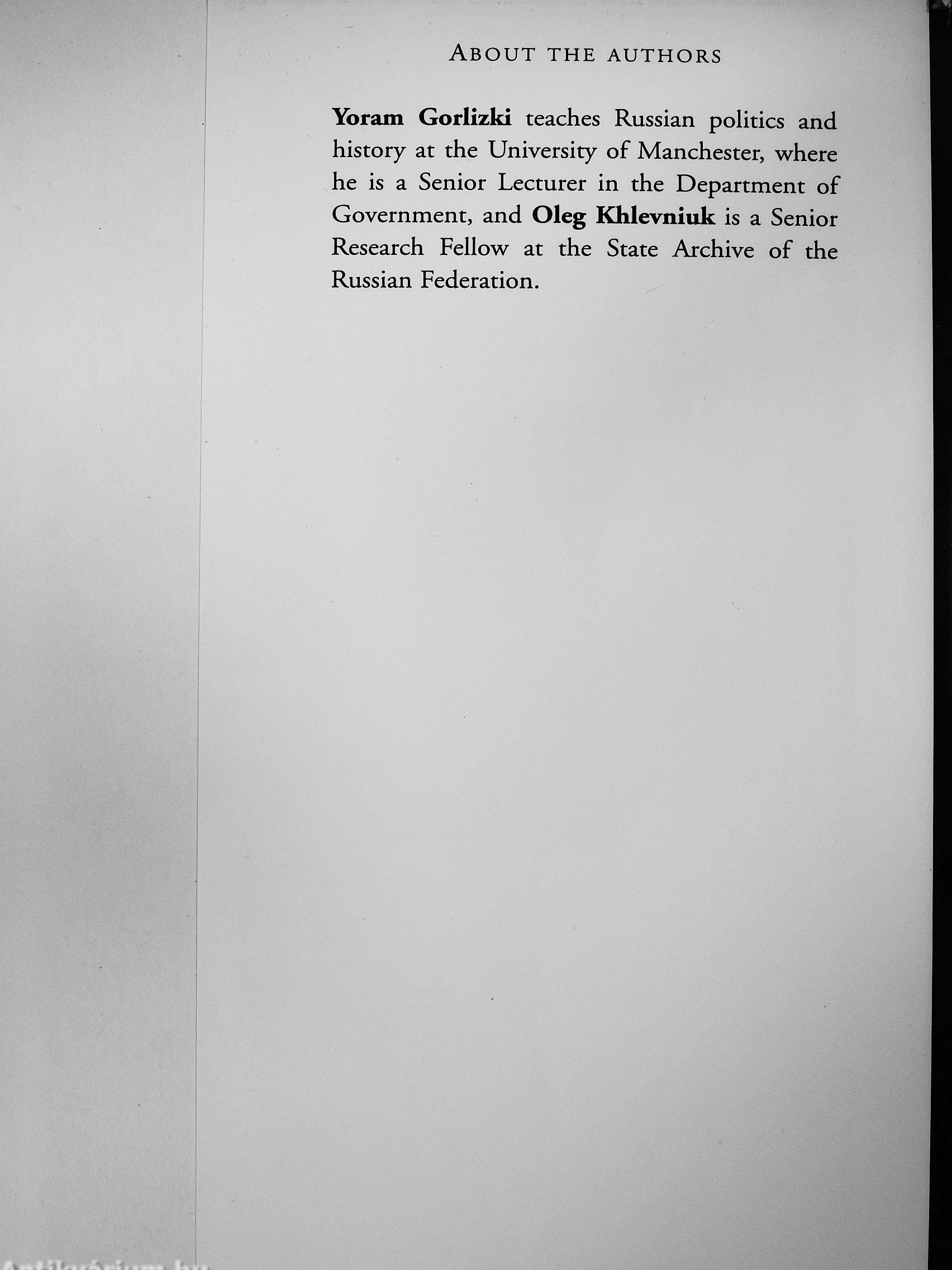
About the authors
Yoram Gorlizki teaches Russian politics and history at the University of Manchester, where he is a Senior Lecturer in the Department of Government, and Oleg Khlevniuk is a Senior Research Fellow at the State Archive of the Russian Federation.
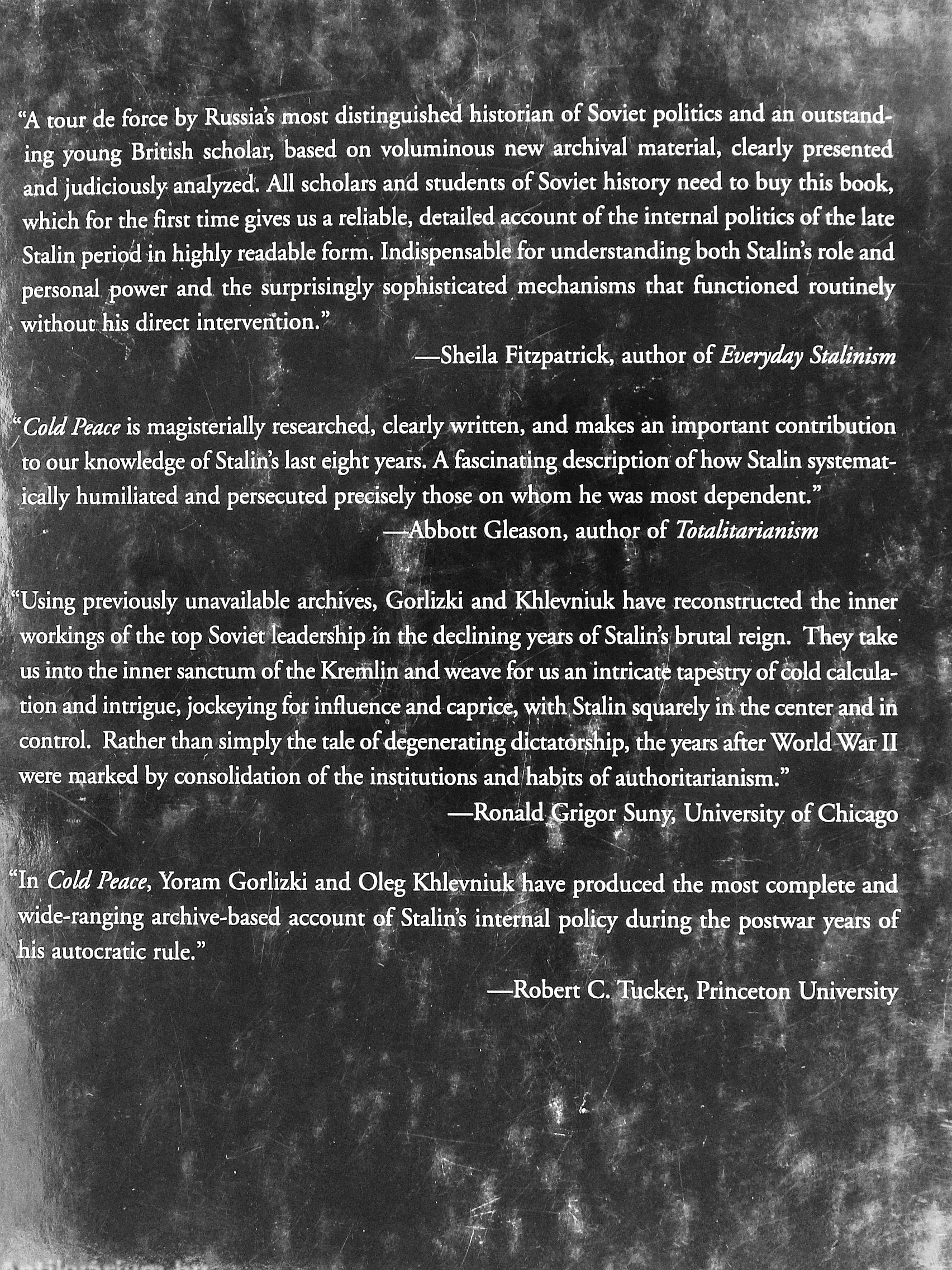
"A tour de force by Russia's most distinguished historian of Soviet politics and an outstanding young British scholar, based on voluminous new archival material, clearly presented and judiciously analyzed. All scholars and students of Soviet history need to buy this book, which for the first rime gives us a reliable, detailed account of the internal politics of the late Stalin period in highly readable form. Indispensabld for understanding both Stalin's role and i personal power and the surprisingly sophisricated mechanisms that functioned rourinely 1 without:his direct intervention.''
J —Sheila Fitzpatrick, author of ?iffrj'd^}'
'^ColdPeace is magisterially researched, clearly written, and makes an important contribution to our knowledge of Stalin's last eight years. A fascinating description of how Stalin systemat-icailly humiliated and persecuted precisely those on whom he was most dependent." ¦ —i^hoxt G\e3son, inxhpt of Totalitarianism
t . ¦ p ¦
l^'Using previously unavailable archives, Gorlizki and Khlevniuk have reconstructed the inner ' ' workings of the top Soviet leadership in the declining years of Stalin's, brutal reign. They take us into the inner sancmm of the Kremlin and weave for us an intricat^ tapestiy of ?old calculation and intrigue, jockeying for influence and caprice, with Stdin squarely iii the center iA control. Rather than simply the tale of degenerating dictatorliiip, the years after World War EI were njarked by consolidation of the institutions and 'habits of aiithoritarianism." ^ Si —RonaldjErigor Suny, University of Chicago
- "In Cold Peace, Yoram Goriizki and Oleg Khlfvniu)L|iave produced the most complete and il wide-ranging archive-based account of Stalin's intetiial policy during the postwar years of i; :liis autocratic rule." ^
—Robert C.Tucker, Princeton University
Vissza
Témakörök
- Idegennyelv > Idegennyelvű könyvek > Angol > Történelem > Európa története > Egyéb
- Történelem > Idegennyelvű > Angol
- Történelem > Politika > Belpolitika > Egyéb
- Történelem > Kontinensek szerint > Európa, európai országok története > Kelet-Európa > Oroszország, Szovjetúnió
- Történelem > Legújabb kor > A hidegháború kora (1946-1991)
- Történelem > Politika > Pártok, szervezetek
- Történelem > Politika > Ideológiák > Kommunizmus > Egyéb
Megvásárolható példányok
Nincs megvásárolható példány
A könyv összes megrendelhető példánya elfogyott. Ha kívánja, előjegyezheti a könyvet, és amint a könyv egy újabb példánya elérhető lesz, értesítjük.
 Folytatás Microsoft-tal