Fülszöveg
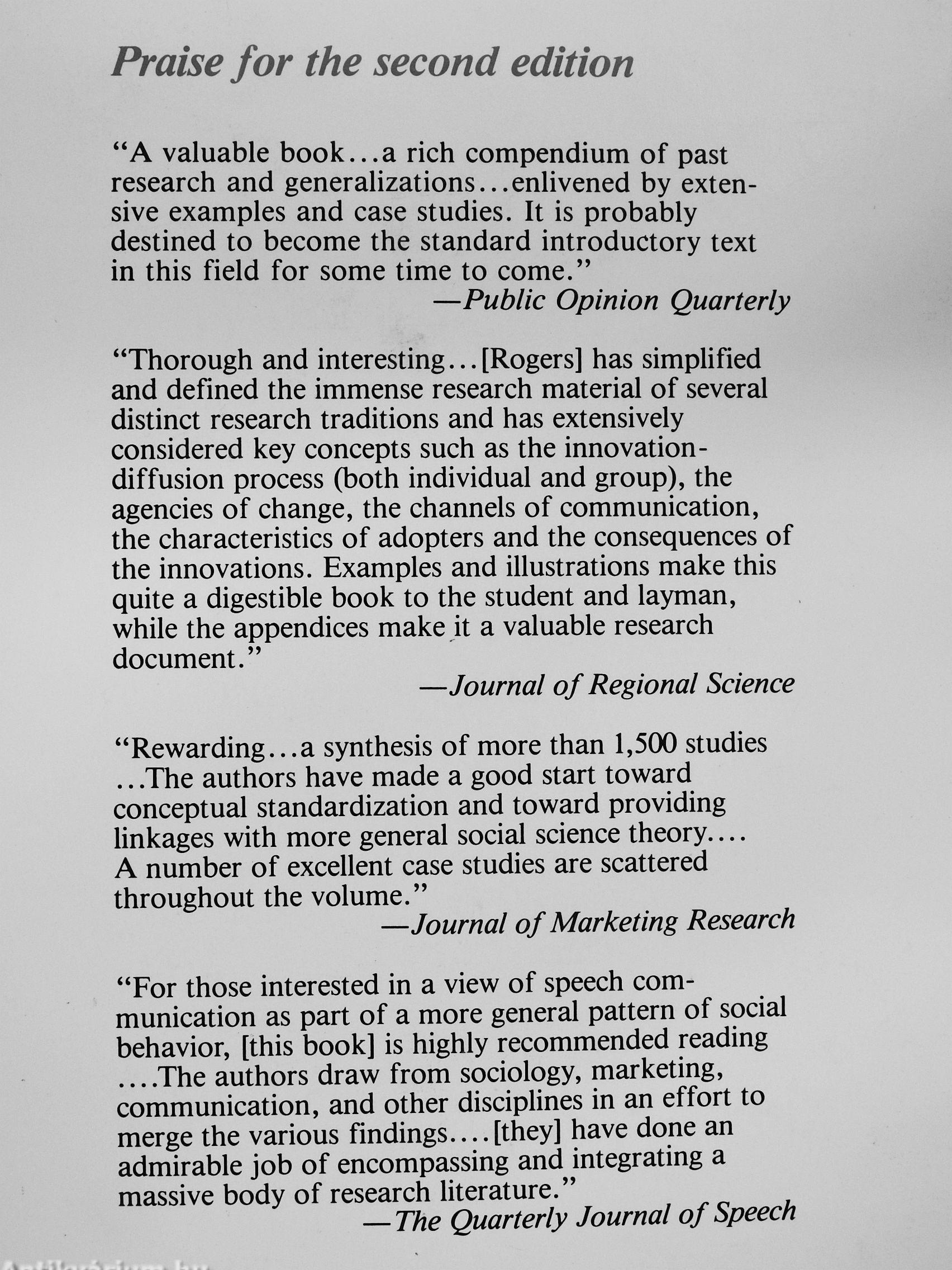
Praise for the second edition
"A valuable book a rich compendium of past research and generalizations enhvened by extensive examples and case studies. It is probably destined to become the standard introductory text in this field for some time to come."
—Public Opinion Quarterly
"Thorough and interesting [Rogers] has simplified and defined the immense research material of several distinct research traditions and has extensively considered key concepts such as the innovation-diffusion process (both individual and group), the agencies of change, the channels of communication, the characteristics of adopters and the consequences of the innovations. Examples and illustrations make this quite a digestible book to the student and layman, while the appendices make it a valuable research document."
—Journal of Regional Science
"Rewarding a synthesis of more than 1,500 studies .The authors have made a good start toward conceptual standardization and toward providing linkages with...
Tovább
Fülszöveg
Praise for the second edition
"A valuable book a rich compendium of past research and generalizations enhvened by extensive examples and case studies. It is probably destined to become the standard introductory text in this field for some time to come."
—Public Opinion Quarterly
"Thorough and interesting [Rogers] has simplified and defined the immense research material of several distinct research traditions and has extensively considered key concepts such as the innovation-diffusion process (both individual and group), the agencies of change, the channels of communication, the characteristics of adopters and the consequences of the innovations. Examples and illustrations make this quite a digestible book to the student and layman, while the appendices make it a valuable research document."
—Journal of Regional Science
"Rewarding a synthesis of more than 1,500 studies .The authors have made a good start toward conceptual standardization and toward providing linkages with more general social science theory A number of excellent case studies are scattered throughout the volume."
—Journal of Marketing Research
"For those interested in a view of speech communication as part of a more general pattern of social behavior, [this book] is highly recommended reading .The authors draw from sociology, marketing, communication, and other disciplines in an effort to merge the various findings [they] have done an admirable job of encompassing and integrating a massive body of research literature."
— The Quarterly Journal of Speech
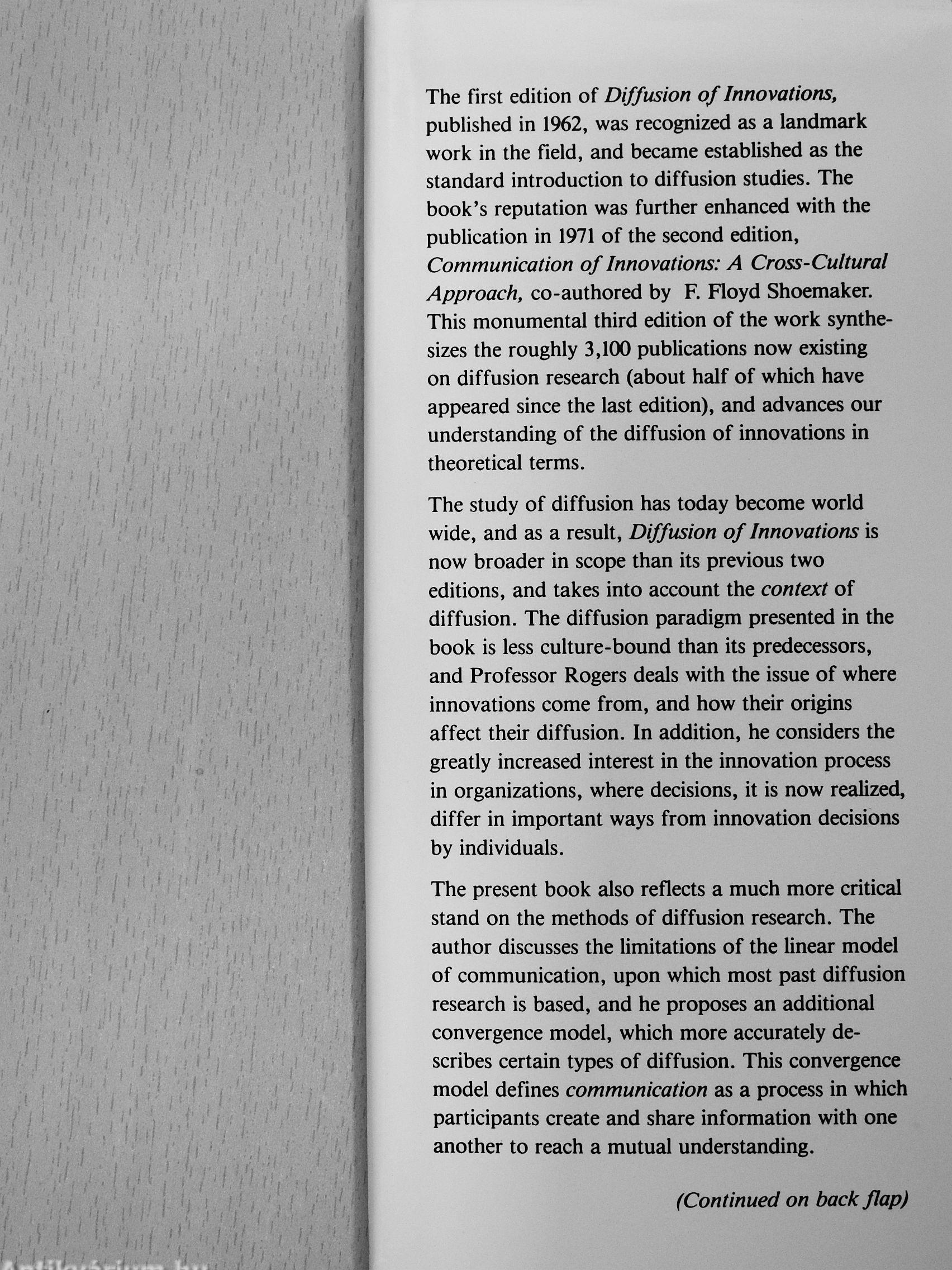
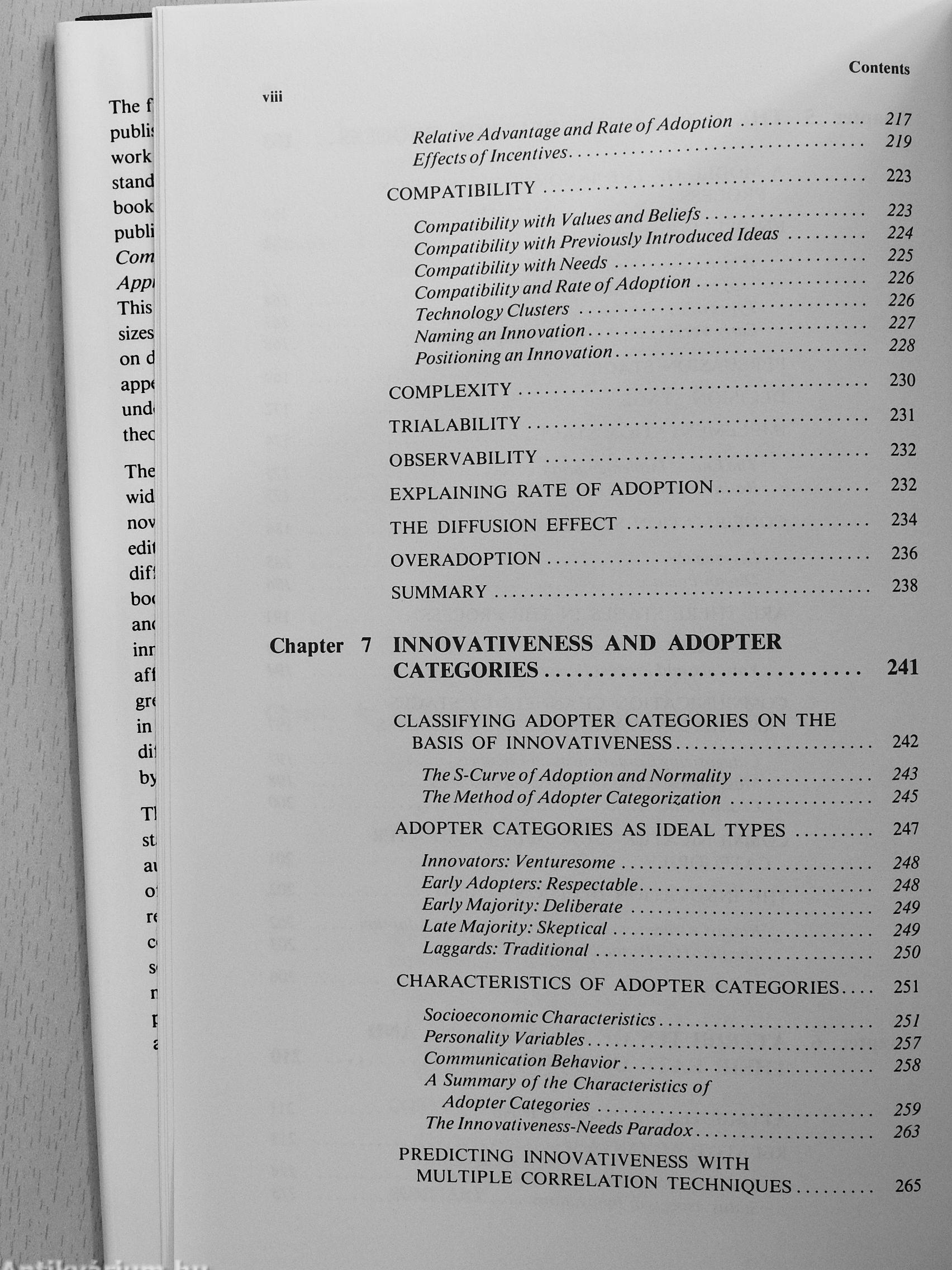
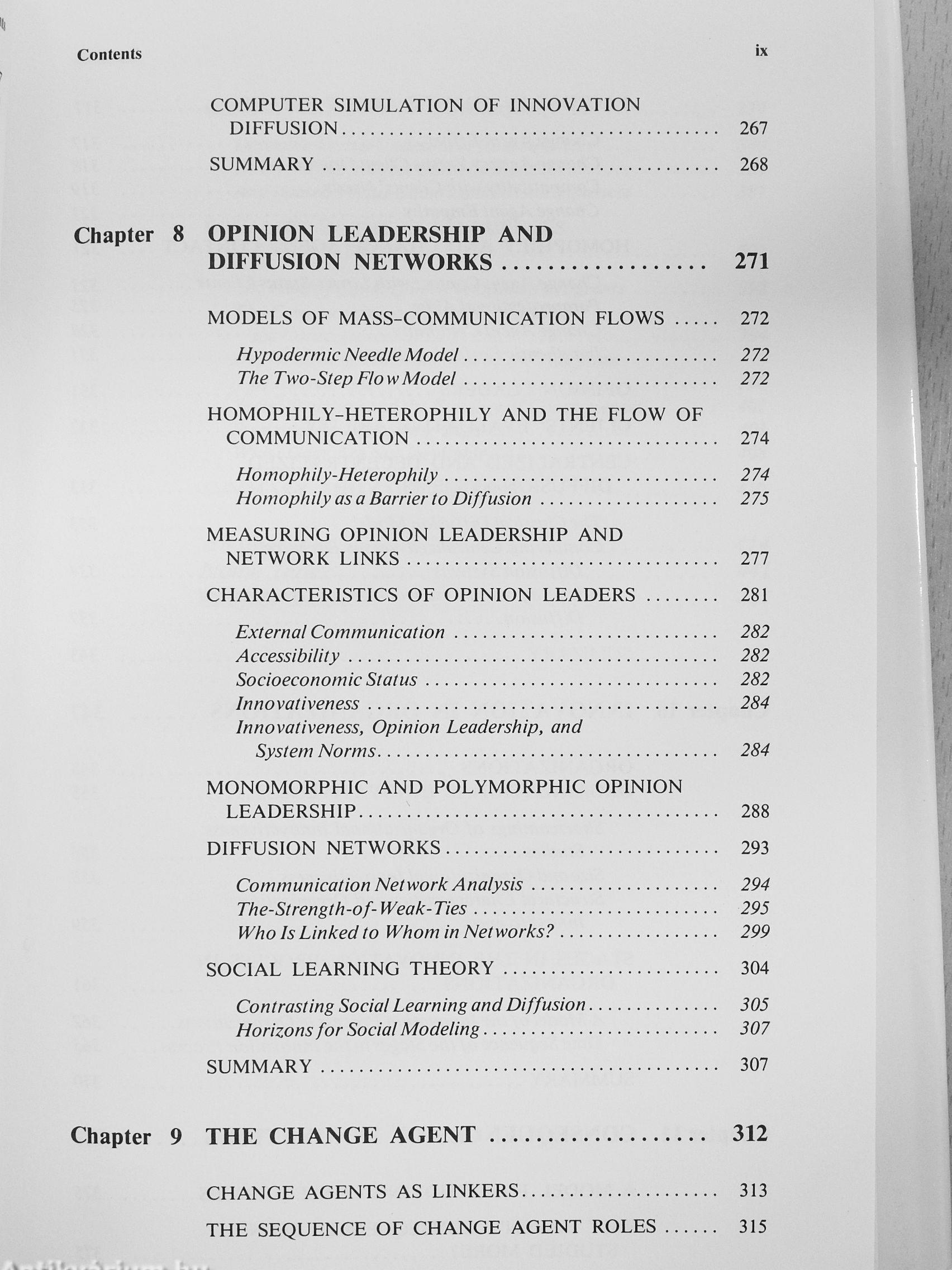
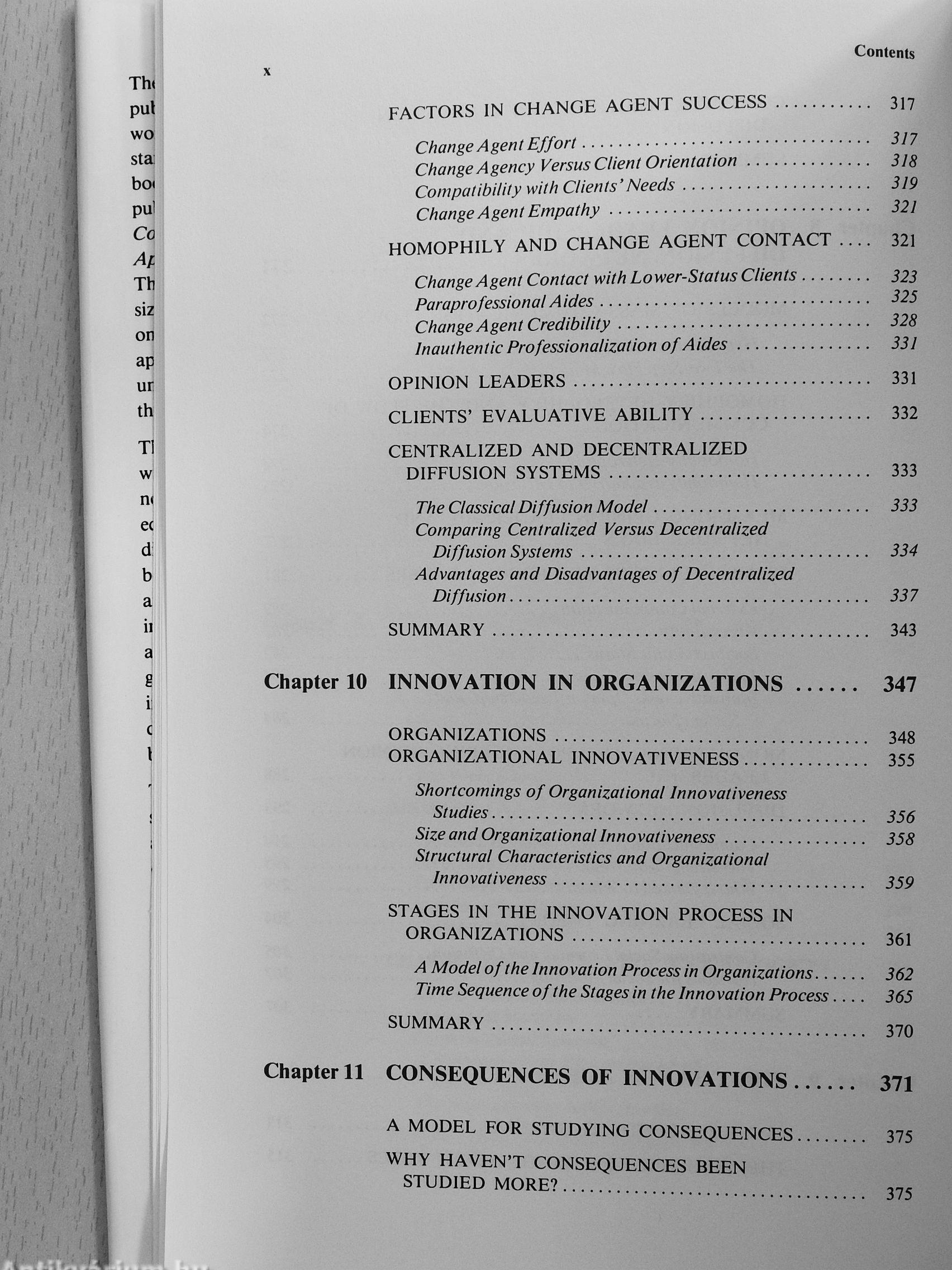
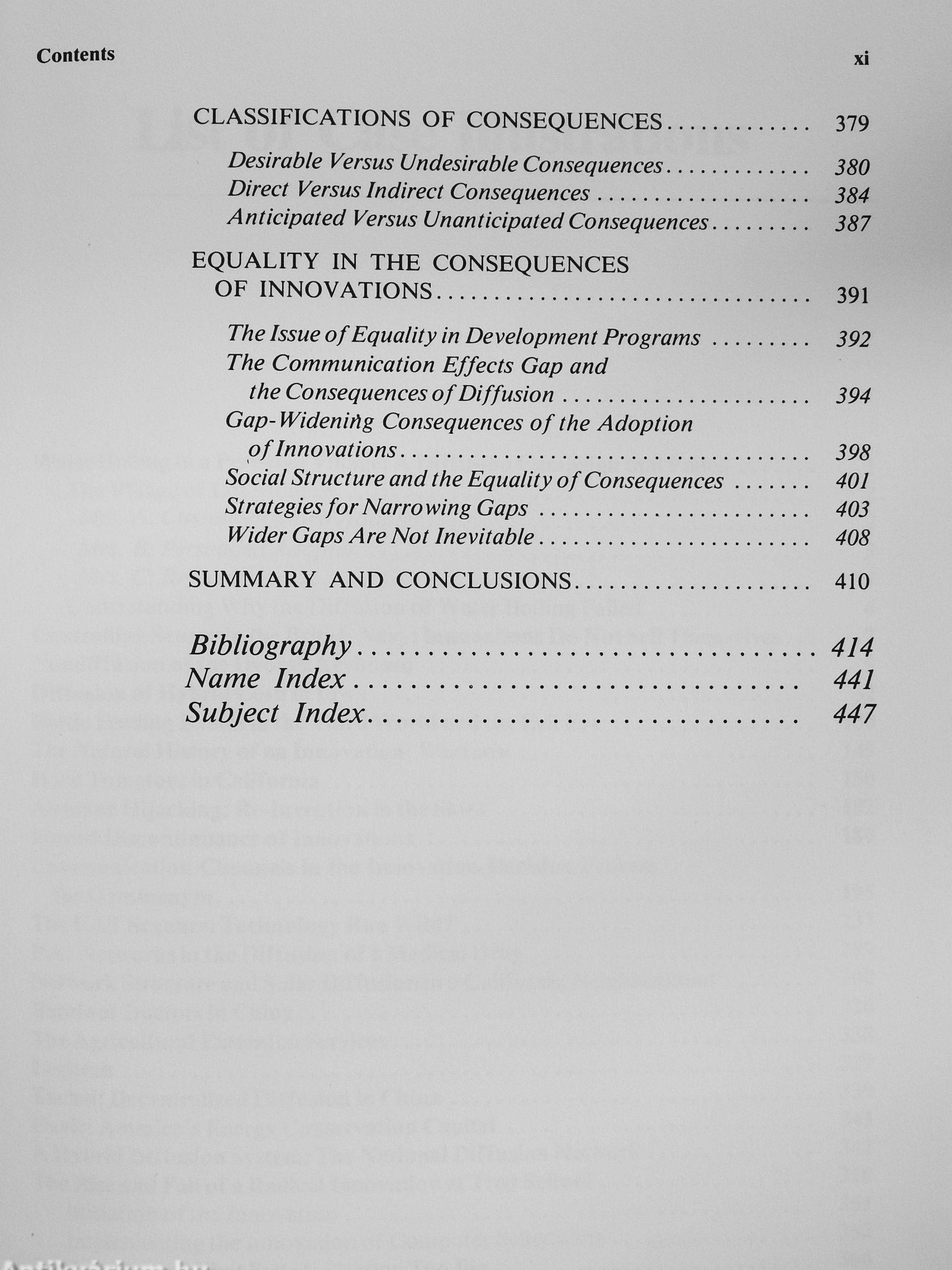
The first edition of Diffusion of Innovations, published in 1%2, was recognized as a landmark work in the field, and became established as the standard introduction to diffusion studies. The book's reputation was further enhanced with the publication in 1971 of the second edition, Communication of Innovations: A Cross-Cultural Approach, co-authored by F. Floyd Shoemaker. This monumental third edition of the work synthesizes the roughly 3,100 publications now existing on diffusion research (about half of which have appeared since the last edition), and advances our understanding of the diffusion of innovations in theoretical terms.
The study of diffusion has today become world wide, and as a result. Diffusion of Innovations is now broader in scope than its previous two editions, and takes into account the context of diffusion. The diffusion paradigm presented in the book is less culture-bound than its predecessors, and Professor Rogers deals with the issue of where innovations come from, and how their origins affect their diffusion. In addition, he considers the greatly increased interest in the innovation process in organizations, where decisions, it is now realized, differ in important ways from innovation decisions by individuals.
The present book also reflects a much more critical stand on the methods of diffusion research. The author discusses the limitations of the linear model of communication, upon which most past diffusion research is based, and he proposes an additional convergence model, which more accurately describes certain types of diffusion. This convergence model defines communication as a process in which participants create and share information with one another to reach a mutual understanding.
(Continued on back flap)
(Continued from front flap)
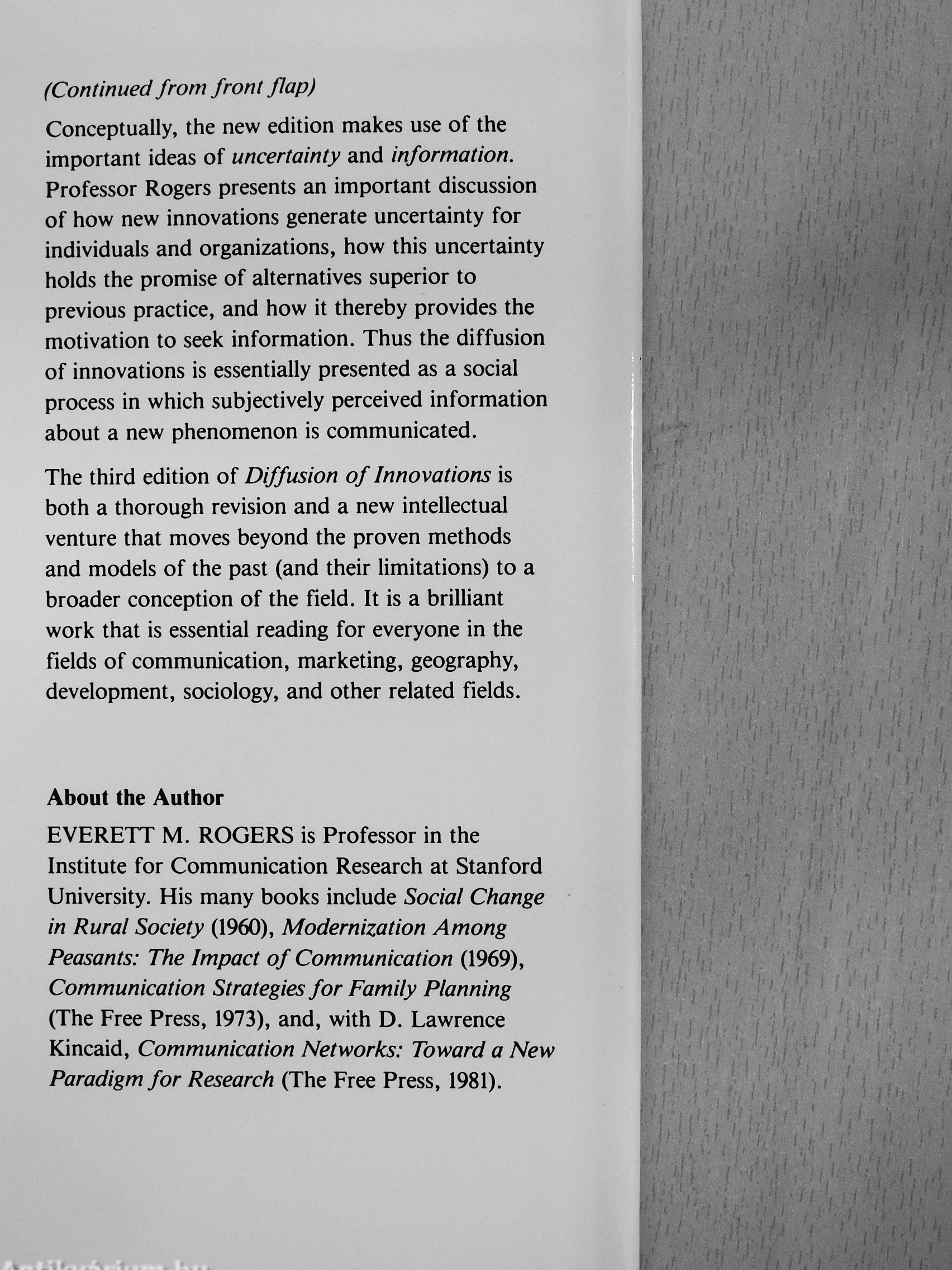
Conceptually, the new edition makes use of the important ideas of uncertainty and information. Professor Rogers presents an important discussion of how new innovations generate uncertainty for individuals and organizations, how this uncertainty holds the promise of alternatives superior to previous practice, and how it thereby provides the motivation to seek information. Thus the diffusion of innovations is essentially presented as a social process in which subjectively perceived information about a new phenomenon is communicated.
The third edition of Diffusion of Innovations is both a thorough revision and a new intellectual venture that moves beyond the proven methods and models of the past (and their limitations) to a broader conception of the field. It is a brilliant work that is essential reading for everyone in the fields of communication, marketing, geography, development, sociology, and other related fields.
About the Author
EVERETT M. ROGERS is Professor in the Institute for Communication Research at Stanford University. His many books include Social Change in Rural Society (1960), Modernization Among Peasants: The Impact of Communication (1969), Communication Strategies for Family Planning (The Free Press, 1973), and, with D. Lawrence Kincaid, Communication Networks: Toward a New Paradigm for Research (The Free Press, 1981).
Vissza 



 Folytatás Microsoft-tal