
1.145.557
kiadvánnyal nyújtjuk Magyarország legnagyobb antikvár könyv-kínálatát

English Grammar
Angol nyelvtan
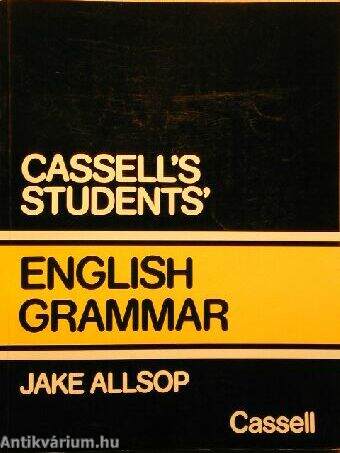
London
| Kiadó: | Cassel Publishers Limited |
|---|---|
| Kiadás helye: | London |
| Kiadás éve: | |
| Kötés típusa: | Ragasztott papírkötés |
| Oldalszám: | 327 oldal |
| Sorozatcím: | Cassell's Students' |
| Kötetszám: | |
| Nyelv: | Angol |
| Méret: | 25 cm x 19 cm |
| ISBN: | 0-304-305324 |
Értesítőt kérek a kiadóról
Értesítőt kérek a sorozatról
A beállítást mentettük,
naponta értesítjük a beérkező friss
kiadványokról
naponta értesítjük a beérkező friss
kiadványokról
A beállítást mentettük,
naponta értesítjük a beérkező friss
kiadványokról
naponta értesítjük a beérkező friss
kiadványokról
Tartalom
| Introduction | 7 |
| List of abbreviations | 8 |
| Nouns | 9 |
| Introduciton | 10 |
| Use of capital letters | 10 |
| Formation of the plural | 11 |
| Nouns which occur only in the plural | 17 |
| Words which can be either singular or plural nouns | 18 |
| Nouns which occur only in the singular | 19 |
| Formation of nouns | 19 |
| The possessive form of nouns | 27 |
| Appendix I: list of common compound nouns | 30 |
| Appendix II: list of common compound nouns and adjectives formed from phrasal verbs | 31 |
| The articles and demonstratives | 33 |
| A The articles | 34 |
| Form and pronunciation | 34 |
| Uses of the articles: an or the? | 35 |
| Uses of the articles: with the or without the? | 45 |
| Demonstratives | 45 |
| Form of the demonstratives | 45 |
| Meaning of the demonstratives | 47 |
| Other uses of the demonstratives | 47 |
| Appendix III: expressions using the pattern VERB+NOUN | 49 |
| Appendix IV: expressions using the pattern PREPOSITION+NOUN | 50 |
| Quantifiers and distributives | 51 |
| A Quantity | 52 |
| Quantifiers with mass and count nouns | 52 |
| Positive and negative ways of looking at things | 54 |
| Meanings of some | 55 |
| Some and any | 56 |
| Quantifiers as pronouns | 57 |
| Compounds with -one, -body, -thing, and -where | 58 |
| Uses of much and many | 59 |
| Distribution | 60 |
| Words which describe distribution | 66 |
| All, every or each | 66 |
| Either and neither | 66 |
| Adjectives | 68 |
| Types of adjective | 69 |
| Formation of adjectives | 70 |
| Position of adjectives | 74 |
| Order of adjectives | 78 |
| Comparison of adjectives | 80 |
| Appendix V: cardinal and ordinal numbers | 83 |
| Appendix VI: nationality adjectives | 85 |
| Appendix VII: adjectives and prepositions | 86 |
| Pronouns | 88 |
| A Personal pronouns | 89 |
| Summary of forms | 89 |
| Meaning and use of personal pronouns | 90 |
| Subject pronouns | 91 |
| Object pronouns | 93 |
| Possessives | 96 |
| Reflexive / empatic pronouns | 97 |
| Other pronouns | 99 |
| Interrogatives: who(m)?, which?, what?, and whose? | 99 |
| Relatives: who(m), which, whose and that | 100 |
| Quantitive and distributive pronouns | 101 |
| Indefinite pronouns (somebody, anybody, etc.) | 102 |
| One(s), other, another | 102 |
| Prepositions | 104 |
| Meaning and use of prepositions | 105 |
| Patterns with prepositions | 105 |
| Prepositions to express relationships in space | 107 |
| Prepositions to express relationships in time | 112 |
| Prepositions to express other relationships | 117 |
| The pattern VERB+PREPOSITION | 121 |
| Appendix VIII: verbs with following prepositions | 122 |
| Appendix IX: common fixed expressions with prepositions | 123 |
| Verb forms | 124 |
| Introduction | 125 |
| The "building blocks' of the verb | 125 |
| Active and passive, simple and continuous | 128 |
| The parts of the main verb | 130 |
| Formation of the negative: not/n't | 135 |
| Formation of questions | 137 |
| Formation of verbs | 139 |
| Appendix X: alphabetical list of irregular verbs | 143 |
| Appendix XI: list of verbs in -ify, -ize and -ate | 144 |
| Appendix XII: matrix of verbs on the pattern LATIN PREFIX+ROOT | 145 |
| Verbs - meaning and uses | 147 |
| A Tenses | 148 |
| The two elements of meaning | 148 |
| The present tenses | 149 |
| The past tenses | 156 |
| The perfect tenses | 159 |
| The imperative | 167 |
| The basic imperative | 167 |
| 'Coloured' imperatives | 168 |
| Imperatives with let | 169 |
| The passive | 169 |
| Form | 169 |
| Meaming of the passive | 169 |
| Uses of the passive | 170 |
| By and with in the pattern X WAS DONE BY/WITh Y | 173 |
| The future | 175 |
| Introduction | 176 |
| A Future with will/shall | 177 |
| The classical form of the future | 177 |
| First person: I/we | 178 |
| Second person: you | 180 |
| Third person: he, she, it and they | 182 |
| Future continuous: will be moving | 183 |
| Future perfect: will have moved/been moving | 183 |
| Future with going to | 185 |
| Meaning and use | 186 |
| Going to or present simple | 187 |
| Going to or present continuous | 187 |
| Going to or future with shall/will | 188 |
| Other ways of expressing the future | 189 |
| Is to | 189 |
| Is about to | 189 |
| Expressing probability | 189 |
| The tense used in time clauses | 190 |
| Modals (including conditional sentences) | 191 |
| Introduction | 192 |
| Form of modals | 193 |
| Probability: will; must/can't; could, should; may/might | 194 |
| Obligation: must/have to | 196 |
| Obligation: should/ought to | 199 |
| Necessity: need | 200 |
| Ability/success: can/could/be able to | 202 |
| Permission: may/might and can/could | 203 |
| Condition: if-sentences | 204 |
| Phrasal verbs | 209 |
| Introduction | 210 |
| Word order in phrasal verbs | 212 |
| Is the particle a preposition or an adverb? | 215 |
| The meaning and use of phrasal verbs | 216 |
| Appendix XIII: matrix of common phrasal verbs | 221 |
| Appendix XIV: list of phrasal verbs having the pattern VERB+ADVERB+PREPOSITION | 222 |
| Adverbials | 226 |
| A General introduction | 228 |
| Meaning of adverbials | 228 |
| Form of adverbials | 229 |
| Position of adverbials | 229 |
| Adverbials of place (movement and location) | 232 |
| Movement and location | 232 |
| Other useful adverbials of place | 232 |
| Prepositional phrases of place | 234 |
| Here and there | 234 |
| Position of adverbials of place | 235 |
| Adverbials of time | 236 |
| Common when adverbials | 236 |
| Common how long adverbial | 237 |
| Common how often adverbials | 238 |
| Other time adverbs | 240 |
| Order of time adverbials | 241 |
| Adverbials of manner | 241 |
| Adverbs of manner in -ly | 241 |
| Other adverbs of manner | 243 |
| Prepositional phrases | 243 |
| Order of different types of adverbials | 243 |
| MANNER+PLACE+TIME (MPT) order | 243 |
| Variations in the MPT order | 244 |
| Other adverbials | 244 |
| Viewpoint, commenting adverbials and adverbials of degree | 244 |
| Adverbs which join or link sentences and ideas | 247 |
| Adverbs used to modify adjectives and other adverbs | 248 |
| Sentence patterns | 251 |
| Note on grammatical terms | 253 |
| Summary of types of verb patterns; key sentences | 255 |
| Patterns with intrasensitive verbs: types A-E | 255 |
| Type A: be+complement | 255 |
| Type B: Vi+O and Vi+complement | 258 |
| Type C: seem (etc.) + complement | 259 |
| Type D: Vi+preposition+object | 259 |
| Type E: verb+to-infinitive and verb+base infinitive | 260 |
| Patterns with transitive verbs: types F-J | 261 |
| Type F: Vt+object | 267 |
| Type G: Vt+object+base infinitive or present participle | 269 |
| Type H: Vt+direct and indirect object | 270 |
| Type I: reporting verb +-np object +that-; wh-clause | 273 |
| Type J: Vt+np object+adv/adj/noun/past participle | 278 |
| Sentence construction | 279 |
| A Conjunctions | 279 |
| Definition of conjunctions | 279 |
| and, but, so, (n)either...(n)or, or | 280 |
| Other conjunctions | 284 |
| Sequence of tenses in reported (indirect) speech and questions | 284 |
| Tense and other changes | 284 |
| Variations in the sequence of tenses | 286 |
| Question word+to-infinitive phrase | 289 |
| wh-clauses | 289 |
| Relative clauses (defining and non-defining relatives) | 290 |
| Definition of relative clauses | 290 |
| Defining relative clauses | 291 |
| Non-defining relative clauses | 295 |
| Appendix XV: notes on punctuation | 297 |
| Index | 305 |
Témakörök
- Idegennyelv > Idegennyelvű könyvek > Angol > Nyelvészet
- Nyelvészet > Idegen nyelvek > Nyelvtana
- Idegennyelv > Nyelvtanulás > Nyelvtanítás > Nyelvkönyv
- Idegennyelv > Nyelvtanulás > Nyelvtanítás > Oktatási nyelv > Idegennyelvű
- Idegennyelv > Nyelvtanulás > Nyelvek > Angol > Leíró nyelvtan
- Idegennyelv > Nyelvtanulás > Nyelvek > Angol > Gyakorlatok
Jake Allsop
Jake Allsop műveinek az Antikvarium.hu-n kapható vagy előjegyezhető listáját itt tekintheti meg: Jake Allsop könyvek, művekMegvásárolható példányok
Nincs megvásárolható példány
A könyv összes megrendelhető példánya elfogyott. Ha kívánja, előjegyezheti a könyvet, és amint a könyv egy újabb példánya elérhető lesz, értesítjük.
 Folytatás Microsoft-tal