
1.150.767
kiadvánnyal nyújtjuk Magyarország legnagyobb antikvár könyv-kínálatát

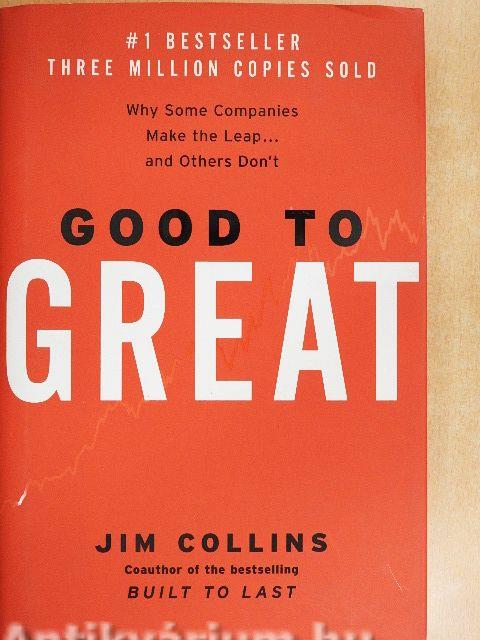
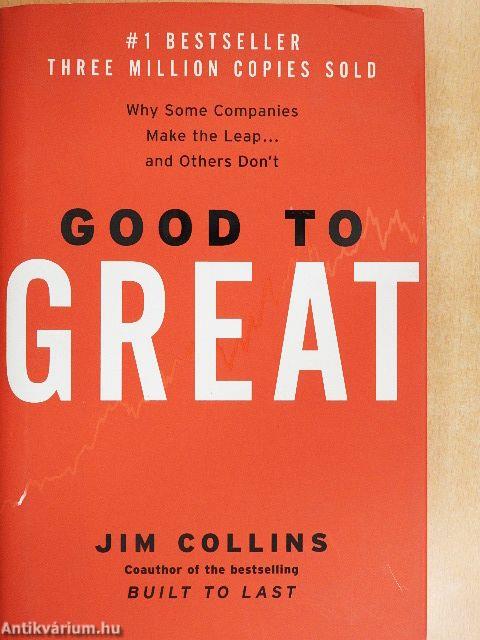
Good to Great
Why Some Companies Make the Leap... and Others Don't
New York
| Kiadó: | HarperBusiness |
|---|---|
| Kiadás helye: | New York |
| Kiadás éve: | |
| Kötés típusa: | Fűzött keménykötés |
| Oldalszám: | 300 oldal |
| Sorozatcím: | |
| Kötetszám: | |
| Nyelv: | Angol |
| Méret: | 24 cm x 16 cm |
| ISBN: | 0-06-662099-6 |
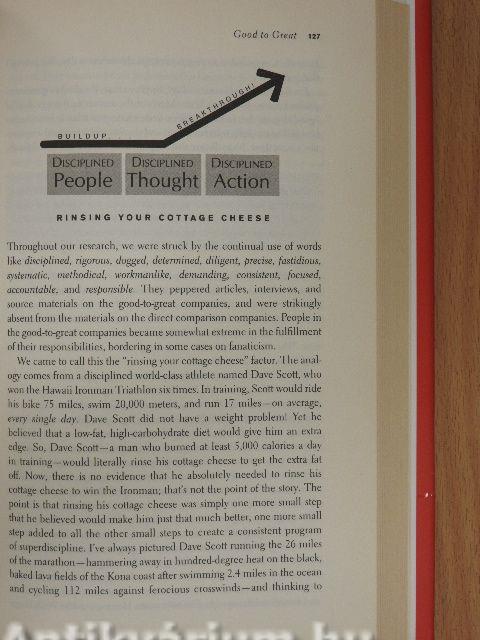
| Megjegyzés: | Fekete-fehér ábrákkal. |
Értesítőt kérek a kiadóról
A beállítást mentettük,
naponta értesítjük a beérkező friss
kiadványokról
naponta értesítjük a beérkező friss
kiadványokról
A beállítást mentettük,
naponta értesítjük a beérkező friss
kiadványokról
naponta értesítjük a beérkező friss
kiadványokról
Előszó
Tovább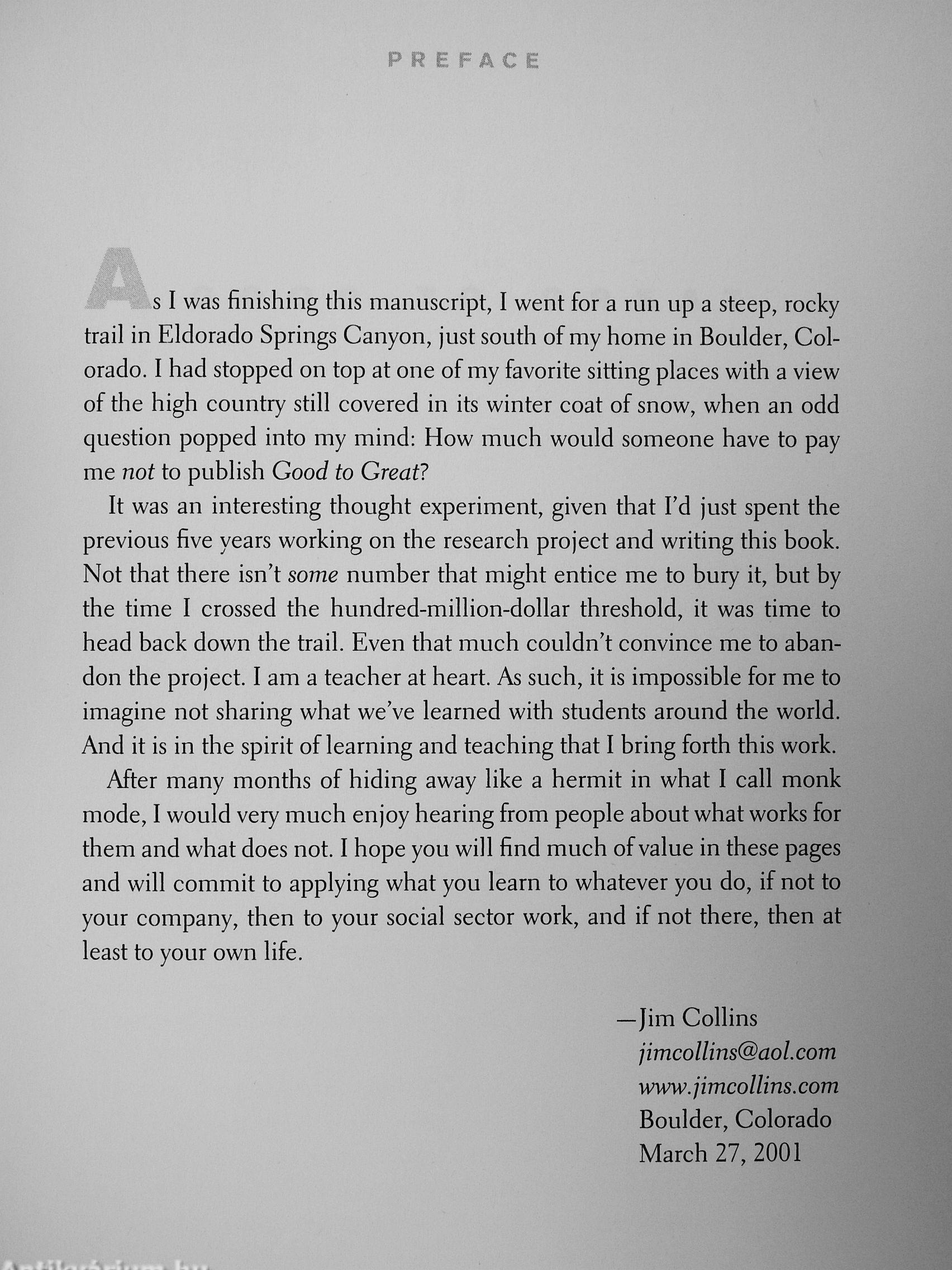
Fülszöveg
USA $29.99
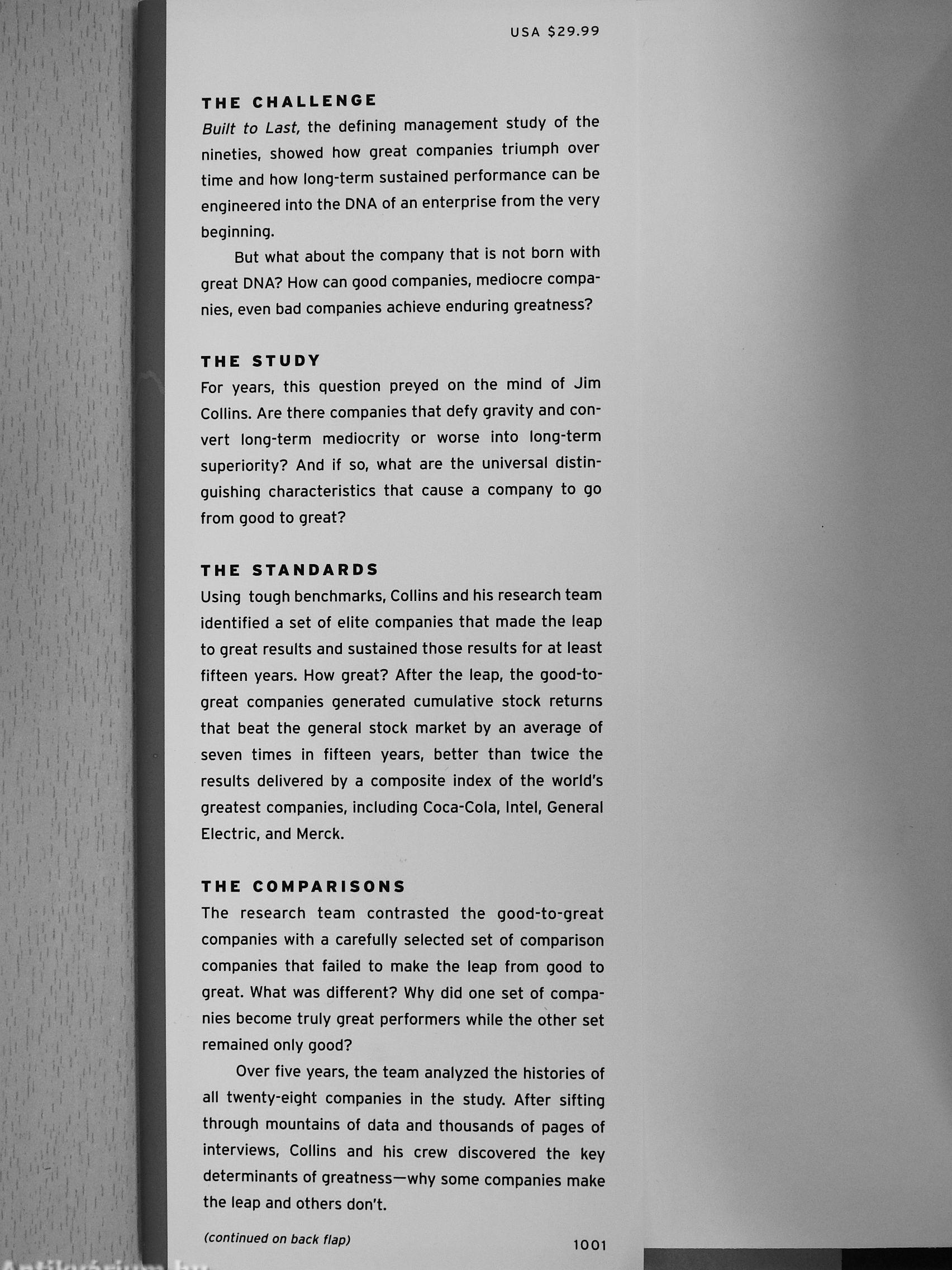
THE CHALLENGE
Built to Last, the defining management study of the nineties, showed how great companies triumph over time and how long-term sustained performance can be engineered into the DNA of an enterprise from the very beginning.
But what about the company that is not born with great DNA? How can good companies, mediocre companies, even bad companies achieve enduring greatness?
THE STUDY
For years, this question preyed on the mind of Jim Collins. Are there companies that defy gravity and convert long-term mediocrity or worse into long-term superiority? And if so, what are the universal distinguishing characteristics that cause a company to go from good to great?
THE STANDARDS
Using tough benchmarks, Collins and his research team identified a set of elite companies that made the leap to great results and sustained those results for at least fifteen years. How great? After the leap, the good-to-great companies generated cumulative stock returns that beat the... Tovább
Fülszöveg
USA $29.99
THE CHALLENGE
Built to Last, the defining management study of the nineties, showed how great companies triumph over time and how long-term sustained performance can be engineered into the DNA of an enterprise from the very beginning.
But what about the company that is not born with great DNA? How can good companies, mediocre companies, even bad companies achieve enduring greatness?
THE STUDY
For years, this question preyed on the mind of Jim Collins. Are there companies that defy gravity and convert long-term mediocrity or worse into long-term superiority? And if so, what are the universal distinguishing characteristics that cause a company to go from good to great?
THE STANDARDS
Using tough benchmarks, Collins and his research team identified a set of elite companies that made the leap to great results and sustained those results for at least fifteen years. How great? After the leap, the good-to-great companies generated cumulative stock returns that beat the general stock market by an average of seven times in fifteen years, better than twice the results delivered by a composite Index of the world's greatest companies, including Coca-Cola, Intel, General Electric, and Merck.
THE COMPARISONS
The research team contrasted the good-to-great companies with a carefully selected set of comparison companies that failed to make the leap from good to great. What was different? Why did one set of companies become truly great performers while the other set remained only good?
Over five years, the team analyzed the histories of all twenty-eight companies in the study. After sifting through mountains of data and thousands of pages of interviews, Collins and his crew discovered the key determinants of greatness-why some companies make the leap and others don't.
(continued on back flap)
1001
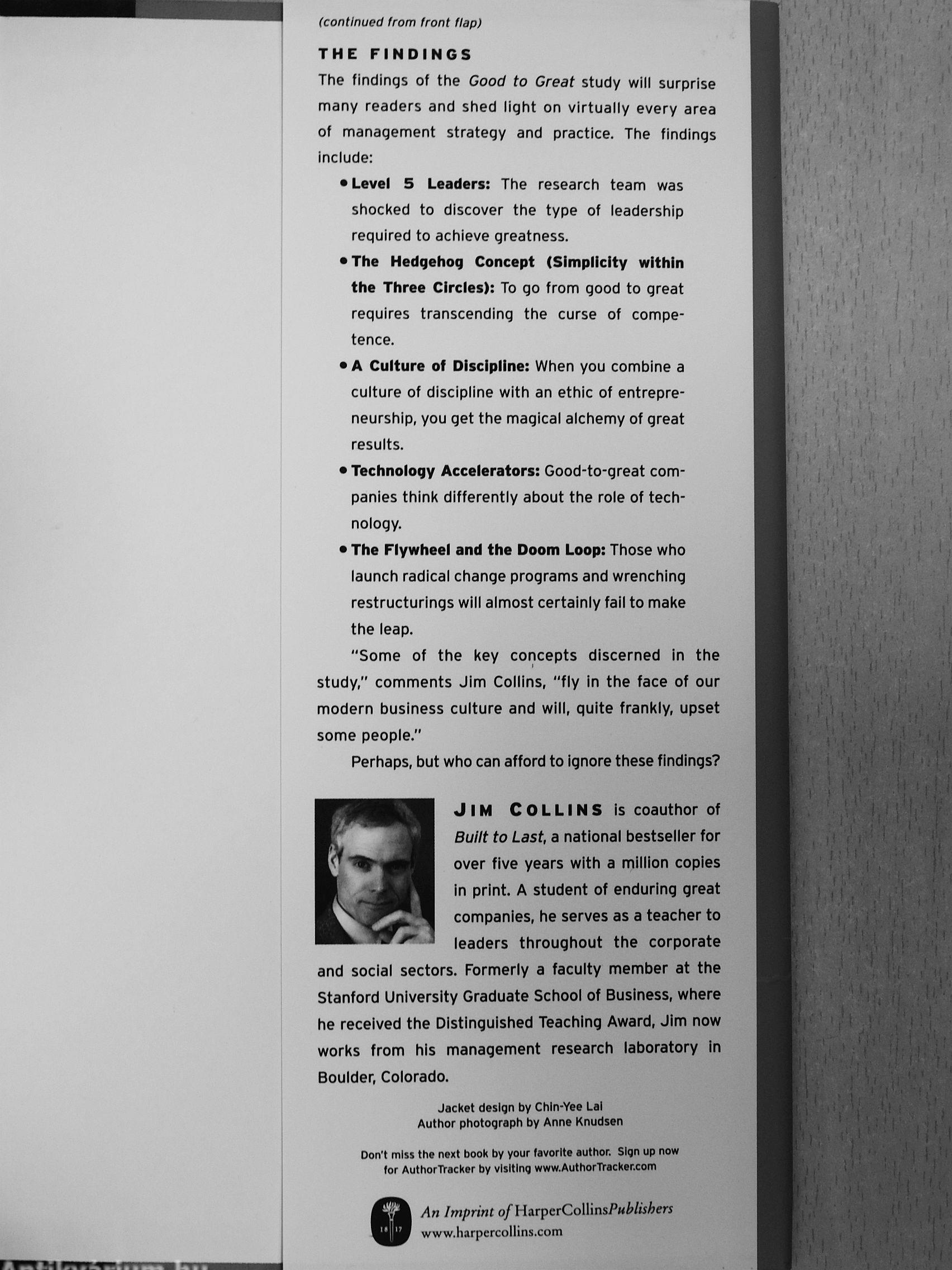
(continued from front flap) THE FINDINGS
The findings of the Good to Great study will surprise many readers and shed light on virtually every area of management strategy and practice. The findings include:
• Level 5 Leaders: The research team was shocked to discover the type of leadership required to achieve greatness.
• The Hedgehog Concept (Simplicity within the Three Circles): To go from good to great requires transcending the curse of competence.
• A Culture of Discipline: When you combine a culture of discipline with an ethic of entrepre-neurship, you get the magical alchemy of great results.
• Technology Accelerators: Good-to-great companies think differently about the role of technology.
• The Flywheel and the Doom Loop: Those who launch radical change programs and wrenching restructurings will almost certainly fail to make the leap.
"Some of the key concepts discerned in the study," comments Jim Collins, "fly in the face of our modern business culture and will, quite frankly, upset some people."
Perhaps, but who can afford to Ignore these findings?
JIM Collins is coauthor of Built to Last, a national bestseller for over five years with a million copies In print. A student of enduring great companies, he serves as a teacher to leaders throughout the corporate and social sectors. Formerly a faculty member at the Stanford University Graduate School of Business, where he received the Distinguished Teaching Award, Jim now works from his management research laboratory in Boulder, Colorado.
Jacket design by Chln-Yee Lai Author photograph by Anne Knudsen
Don't miss the next book by your favorite author. Sign up now tor AuthorTt-acker by visiting www.AuthorTracker.com
H
QP
An Imprint of HarpcrCoWinsPublishers www.lurpcrcoIlins.com
Praise for ^
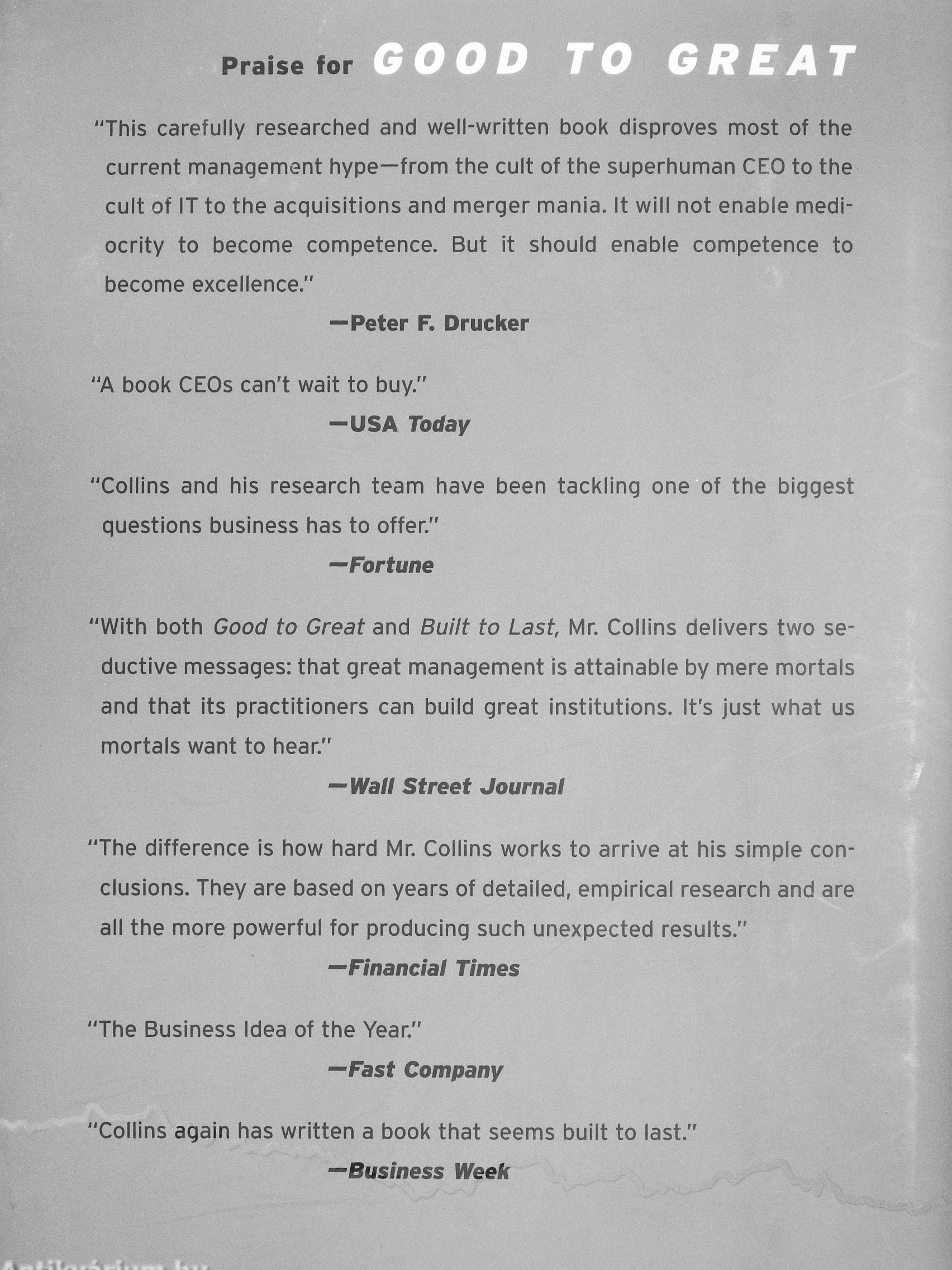
"This carefully researched and well-written book disproves most of the current management hype—from the cult of the superhuman CEO to the cult of IT to the acquisitions and merger mania. It will not enable mediocrity to become competence. But it should enable competence to become excellence."
—Peter F. Drucker
"A book CEOs can't wait to buy."
-USA Today
"Collins and his research team have been tackling one of the biggest questions business has to offer."
—Fortune
"With both Good to Great and Built to Last, Mr. Collins delivers two seductive messages: that great management is attainable by mere mortals and that its practitioners can build great institutions. It's just what us mortals want to hear."
-Wall Street Journal
"The difference is how hard Mr. Collins works to arrive at his simple conclusions. They are based on years of detailed, empirical research and are all the more powerful for producing such unexpected results." —Financial Times
"The Business Idea of the Year."
—Fast Company
"Collins again has written a book that seems built to last." —Business Week Vissza
Jim Collins
Jim Collins műveinek az Antikvarium.hu-n kapható vagy előjegyezhető listáját itt tekintheti meg: Jim Collins könyvek, művekMegvásárolható példányok
Állapotfotók
Szép állapotú példány.
Állapot:
Jó
8.400 ,-Ft
42
pont kapható
Kosárba
 Folytatás Microsoft-tal