
1.122.048
kiadvánnyal nyújtjuk Magyarország legnagyobb antikvár könyv-kínálatát

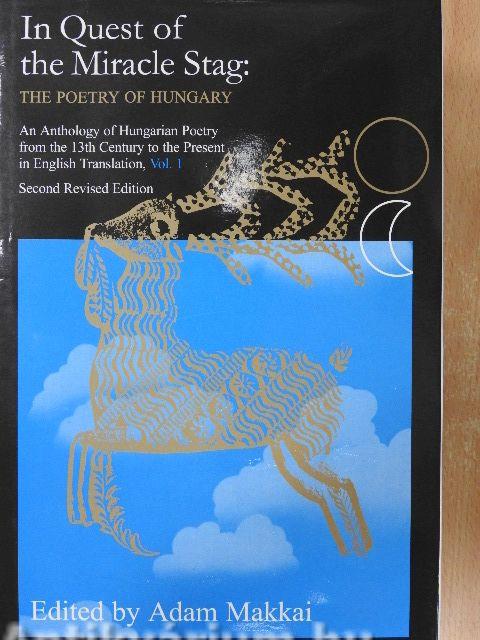
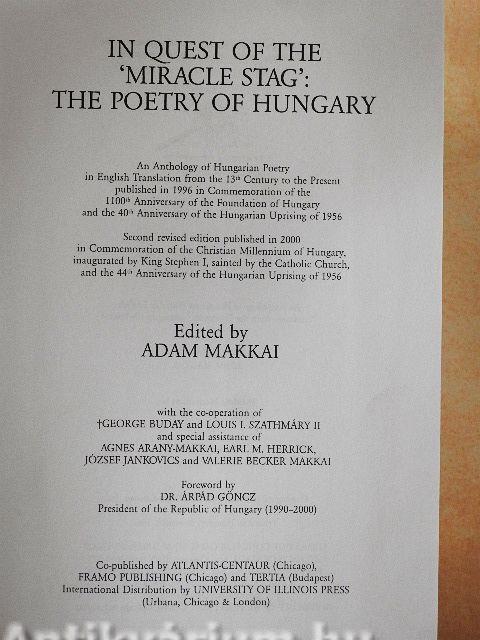
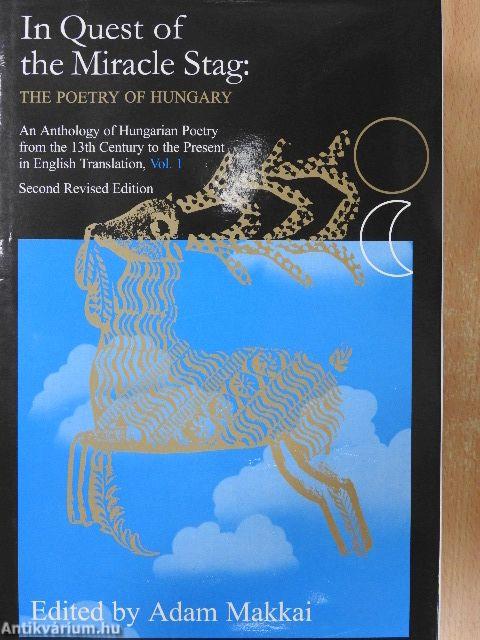
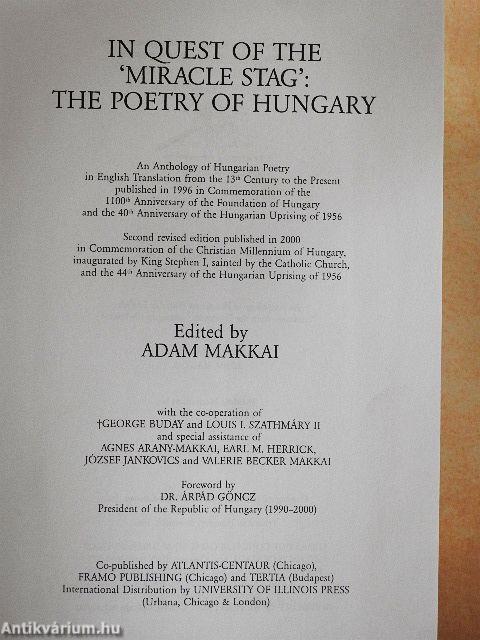
In Quest of the 'Miracle Stag': The Poetry of Hungary
An Anthology of Hungarian Poetry in English Translation form the 13th Century to the Present published in 1996 in Commemoration of the 1100th Anniversary of the Foundation of Hungary and the 40th Anniversary of the Hungarian Uprising of 1956
Chicago-Budapest-Urbana
| Kiadó: | Atlantis-Centaur-Framo Publishing-Tertia-University of Illinois Press |
|---|---|
| Kiadás helye: | Chicago-Budapest-Urbana |
| Kiadás éve: | |
| Kötés típusa: | Vászon |
| Oldalszám: | 1.140 oldal |
| Sorozatcím: | An Anthology of Hungarian Poetry in English Translation |
| Kötetszám: | 1 |
| Nyelv: | Angol |
| Méret: | 23 cm x 16 cm |
| ISBN: | 963-860242-2 |
| Megjegyzés: | 2. kiadás. Fekete-fehér illusztrációkkal. További kapcsolódó személyek a könyvben. Magyar nyelvű előszóval. |
Értesítőt kérek a kiadóról
Értesítőt kérek a sorozatról
A beállítást mentettük,
naponta értesítjük a beérkező friss
kiadványokról
naponta értesítjük a beérkező friss
kiadványokról
A beállítást mentettük,
naponta értesítjük a beérkező friss
kiadványokról
naponta értesítjük a beérkező friss
kiadványokról
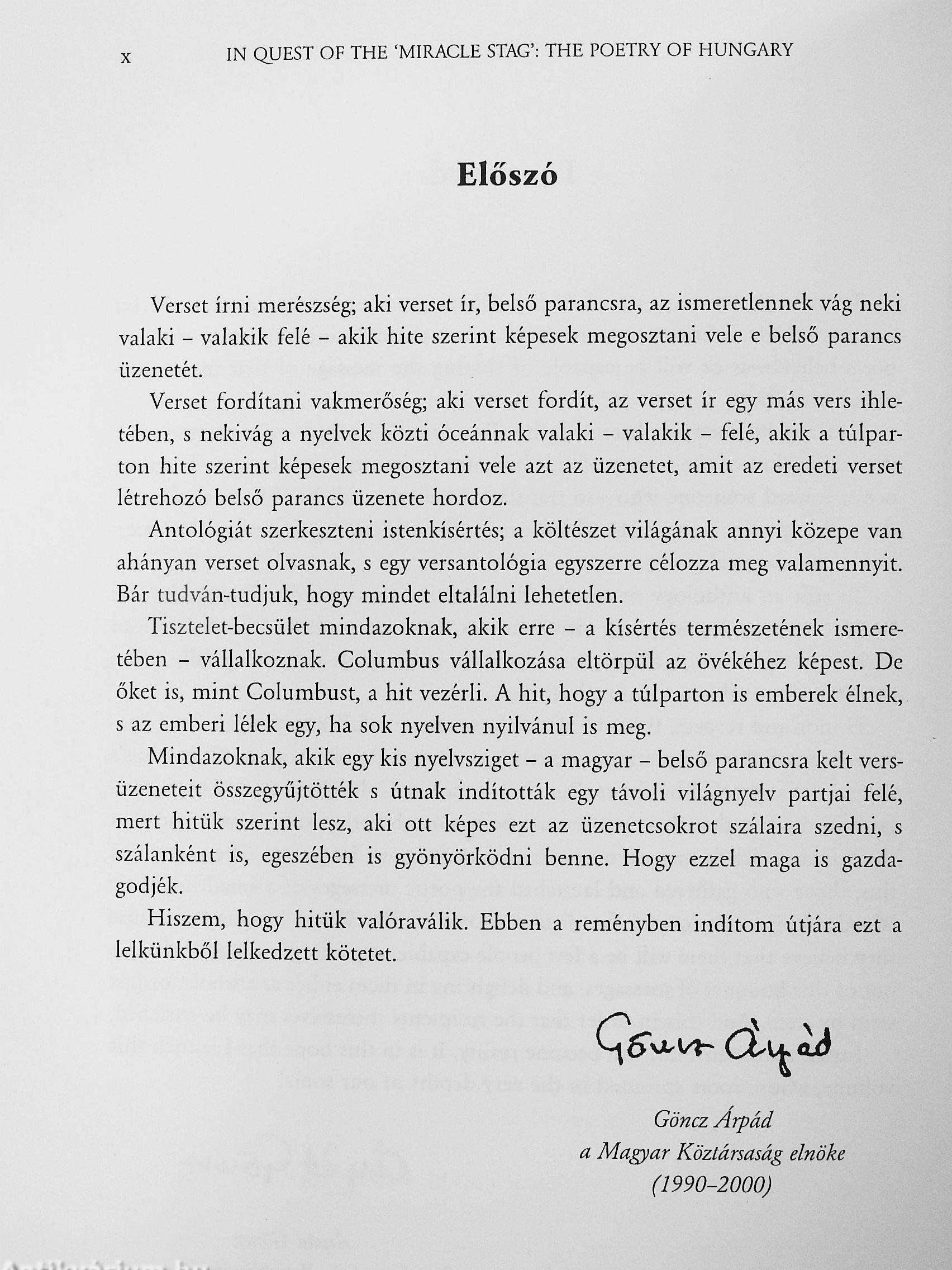
Előszó
Tovább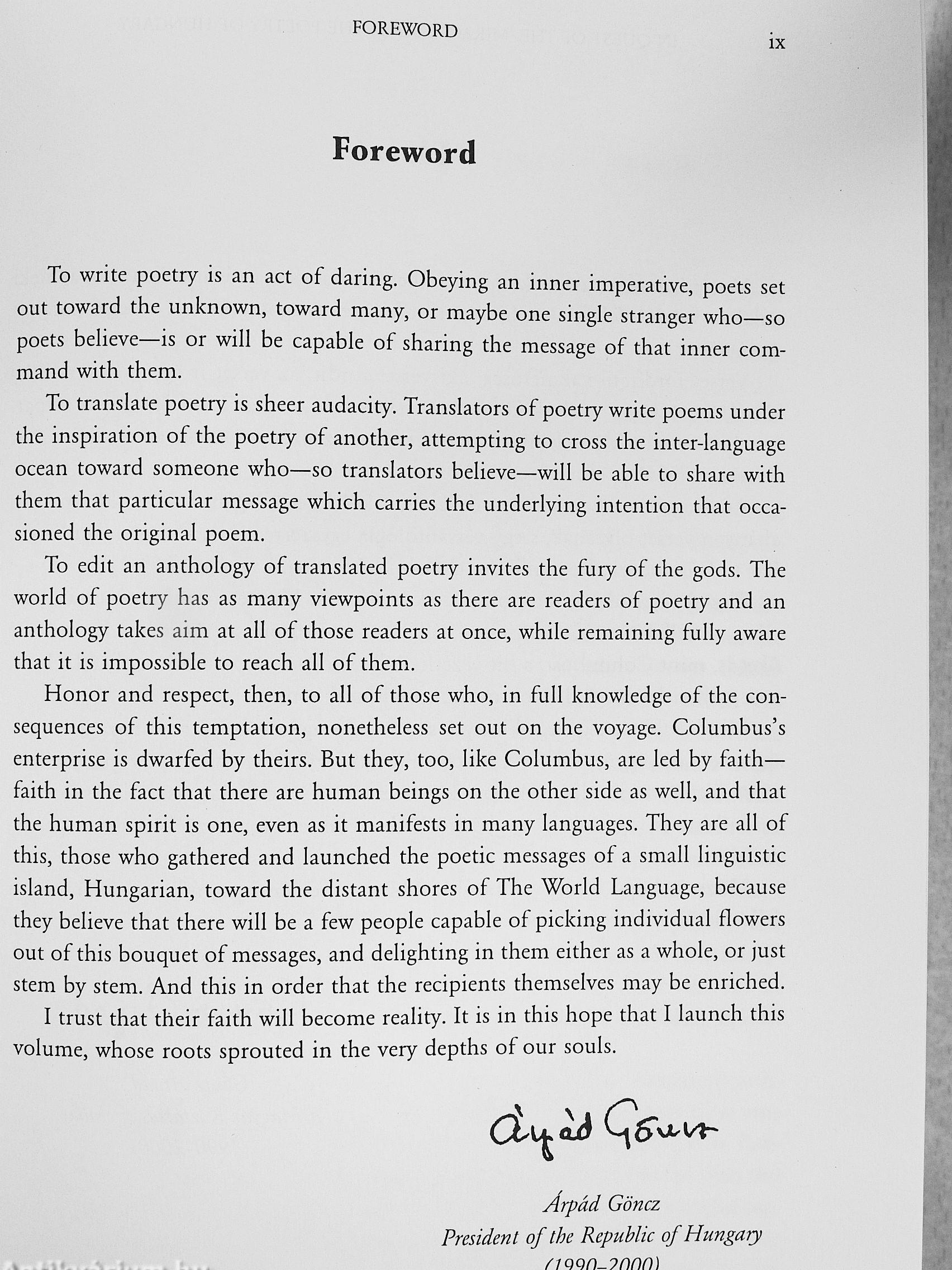
Fülszöveg
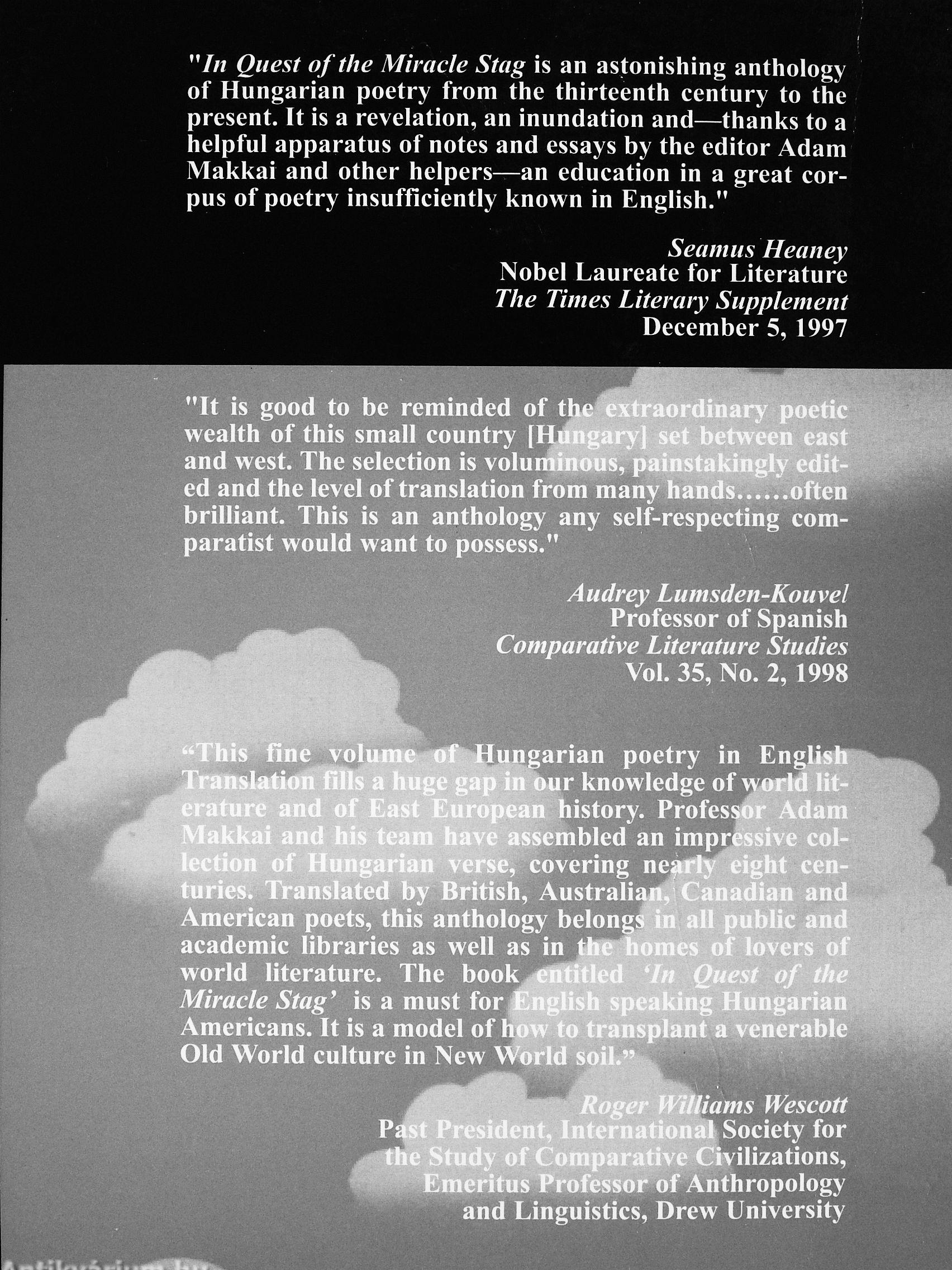
"//I Quest of the Miracle Stag is an astonishing anthology of Hungarian poetry from the thirteenth century to the present. It is a revelation, an inundation and—thanks to a helpful apparatus of notes and essays by the editor Adam Makkai and other helpers—an education in a great corpus of poetry insufficiently known in English."
Seamus Heaney Nobel Laureate for Literature The Times Literary Supplement December 5, 1997
"It is good to be reminded of tpoetic wealth of this small country east and west. The selection is volun^^^, pn^tstra^y edited and the level of translation from many hands often
brilliant. This is an anthology any self-respecting com-paratist would want to possess."
Audrey Lumsden-Kouvei Professor of Spanish Comparative Literature Studies Vol. 35, No. 2,1998
<*This fine volume ||ft||Iui^arian poetry in En^uh ^^pnslfitioii fills a tw^^BM^ur knowledge of ^rla Itt-alkt^ and of EiNitiP^KiBii history. Profes^r Adam Makl^ aed jtepn itH|''ftssembled an imp^tesive... Tovább
Fülszöveg
"//I Quest of the Miracle Stag is an astonishing anthology of Hungarian poetry from the thirteenth century to the present. It is a revelation, an inundation and—thanks to a helpful apparatus of notes and essays by the editor Adam Makkai and other helpers—an education in a great corpus of poetry insufficiently known in English."
Seamus Heaney Nobel Laureate for Literature The Times Literary Supplement December 5, 1997
"It is good to be reminded of tpoetic wealth of this small country east and west. The selection is volun^^^, pn^tstra^y edited and the level of translation from many hands often
brilliant. This is an anthology any self-respecting com-paratist would want to possess."
Audrey Lumsden-Kouvei Professor of Spanish Comparative Literature Studies Vol. 35, No. 2,1998
<*This fine volume ||ft||Iui^arian poetry in En^uh ^^pnslfitioii fills a tw^^BM^ur knowledge of ^rla Itt-alkt^ and of EiNitiP^KiBii history. Profes^r Adam Makl^ aed jtepn itH|''ftssembled an imp^tesive col-ieifton of verse, covering ne^trfy eight cen-
turies7 Translated by British, Australim^;|^nadian and American poets, this anthology belong^P^^ public and academic libraries as well as in of lovers of
world literature. The book^gg^^-of the Miracle Stag' is a must for Hungarian
Americans. It is a model of tflPi[^%aiispiant a venerable Old World culture in New \^rld s<uL."
Wescott
-A^jB^^^^^^^^i've Civilizations, Emeritus Professor of Anthropology and Linguistics, Drew University
¦ I
:' ' i 1
1 . I i , I
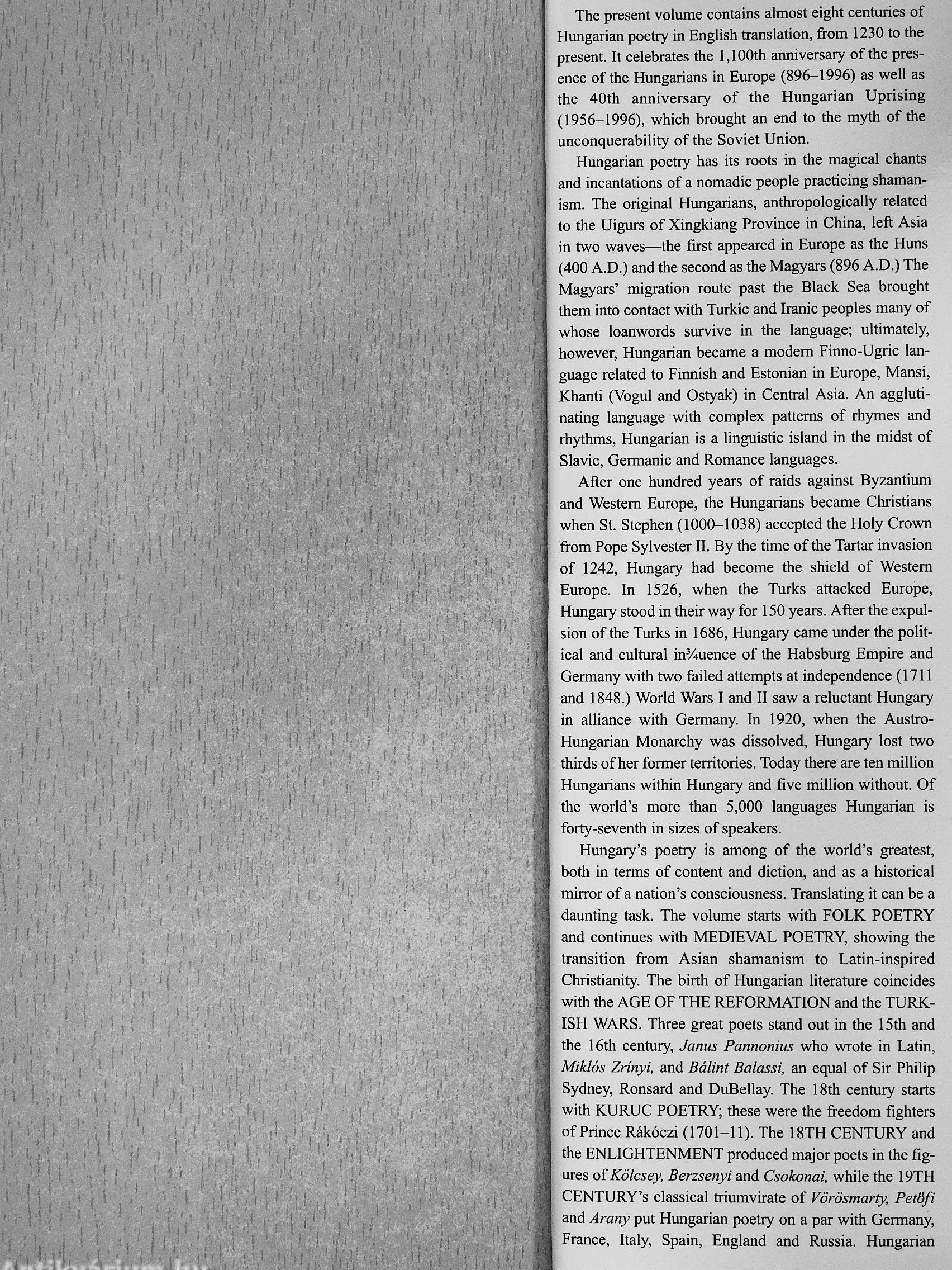
The present volume contains almost eight centuries of Hungarian poetry in English translation, from 1230 to the present. It celebrates the 1,100th anniversary of the presence of the Hungarians in Europe (896-1996) as well as the 40th anniversary of the Hungarian Uprising (1956-1996), which brought an end to the myth of the unconquerability of the Soviet Union.
Hungarian poetry has its roots in the magical chants and incantations of a nomadic people practicing shamanism. The original Hungarians, anthropologically related to the Uigurs of Xingkiang Province in China, left Asia in two waves—the first appeared in Europe as the Huns (400 A.D.) and the second as the Magyars (896 A.D.) The Magyars' migration route past the Black Sea brought them into contact with Turkic and Iranic peoples many of whose loanwords survive in the language; ultimately, however, Hungarian became a modem Finno-Ugric language related to Finnish and Estonian in Europe, Mansi, Khanti (Vogul and Ostyak) in Central Asia. An agglutinating language with complex patterns of rhymes and rhythms, Hungarian is a linguistic island in the midst of Slavic, Germanic and Romance languages.
After one hundred years of raids against Byzantium and Western Europe, the Hungarians became Christians when St. Stephen (1000-1038) accepted the Holy Crown fi-om Pope Sylvester II. By the time of the Tartar invasion of 1242, Hungary had become the shield of Western Europe. In 1526, when the Turks attacked Europe, Hungary stood in their way for 150 years. After the expulsion of the Turks in 1686, Hungary came under the poht-ical and cultural iny4uence of the Habsburg Empire and Germany with two failed attempts at independence (1711 and 1848.) World Wars I and II saw a reluctant Hungary in alliance with Germany. In 1920, when the Austro-Hungarian Monarchy was dissolved, Hungary lost two thirds of her former territories. Today there are ten million Hungarians within Hungary and five million without. Of the worid's more than 5,000 languages Hungarian is forty-seventh in sizes of speakers.
Hungary's poetry is among of the worid's greatest, both in terms of content and diction, and as a historical mirror of a nation's consciousness. Translating it can be a daunting task. The volume starts with FOLK POETRY and continues with MEDIEVAL POETRY, showing the transition from Asian shamanism to Latin-inspired Christianity. The birth of Hungarian literature coincides with the AGE OF THE REFORMATION and the TURKISH WARS. Three great poets stand out in the 15th and the 16th century, Janus Pannonius who wrote in Latin, Miklós Zrínyi, and Bálint Balassi, an equal of Sir Philip Sydney, Ronsard and DuBellay The 18th century starts with KURUC POETRY; these were the freedom fighters of Prince Rákóczi (1701-11). The 18TH CENTURY and the ENLIGHTENMENT produced major poets in the figures of Kölcsey, Berzsenyi and Csokonai, while the 19TH CENTURY'S classical triumvirate of Vörösmarty, Petbfi and Arany put Hungarian poetry on a par with Germany, France, Italy, Spain, England and Russia. Hungarian
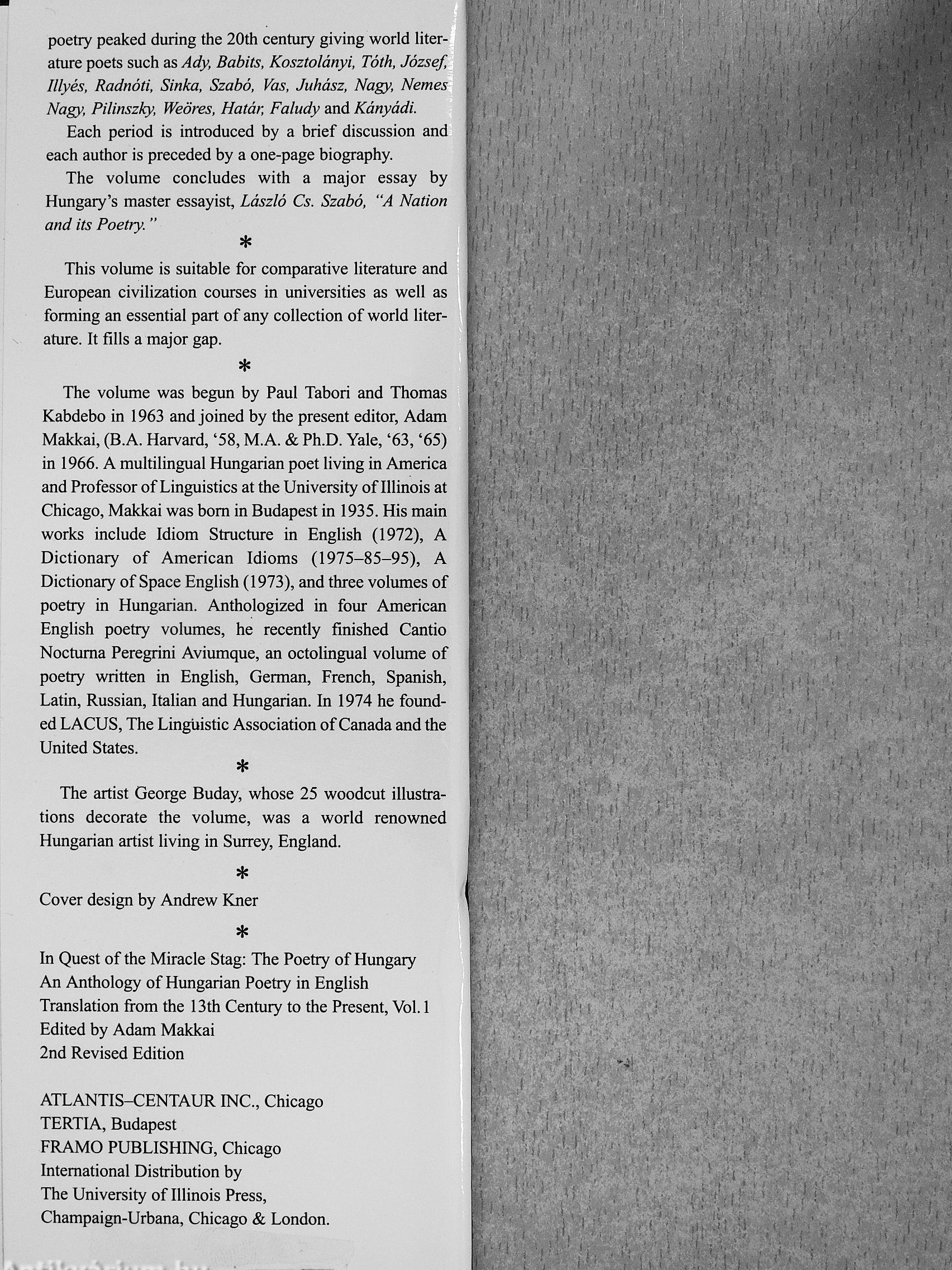
poetry peaked during the 20th century giving world literature poets such as Ady, Babits, Kosztolányi, Tóth, József, Illyés, Radnóti, Sinka, Szabó, Vas, Juhász, Nagy, Nemes Nagy, Pilinszky, Weöres, Határ, Faludy and Kányádi.
Each period is introduced by a brief discussion and each author is preceded by a one-page biography.
The volume concludes with a major essay by Hungary's master essayist, László Cs. Szabó, "A Nation and its Poetry."
*
This volume is suitable for comparative literature and European civilization courses in universities as well as forming an essential part of any collection of world literature. It fills a major gap.
*
The volume was begun by Paul Tabori and Thomas Kabdebo in 1963 and joined by the present editor, Adam Makkai, (B.A. Harvard, '58, M.A. & Ph.D. Yale, '63, '65) in 1966. A multilingual Hungarian poet living in America and Professor of Linguistics at the University of Illinois at Chicago, Makkai was bom in Budapest in 1935. His main works include Idiom Structure in English (1972), A Dictionary of American Idioms (1975-85-95), A Dictionary of Space English (1973), and three volumes of poetry in Hungarian. Anthologized in four American English poetry volumes, he recently finished Cantio Noctuma Peregrini Aviumque, an octolingual volume of poetry vmtten in English, German, French, Spanish, Latin, Russian, Italian and Hungarian. In 1974 he fotmd-ed LACUS, The Linguistic Association of Canada and the United States.
*
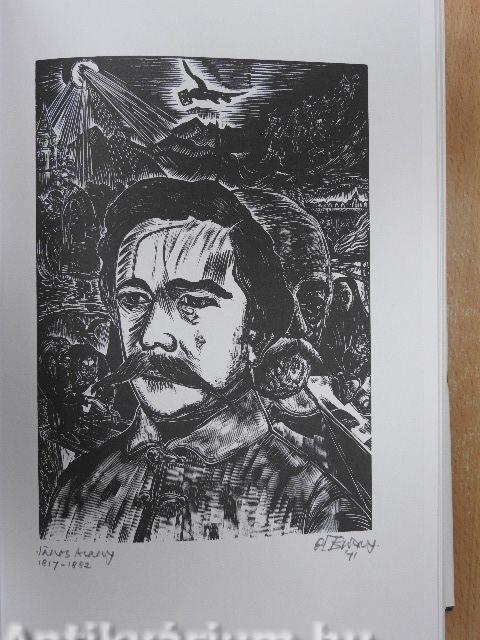
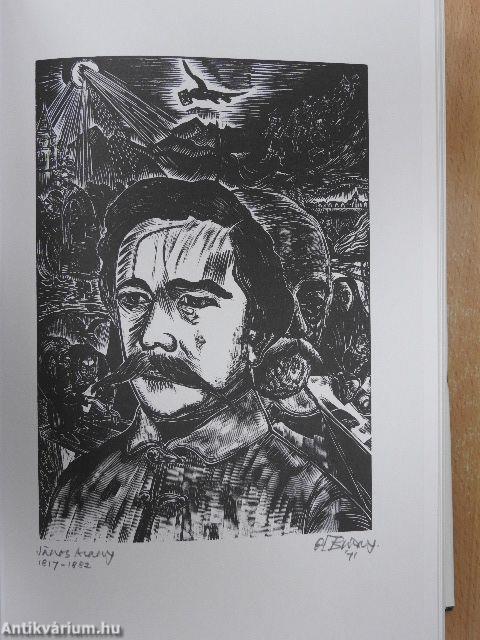
The artist George Buday, whose 25 woodcut illustrations decorate the volume, was a world renowned
Hungarian artist living in Surrey, England.
*
Cover design by Andrew Kner *
In Quest of the Miracle Stag: The Poetry of Hungary An Anthology of Hungarian Poetry in English Translation from the 13th Century to the Present, Vol. 1 Edited by Adam Makkai 2nd Revised Edition
ATLANTIS-CENTAUR INC., Chicago TERTIA, Budapest FRAMO PUBLISHING, Chicago International Distribution by The University of Illinois Press, Champaign-Urbana, Chicago & London.
m^mmmm'^-mm tel
^ !. V-111 vf i i'^V; -vl''^-
•• ¦ ''i^ n-rO-i!
i i
m
V. )
¦ : ¦ I
¦ ii I -i ¦ li'
,5 •
: : .Y* I
¦ i , I -ri'i'V-'i U-a.^'f-'
Vissza
Témakörök
- Szépirodalom > Versek, eposzok > Versantológia
- Idegennyelv > Idegennyelvű könyvek > Angol > Szépirodalom > Versek, eposzok > Versantológia
- Idegennyelv > Idegennyelvű könyvek > Angol > Irodalomtörténet
- Irodalomtörténet > Irodalomelmélet > Műfordítás
- Szépirodalom > Versek, eposzok > A szerző származása szerint > Európa > Magyarország
Megvásárolható példányok
Állapotfotók
Állapot:
Jó
9.980 ,-Ft
50
pont kapható
Kosárba
 Folytatás Microsoft-tal