Fülszöveg
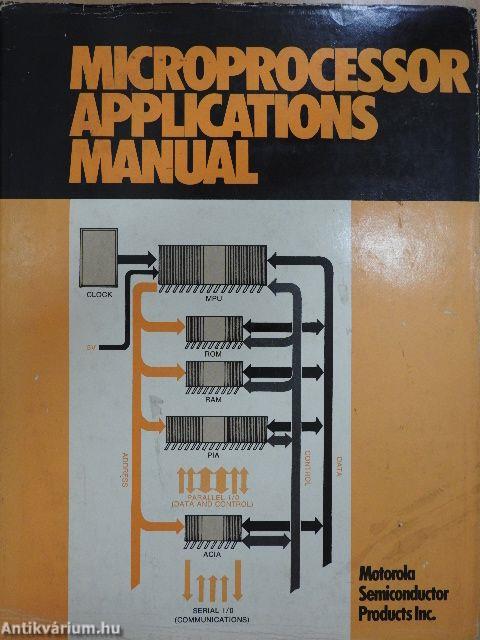
MICROPROCESSOR
APPLICATIONS
MANUAL
By Motorola Semiconductor Products Inc.
General purpose Microprocessing Units (l\/IPUs), which evolved from the minicomputer, are an exciting new development for today's electronics professionals. That's because LSI technology can now provide the logic and memory capabilities needed to perform an increasing number of computer functions at low cost. Programmable LSI circuits combine the flexibility of custom design with the cost advantages of readily available standard products. Designs can be modified and features added simply by changing a program in the memory. And the user saves money by replacing many logic packages with a few LSI chips. What's more, for the first time, it is now economically feasible to enter the general consumer market with such sophisticated products as computerized video games and microprocessor controlled automotive systems.
This authoritative volume provides detailed applications information for a representative...
Tovább
Fülszöveg
MICROPROCESSOR
APPLICATIONS
MANUAL
By Motorola Semiconductor Products Inc.
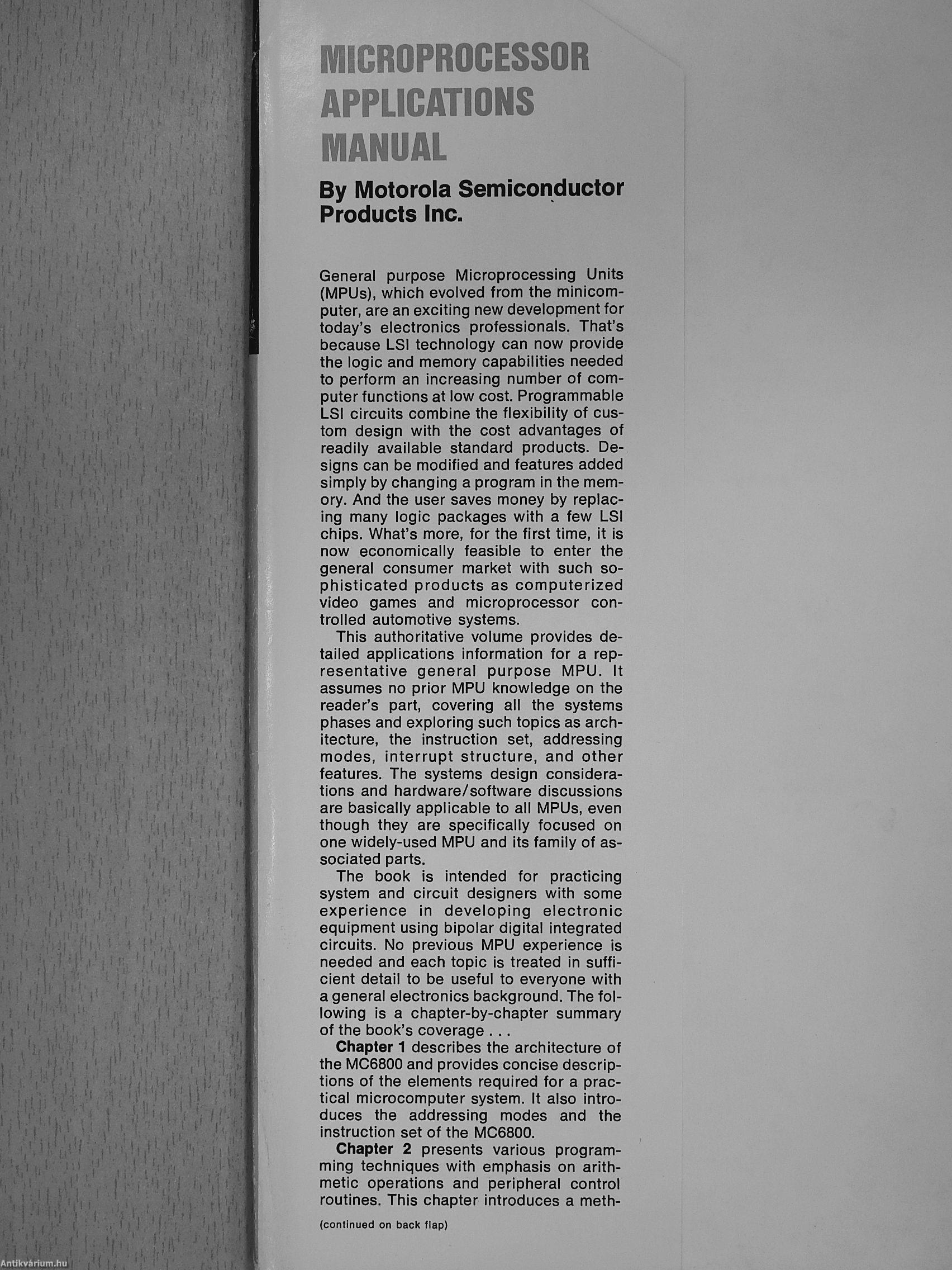
General purpose Microprocessing Units (l\/IPUs), which evolved from the minicomputer, are an exciting new development for today's electronics professionals. That's because LSI technology can now provide the logic and memory capabilities needed to perform an increasing number of computer functions at low cost. Programmable LSI circuits combine the flexibility of custom design with the cost advantages of readily available standard products. Designs can be modified and features added simply by changing a program in the memory. And the user saves money by replacing many logic packages with a few LSI chips. What's more, for the first time, it is now economically feasible to enter the general consumer market with such sophisticated products as computerized video games and microprocessor controlled automotive systems.
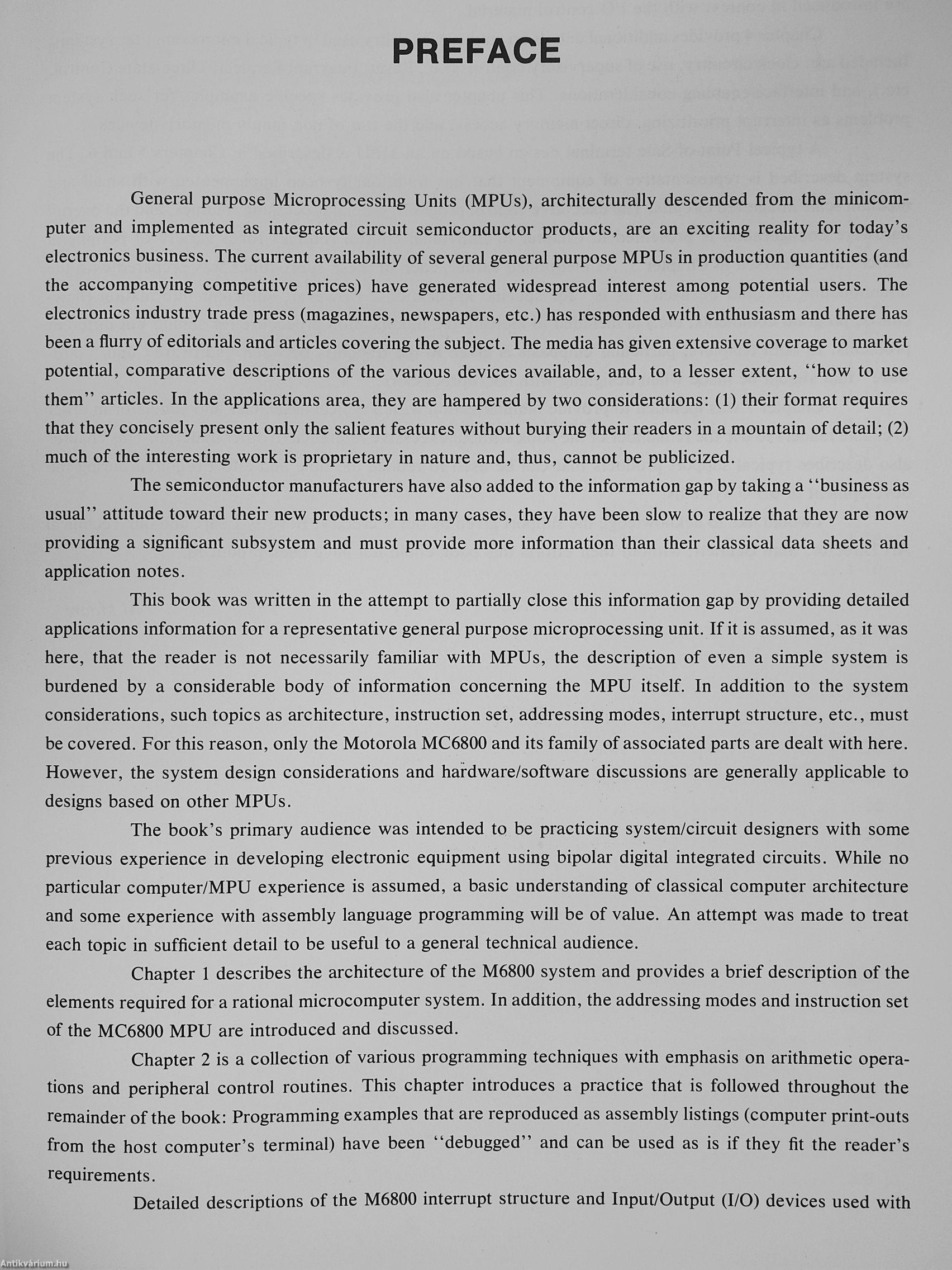
This authoritative volume provides detailed applications information for a representative general purpose MPU. It assumes no prior MPU knowledge on the reader's part, covering all the systems phases and exploring such topics as architecture, the instruction set, addressing modes, interrupt structure, and other features. The systems design considerations and hardware/software discussions are basically applicable to all MPUs, even though they are specifically focused on one widely-used MPU and its family of associated parts.
The book is intended for practicing system and circuit designers with some experience in developing electronic equipment using bipolar digital integrated circuits. No previous MPU experience is needed and each topic is treated in sufficient detail to be useful to everyone with a general electronics background. The following is a chapter-by-chapter summary of the book's coverage
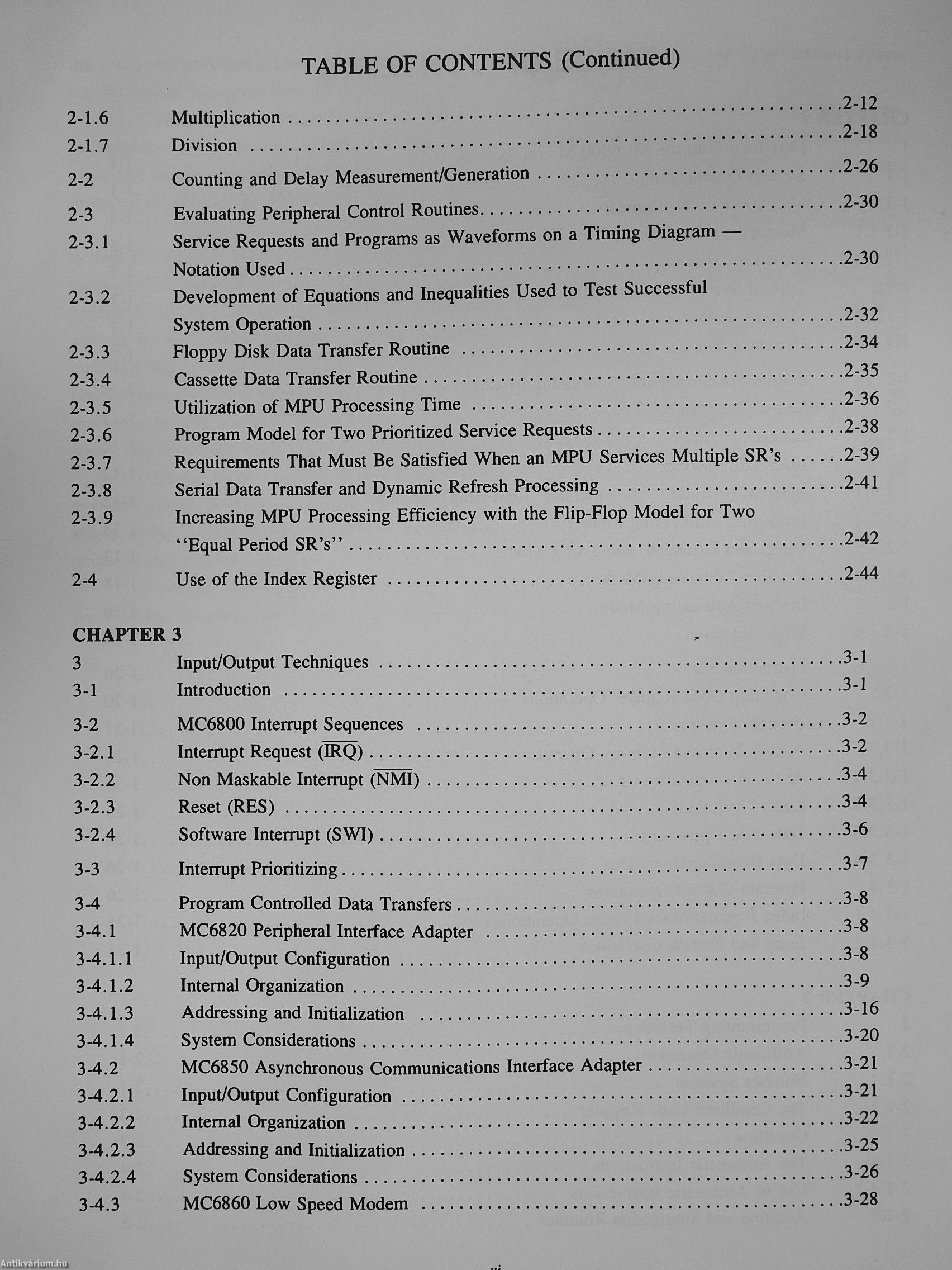
Chapter 1 describes the architecture of the MC6800 and provides concise descriptions of the elements required for a practical microcomputer system, it also introduces the addressing modes and the instruction set of the MC6800.
Chapter 2 presents various programming techniques with emphasis on arithmetic operations and peripheral control routines. This chapter introduces a meth-
(CDntlnued on back flap)
(continued (rom front flap)
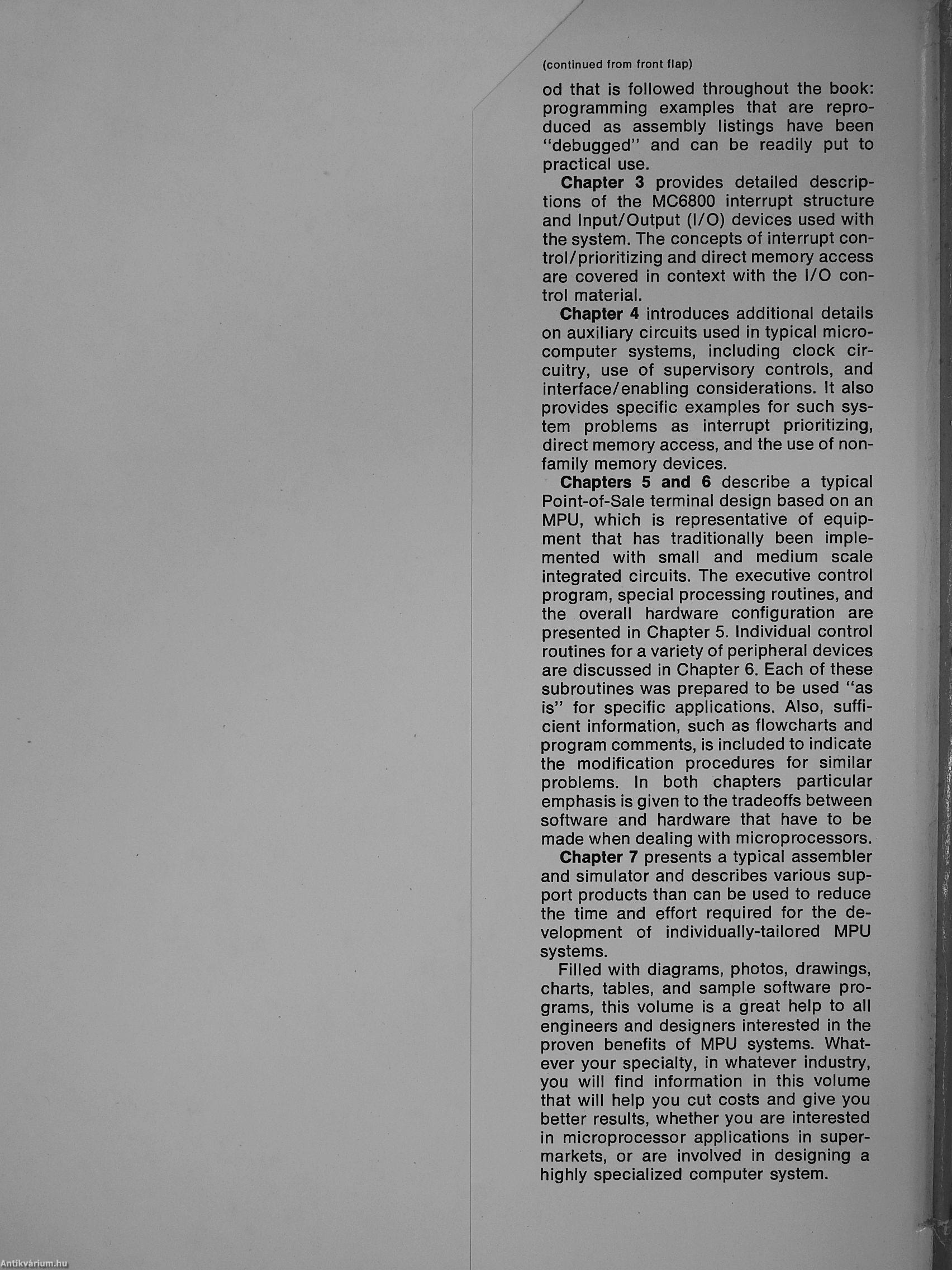
od that is followed throughout the book: programming examples that are reproduced as assembly listings have been "debugged" and can be readily put to practical use.
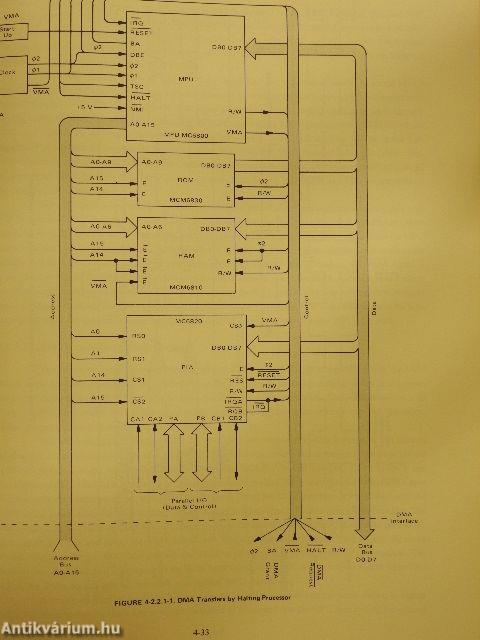
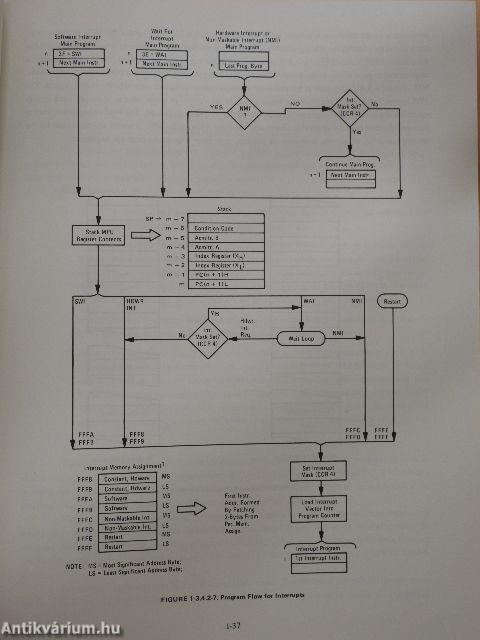
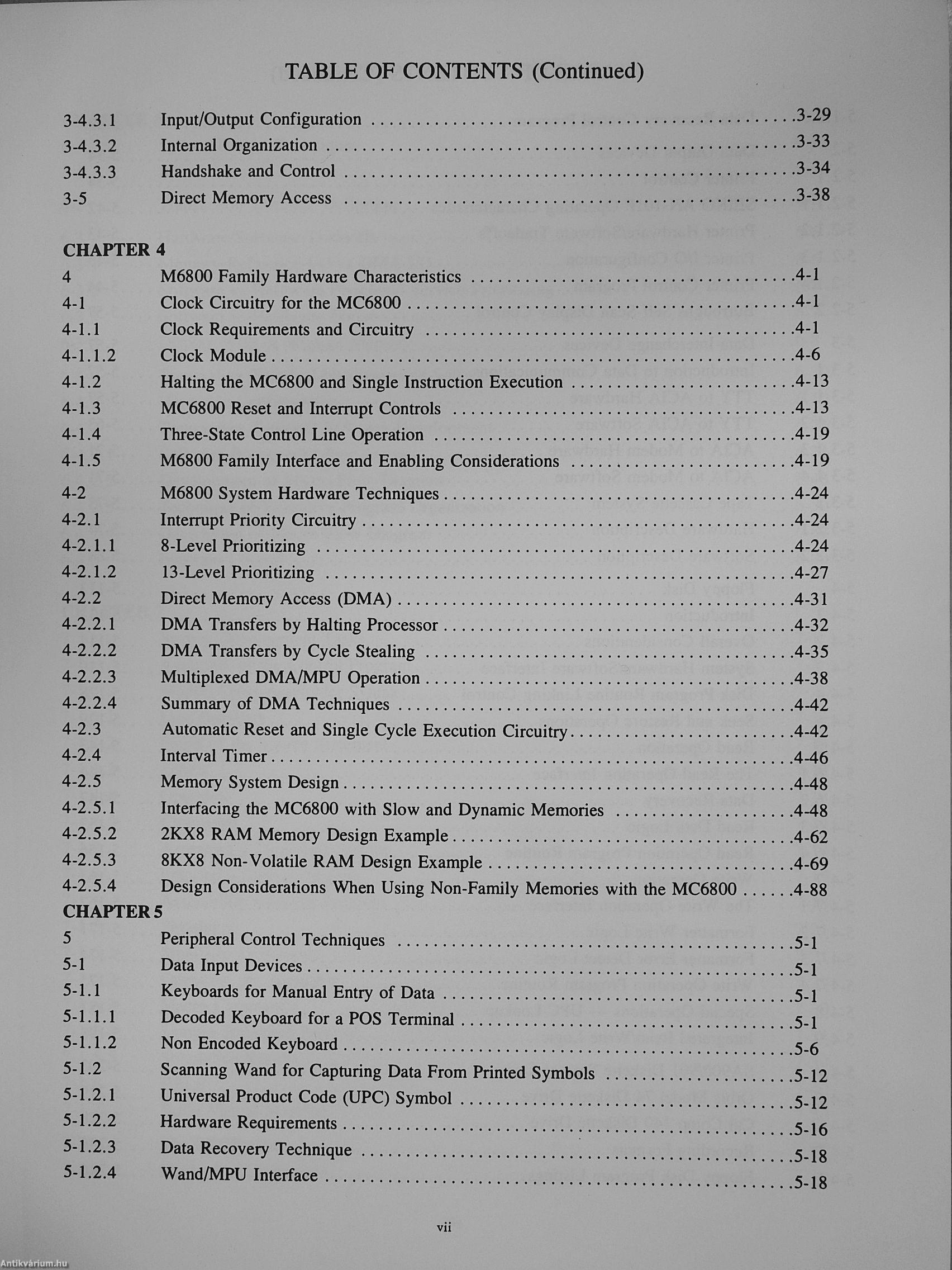
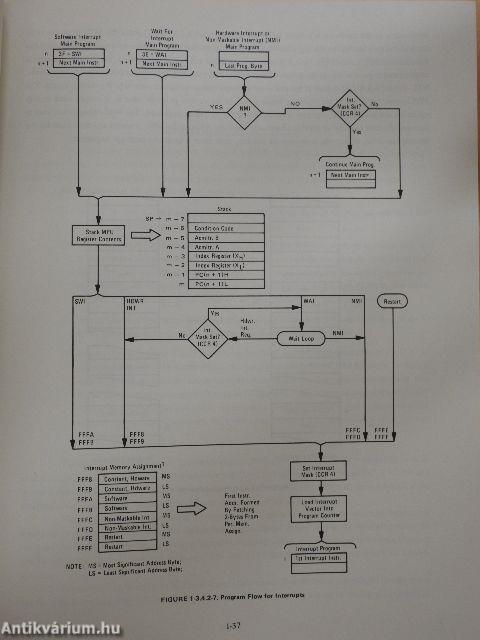
Chapter 3 provides detailed descriptions of the MC6800 interrupt structure and Input/Output (I/O) devices used with the system. The concepts of interrupt control/prioritizing and direct memory access are covered in context with the I/O control material.
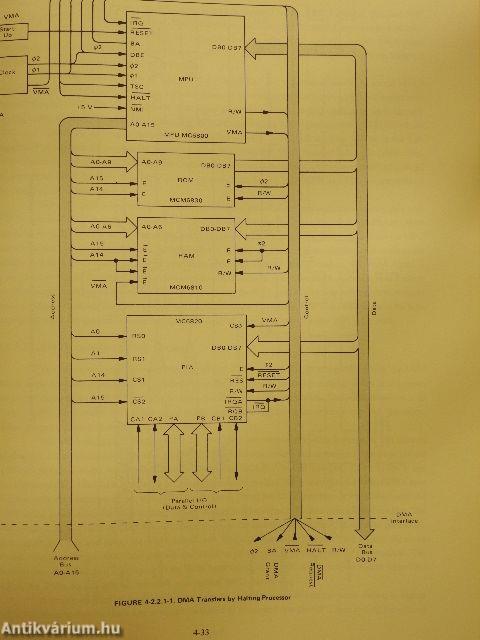
Chapter 4 introduces additional details on auxiliary circuits used in typical microcomputer systems, including clock circuitry, use of supervisory controls, and interface/enabling considerations. It also provides specific examples for such system problems as interrupt prioritizing, direct memory access, and the use of non-family memory devices.
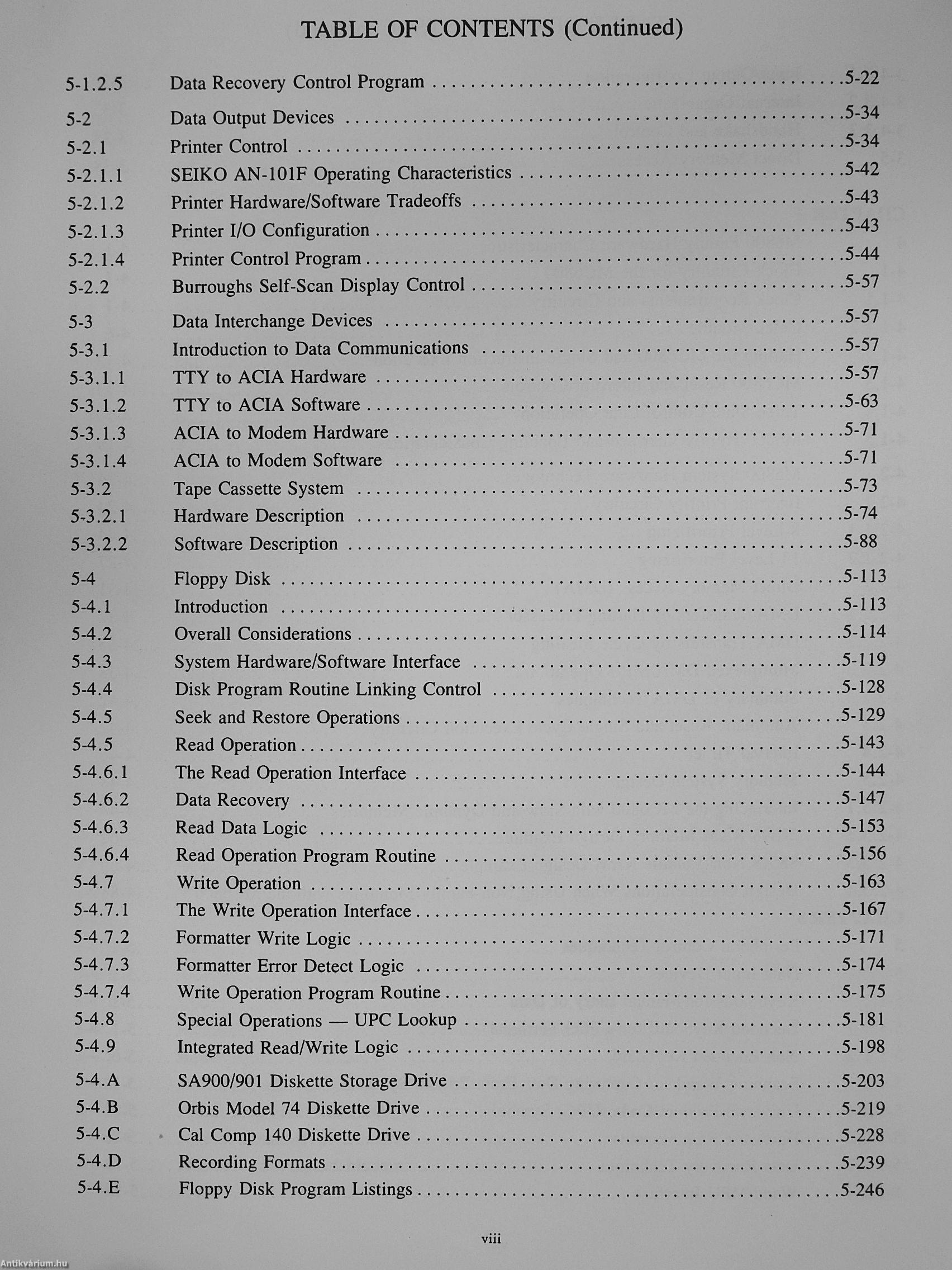
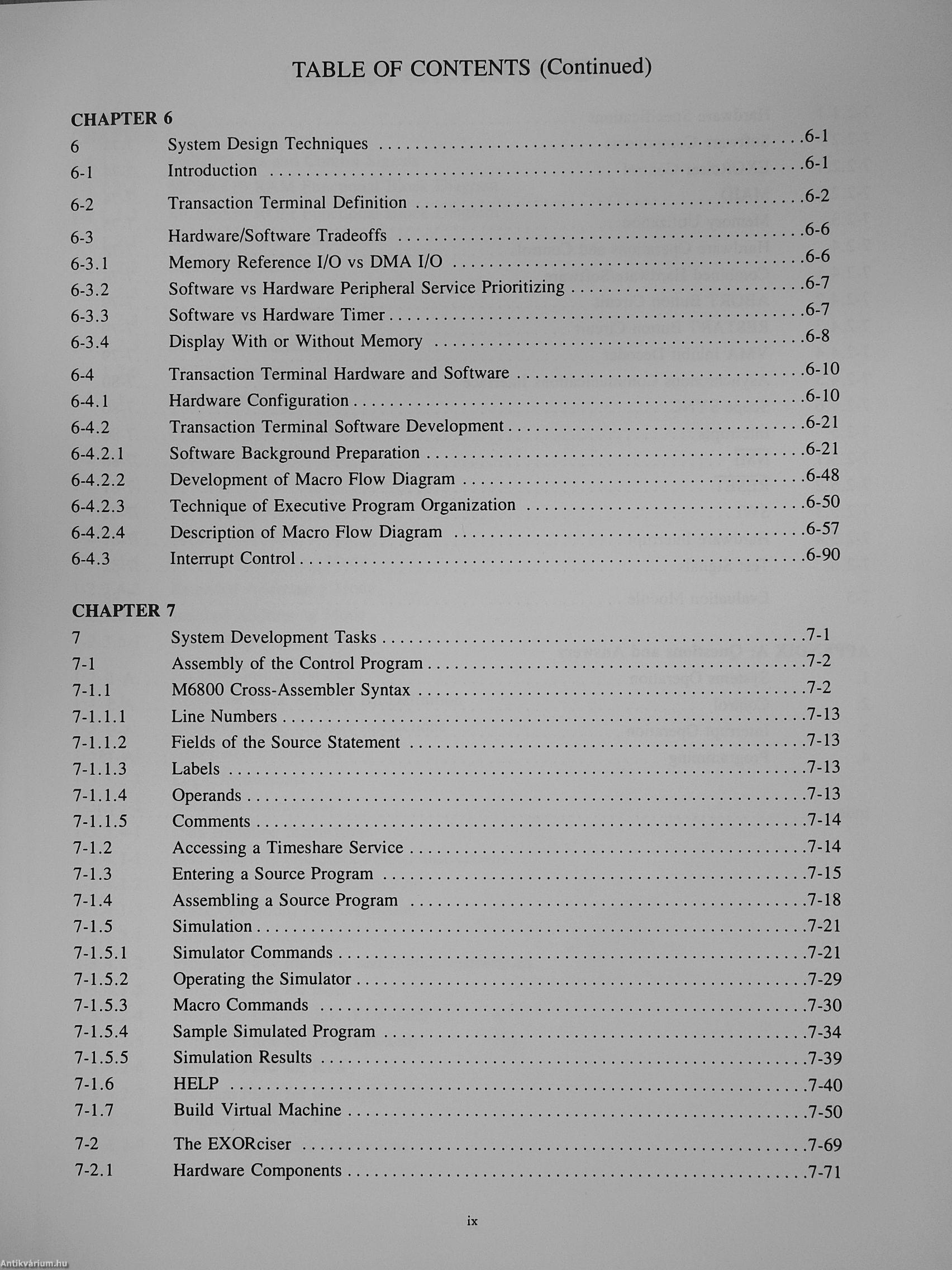
Chapters 5 and 6 describe a typical Point-of-Sale terminal design based on an MRU, which is representative of equipment that has traditionally been implemented with small and medium scale integrated circuits. The executive control program, special processing routines, and the overall hardware configuration are presented in Chapter 5. Individual control routines for a variety of peripheral devices are discussed in Chapter 6. Each of these subroutines was prepared to be used "as is" for specific applications. Also, sufficient information, such as flowcharts and program comments, is included to indicate the modification procedures for similar problems. In both chapters particular emphasis is given to the tradeoffs between software and hardware that have to be made when dealing with microprocessors.
Chapter 7 presents a typical assembler and simulator and describes various support products than can be used to reduce the time and effort required for the development of individually-tailored MRU systems.
Filled with diagrams, photos, drawings, charts, tables, and sample software programs, this volume is a great help to all engineers and designers interested in the proven benefits of MRU systems. Whatever your specialty, in whatever industry, you will find information in this volume that will help you cut costs and give you better results, whether you are interested in microprocessor applications in supermarkets, or are involved in designing a highly specialized computer system.
Vissza 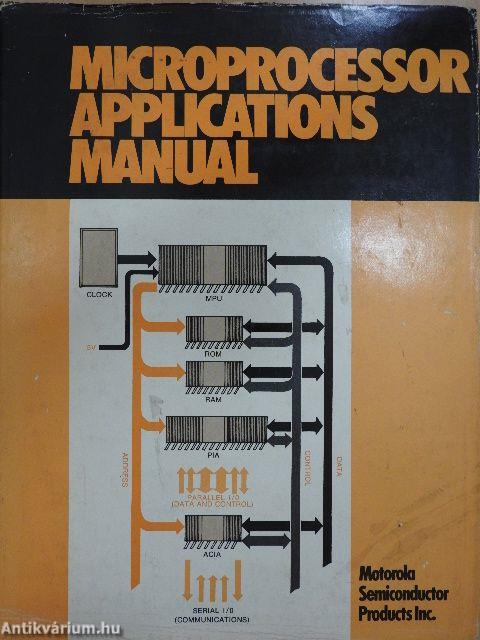


 Folytatás Microsoft-tal