
1.123.092
kiadvánnyal nyújtjuk Magyarország legnagyobb antikvár könyv-kínálatát

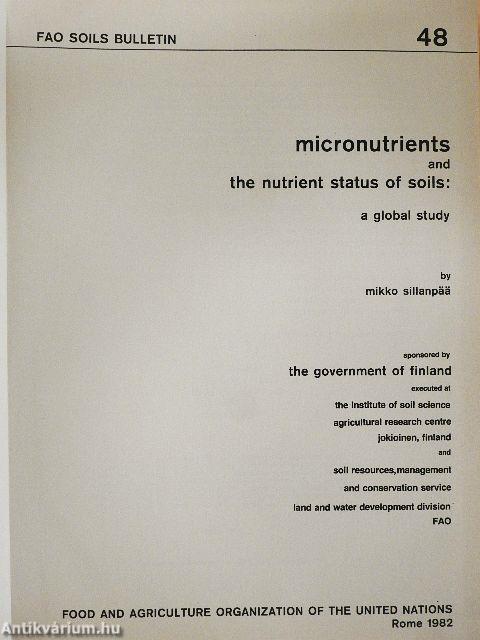
Micronutrients and the nutrient status of soils: a global study
Róma
| Kiadó: | Food and Agriculture Organization of the United Nations |
|---|---|
| Kiadás helye: | Róma |
| Kiadás éve: | |
| Kötés típusa: | Varrott keménykötés |
| Oldalszám: | 444 oldal |
| Sorozatcím: | FAO Soils Bulletin |
| Kötetszám: | 48 |
| Nyelv: | Angol |
| Méret: | 28 cm x 20 cm |
| ISBN: | 92-5-101193-1 |
| Megjegyzés: | Fekete-fehér ábrákkal. |
Értesítőt kérek a kiadóról
Értesítőt kérek a sorozatról
A beállítást mentettük,
naponta értesítjük a beérkező friss
kiadványokról
naponta értesítjük a beérkező friss
kiadványokról
A beállítást mentettük,
naponta értesítjük a beérkező friss
kiadványokról
naponta értesítjük a beérkező friss
kiadványokról
Előszó
Ill
Foreword
During the last two decades, the increasing use of mineral fertilizers and organic manures of different types has led to impressive yield increases in developing countries. Major... Tovább
Előszó
Ill
Foreword
During the last two decades, the increasing use of mineral fertilizers and organic manures of different types has led to impressive yield increases in developing countries. Major emphasis was given to the supply of the main macronutrients, nitrogen, phosphate and potash.
For a long time it was felt that under the existing farming systems and fertilizing practices the level of micronutrients was adequate and that the problem of micronutrient deficiencies was not a serious one. However, indications from developing countries show that micronutrient problems are becoming more and more frequent.
In the early 1970s the Government of Finland, through its Institute of Soil Science and FAO embarked on a system of investigation of microelement deficiencies in developing countries.
In 1974, the project "Trace Element Study, TF/129/FIN" started under the FAO/ Finland Cooperative Programme, with the financial support of the Government of Finland, and with the cooperation of the staff of the Institute of Soil Science, under the direction of Prof M. Sillanpaa. The facilities of the Institute were made available to the project. This programme involved a worldwide study on micronutrients, in cooperation with 30 countries.
The study, which is presented in this document, shows that the undertaking was very timely. It appears that micronutrients are becoming deficient in developing countries and that remedial measuring will need to be taken to ensure full soil and plant productivity. The study also gives guidance for the investigation of micronutrient deficiencies, which should be dealt with at the country level.
FAO expresses its appreciation to the Government of Finland for its generous support of the study and for its excellent cooperation throughout.
F.W. Hauck Chief, Soil Resources, Management and Conservation Service Vissza
Tartalom
CONTENTS
page
PREFACE
PART I '
PARTI SOIL AND PLANT DATA, METHODOLOGY AND INTERPRETATION 3
1 MATERIALS AND METHODS ^
1.1 Collection of original plant and soil samples ^
1.2 Indicator plants ^
1.2.1 General ^
1.2.2 Sampling time ^
1.2.3 Contamination ^
1.2.4 Plant varieties °
1.2.5 Need for better grounds for comparing plant data 6
1.2.6 Growing new indicator plants in pots ^
1.3 Analytical methods ^
1.3.1 Methods of soil analyses 9
1.3.2 Methods of plant analyses H
1.3.3 Statistical methods
1.4 Expression of analytical data
1.4.1 Soils
1.4.2 Plants 14
1.4.3 Regression graphs
2 RESULTS AND DISCUSSION 17
2.1 General properties of soils and their mutual relations 17
2.2 Macronutrients 21
2.2.1 General aspects 21
2.2.2 Comparison of the two original indicator plants 21
2.2.3 Comparison of macronutrient status in different countries 21
2.2.4 Macronutrient contents of plants and soils in relation to four soil characteristics 28
2.3 Micronutrients 33
2.3.1 Plant analysis versus soil analysis 33
2.3.2 Molybdenum 35
2.3.2.1 General aspects 35
2.3.2.2 Soil factors affecting the molybdenum contents of plants and soils 36
2.3.3 Boron 46
2.3.3.1 General aspects 46
2.3.3.2 Soil factors affecting the boron contents of plants and soils 48
2.3.4 Copper 54
2.3.4.1 General aspects 54
2.3.4.2 Soils factors affecting the copper contents of plants and soils 55
2.3.5 Iron 61
2.3.5.1 General aspects 61
2.3.5.2 Soil factors affecting the iron contents of plants and soils 61
2.3.6 Manganese 64
2.3.6.1 General aspects 64
2.3.6.2 Soil factors affecting the manganese contents of plants and soils 66
2.3.7 Zinc 75
2.3.7.1 General aspects 75
2.3.7.2 Soil factors affecting the zinc contents of plants and soils 75
VI
page
2.4 Mutual relations between micronutrients 83
2.5 Micronutrient contents of plants and soils in relation to yields with special reference to the "concentration-dilution" phenomenon 86
2.6 Suitability of plant and soil analyses for large scale operations 90
2.7 Estimation of critical micronutrient limits 90
2.8 Plant and soil micronutrieents and other soil data in relation to FAO/Unesco soil units 96
3 SUMMARY FOR PART I 97
PART II 101
PART II NUTRIENT STATUS BY COUNTRIES 103
4 INTRODUCTION 103
5 EUROPE AND OCEANIA 105
5.1 Belgium 105
5.2 Finland 117
5.3 Hungary 128
5.4 Italy 139
5.5 Malta 150
5.6 New Zealand 158
6 LATIN AMERICA 169
6.1 Argentina 169
6.2 Brazil 180
6.3 Ecuador 190
6.4 Mexico 194
6.5 Peru 207
7 FAR EAST 219
7.1 India 219
7.2 Korea, Republic of 232
7.3 Nepal 242
7.4 Pakistan 251
7.5 Philippines 262
7.6 Sri Lanka 271
7.7 Thailand 280
8 NEAR EAST 289
8.1 Egypt 289
8.2 Iraq 300
8.3 Lebanon 313
8.4 Syria 322
8.5 Turkey 332
9 AFRICA 343
9.1 Ethiopia 343
9.2 Ghana 355
9.3 Malawi 363
9.4 Nigeria 372
9.5 Sierra Leone 383
9.6 Tanzania 392
9.7 Zambia 401
'V ' ''i i'- Il • -v . . •</ ¦;:<¦ .!i 'i
I
'I.:'!
' •!']¦' '' . Ii
' ' 1 I ' 1 I 1 i ,l' , il ' ' ' ' I- ' 1 ¦ ¦ 1
: ¦¦ '"'I; ¦' '/'!•, I ' 'i 'l' ¦
VII
page 411
417
10 SUMMARY FOR PART II
REFERENCES
APPENDIXES
1 Instructions for taking plant and soil samples
2 National mean values of basic analytical data on original wheat plants and respective soils
3 National mean values of basic analytical data on original maize plants and respective soils
4 National mean values of basic analytical data on pot-grown wheat plants and respective soils
5 Indicative data on fertilizer application to the original indicator crops
6 Average soil properties and macronutrient contents of soils classified by FAO/Unesco soil units .
7 Average micronutrient contents of soils and respective pot-grown wheats for FAO/Unesco soil units 442
421
422 428 434
440
441
Témakörök
- Idegennyelv > Idegennyelvű könyvek > Angol > Egyéb
- Idegennyelv > Idegennyelvű könyvek > Angol > Természettudományok > Kémia
- Idegennyelv > Idegennyelvű könyvek > Angol > Természettudományok > Egyéb
- Természettudomány > Kémia > Idegennyelvű
- Természettudomány > Kémia > Társtudományok > Egyéb
- Mezőgazdaság > Növényvédelem > Talajerőgazdálkodás
- Természettudomány > Növényvilág > Növényvédelem > Talajerőgazdálkodás
- Természettudomány > Általános természettudomány > Idegennyelvű > Angol
Mikko Sillanpää
Mikko Sillanpää műveinek az Antikvarium.hu-n kapható vagy előjegyezhető listáját itt tekintheti meg: Mikko Sillanpää könyvek, művekMegvásárolható példányok
Állapotfotók
Szép állapotú példány.
Állapot:
Jó
16.000 ,-Ft
80
pont kapható
Kosárba
 Folytatás Microsoft-tal