
1.155.932
kiadvánnyal nyújtjuk Magyarország legnagyobb antikvár könyv-kínálatát

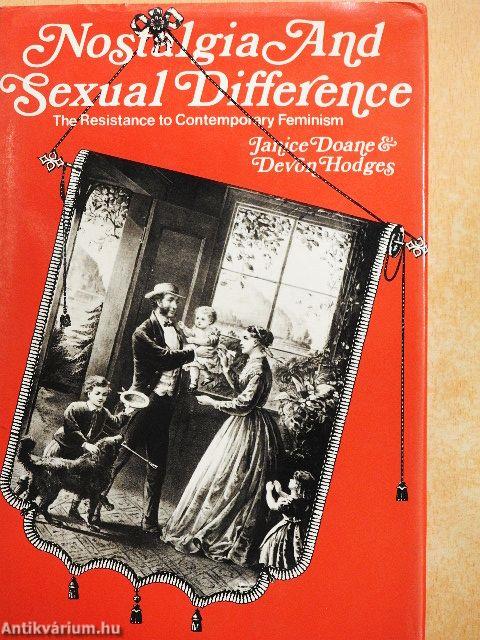
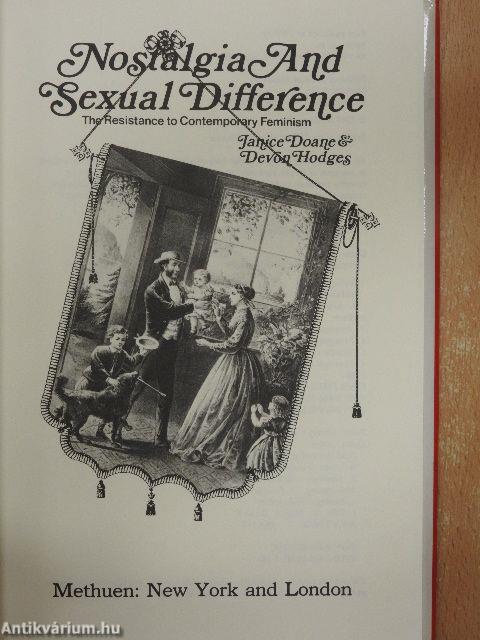
Nostalgia And Sexual Difference
The Resistance to Contemporary Feminism
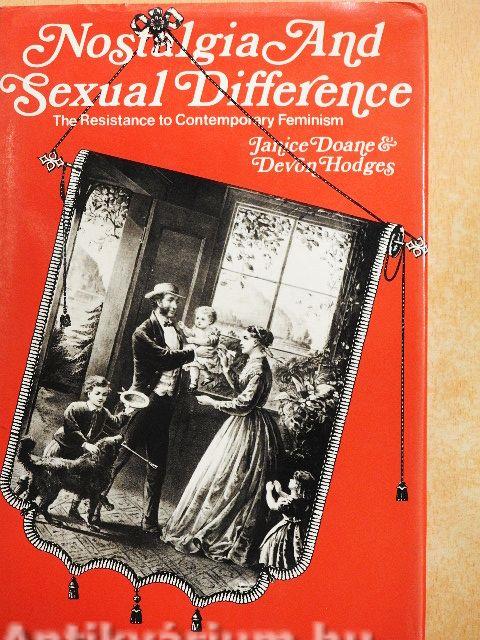
London
| Kiadó: | Methuen & Co. Ltd. |
|---|---|
| Kiadás helye: | London |
| Kiadás éve: | |
| Kötés típusa: | Vászon |
| Oldalszám: | 169 oldal |
| Sorozatcím: | |
| Kötetszám: | |
| Nyelv: | Angol |
| Méret: | 24 cm x 16 cm |
| ISBN: | 0-416-01531-X |
Értesítőt kérek a kiadóról
A beállítást mentettük,
naponta értesítjük a beérkező friss
kiadványokról
naponta értesítjük a beérkező friss
kiadványokról
A beállítást mentettük,
naponta értesítjük a beérkező friss
kiadványokról
naponta értesítjük a beérkező friss
kiadványokról
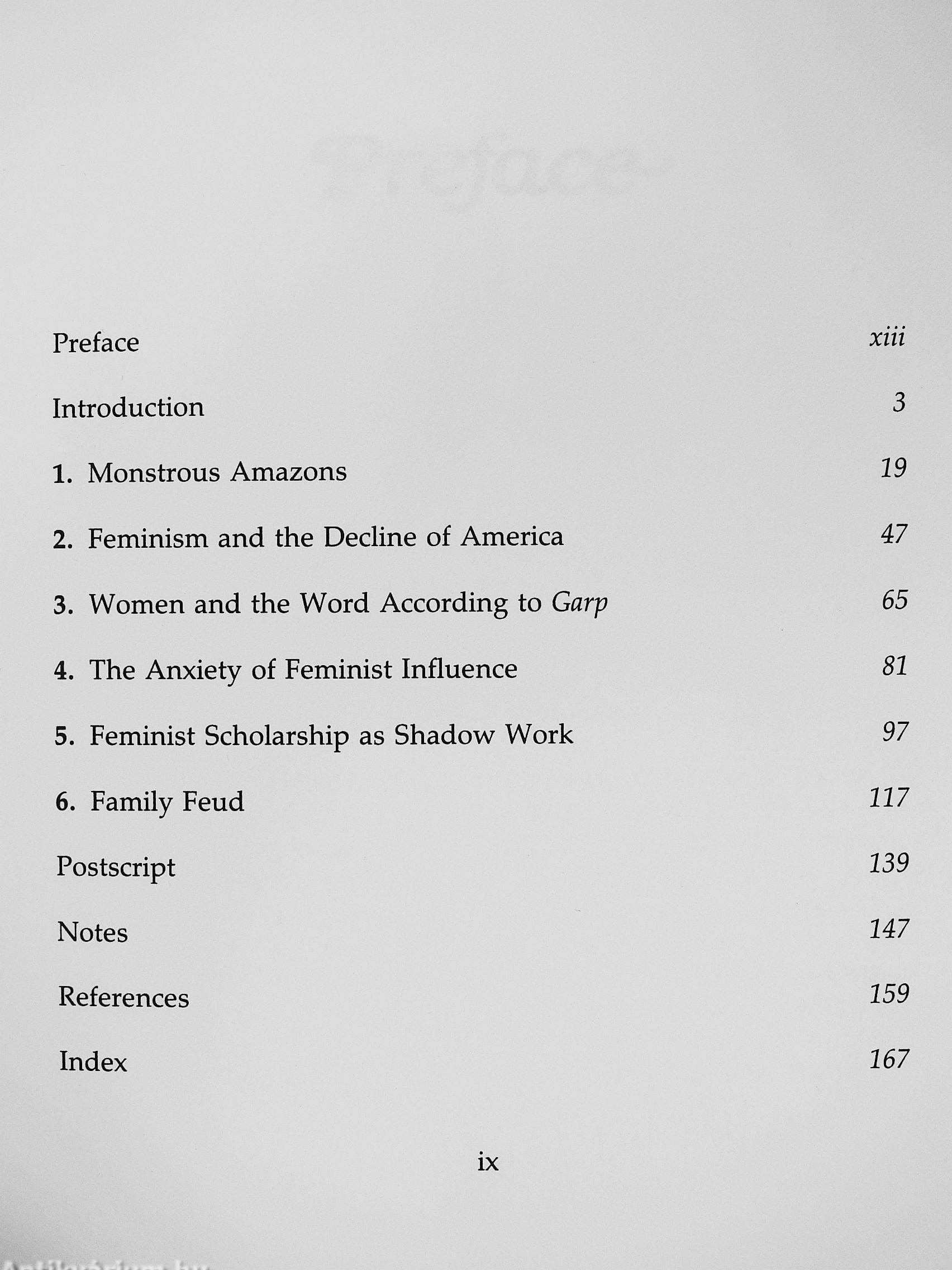
Előszó
Tovább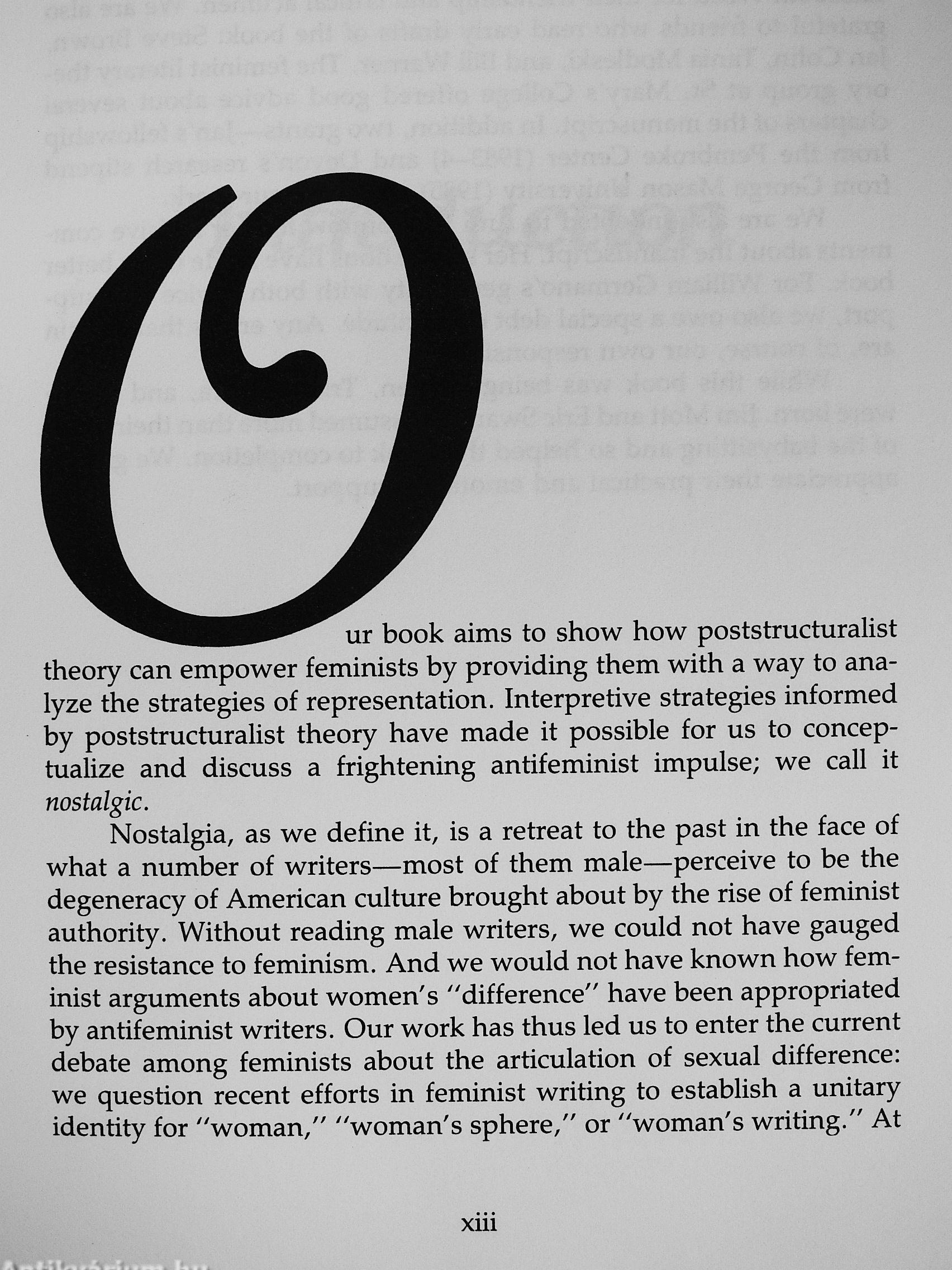
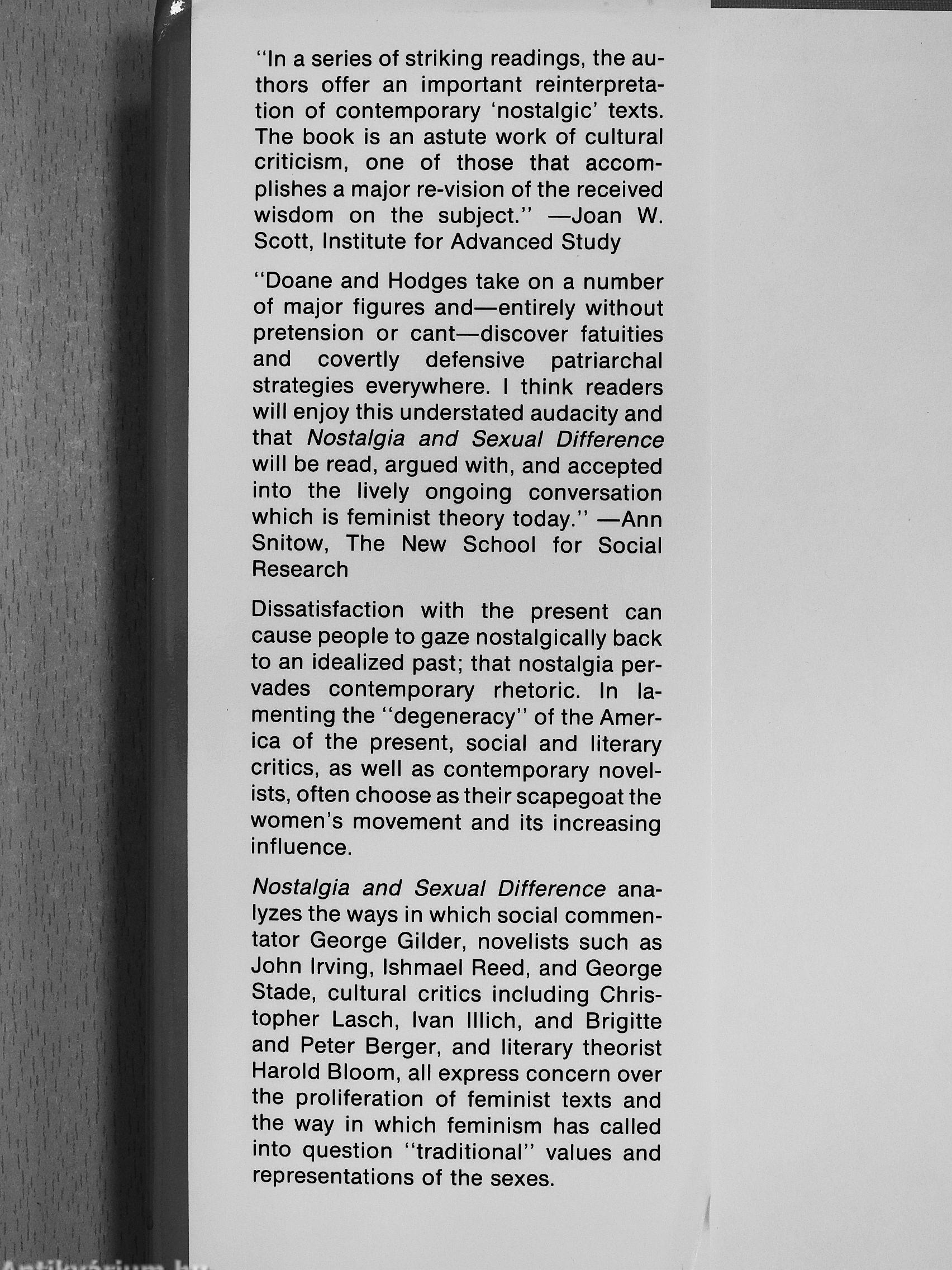
Fülszöveg
"In a series of striking readings, the authors offer an important reinterpreta-tion of contemporary 'nostalgic' texts. The book is an astute work of cultural criticism, one of those that accomplishes a major re-vision of the received wisdom on the subject." —Joan W. Scott, Institute for Advanced Study
"Doane and Hodges take on a number of major figures and—entirely without pretension or cant—discover fatuities and covertly defensive patriarchal strategies everywhere. I think readers will enjoy this understated audacity and that Nostalgia and Sexual Difference will be read, argued with, and accepted into the lively ongoing conversation which is feminist theory today." —Ann Snitow, The New School for Social Research
Dissatisfaction with the present can cause people to gaze nostalgically back to an idealized past; that nostalgia pervades contemporary rhetoric. In lamenting the "degeneracy" of the America of the present, social and literary critics, as well as contemporary... Tovább
Fülszöveg
"In a series of striking readings, the authors offer an important reinterpreta-tion of contemporary 'nostalgic' texts. The book is an astute work of cultural criticism, one of those that accomplishes a major re-vision of the received wisdom on the subject." —Joan W. Scott, Institute for Advanced Study
"Doane and Hodges take on a number of major figures and—entirely without pretension or cant—discover fatuities and covertly defensive patriarchal strategies everywhere. I think readers will enjoy this understated audacity and that Nostalgia and Sexual Difference will be read, argued with, and accepted into the lively ongoing conversation which is feminist theory today." —Ann Snitow, The New School for Social Research
Dissatisfaction with the present can cause people to gaze nostalgically back to an idealized past; that nostalgia pervades contemporary rhetoric. In lamenting the "degeneracy" of the America of the present, social and literary critics, as well as contemporary novelists, often choose as their scapegoat the women's movement and its increasing influence.
Nostalgia and Sexual Difference analyzes the ways in which social commentator George Gilder, novelists such as John Irving, Ishmael Reed, and George Stade, cultural critics including Christopher Lasch, Ivan lllich, and Brigitte and Peter Berger, and literary theorist Harold Bloom, all express concern over the proliferation of feminist texts and the way in which feminism has called into question "traditional" values and representations of the sexes.
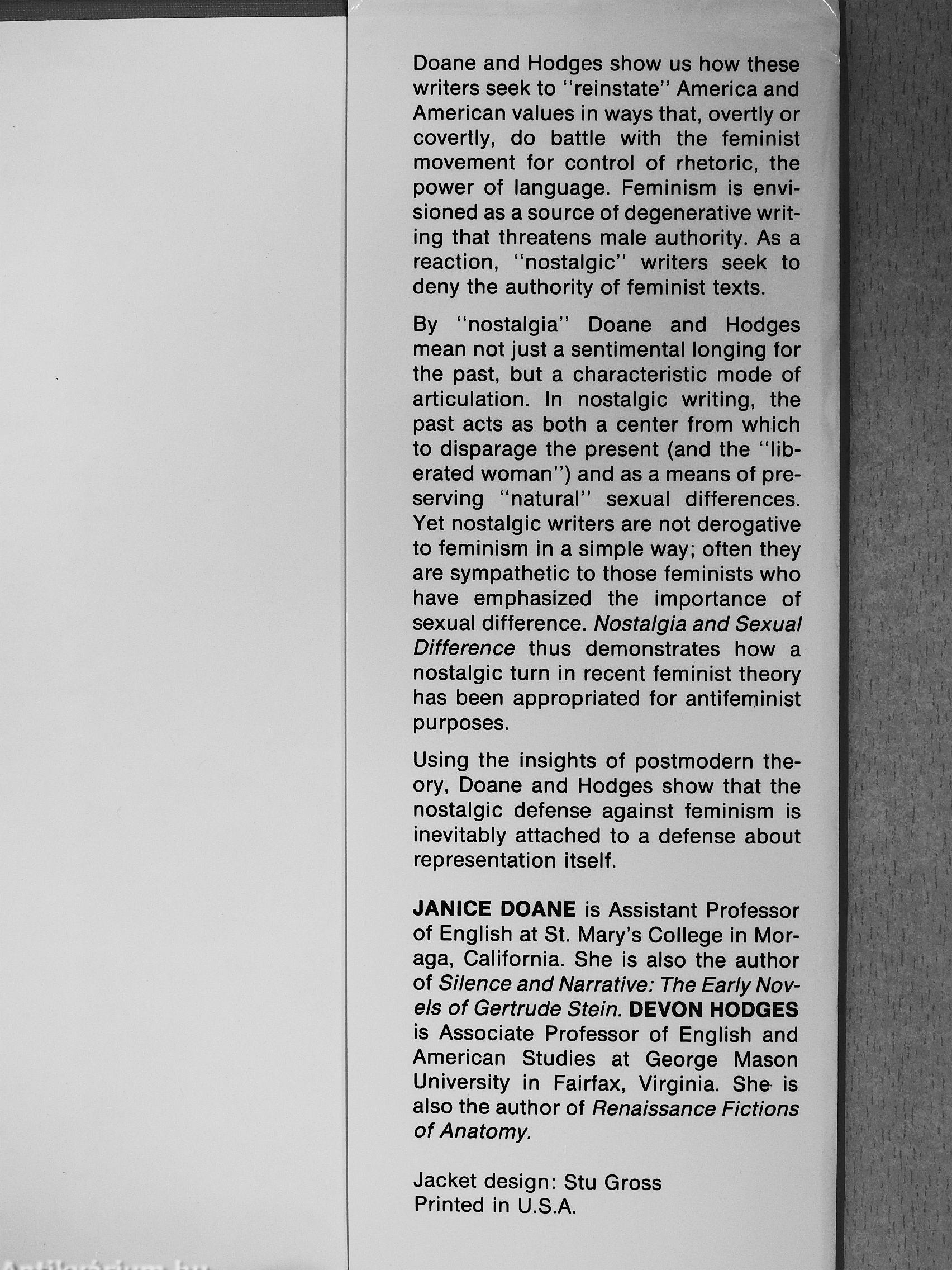
Doane and Hodges show us how these writers seek to "reinstate" America and American values in ways that, overtly or covertly, do battle with the feminist movement for control of rhetoric, the power of language. Feminism is envisioned as a source of degenerative writing that threatens male authority. As a reaction, "nostalgic" writers seek to deny the authority of feminist texts.
By "nostalgia" Doane and Hodges mean not just a sentimental longing for the past, but a characteristic mode of articulation. In nostalgic writing, the past acts as both a center from which to disparage the present (and the "liberated woman") and as a means of preserving "natural" sexual differences. Yet nostalgic writers are not derogative to feminism in a simple way; often they are sympathetic to those feminists who have emphasized the importance of sexual difference. Nostalgia and Sexual Difference thus demonstrates how a nostalgic turn in recent feminist theory has been appropriated for antifeminist purposes.
Using the insights of postmodern theory, Doane and Hodges show that the nostalgic defense against feminism is inevitably attached to a defense about representation itself.
JANICE DOANE is Assistant Professor of English at St. Mary's College in Mor-aga, California. She is also the author of Silence and Narrative: The Early Novels of Gertrude Stein. DEVON HODGES is Associate Professor of English and American Studies at George Mason University in Fairfax, Virginia. She is also the author of Renaissance Fictions of Anatomy.
Jacket design: Stu Gross Printed in U.S.A.
Vissza
Témakörök
- Szociológia > Társadalmi csoportok > Család
- Szociológia > Társadalmi csoportok > Nők
- Idegennyelv > Idegennyelvű könyvek > Angol > Szociológia > Társadalmi csoportok > Család
- Idegennyelv > Idegennyelvű könyvek > Angol > Szociológia > Társadalmi csoportok > Nők
- Idegennyelv > Idegennyelvű könyvek > Angol > Szex, szerelem
- Szociológia > Szociálpolitika > Egyéb
- Szociológia > Története > Irányzatok, elméletek
- Szociológia > Szakszociológiák
- Szociológia > Tanulmányok, esszék
- Idegennyelv > Idegennyelvű könyvek > Angol > Szociológia > Szakszociológiák
- Idegennyelv > Idegennyelvű könyvek > Angol > Szociológia > Tanulmányok, esszék
- Idegennyelv > Idegennyelvű könyvek > Angol > Szociológia > Szociálpolitika > Egyéb
- Idegennyelv > Idegennyelvű könyvek > Angol > Szociológia > Története > Irányzatok, elméletek
- Szex, szerelem > Kultúrtörténet > Nyugati kultúrkör
- Szex, szerelem > Idegennyelvű
Megvásárolható példányok
Állapotfotók
Szép állapotú példány.
Állapot:
Jó
2.540 ,-Ft
13
pont kapható
Kosárba
 Folytatás Microsoft-tal