Fülszöveg
r' , I
\ /
' V
> /
\ ¦ v/
: /
Why do humans do what they do? Why are we, and our society, as we are? Is a radically different society possible? For a hundred years, biological deter-minists have tried to answer these questions by claiming that we are only what our innate biological makeup allows us to be, and no more. Society itself is merely the calculable sum of individual behaviors; its characteristics and hierarchies are biologically, and thus immutably, fixed. These theories are offered as "objective" !ustification for inequalities of all kinds. The sexes are unequal, races have different inherent abilities, people are poor, stupid, criminal, or insane because their genes make them so—and no program of affirmative action or social reorganization can compensate for this truth, which science, above mere human politics, has "proven."
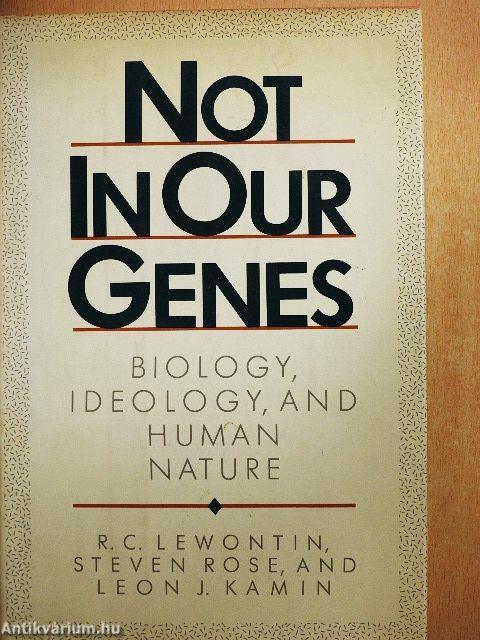
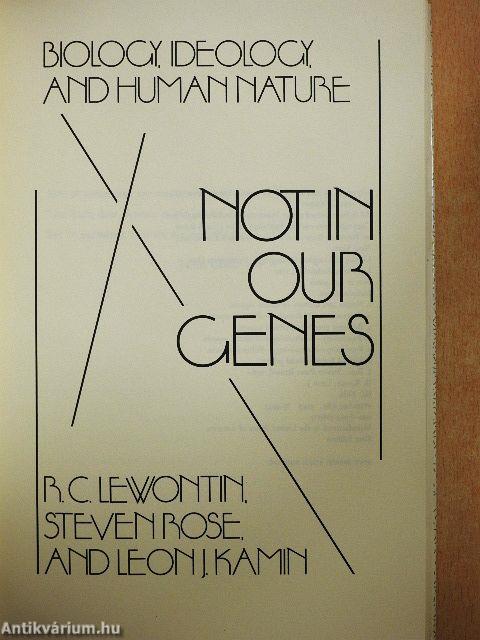
Not in Our Genes dismantles with startling directness not just the scientific props of this reductionist view but the entire myth of...
Tovább
Fülszöveg
r' , I
\ /
' V
> /
\ ¦ v/
: /
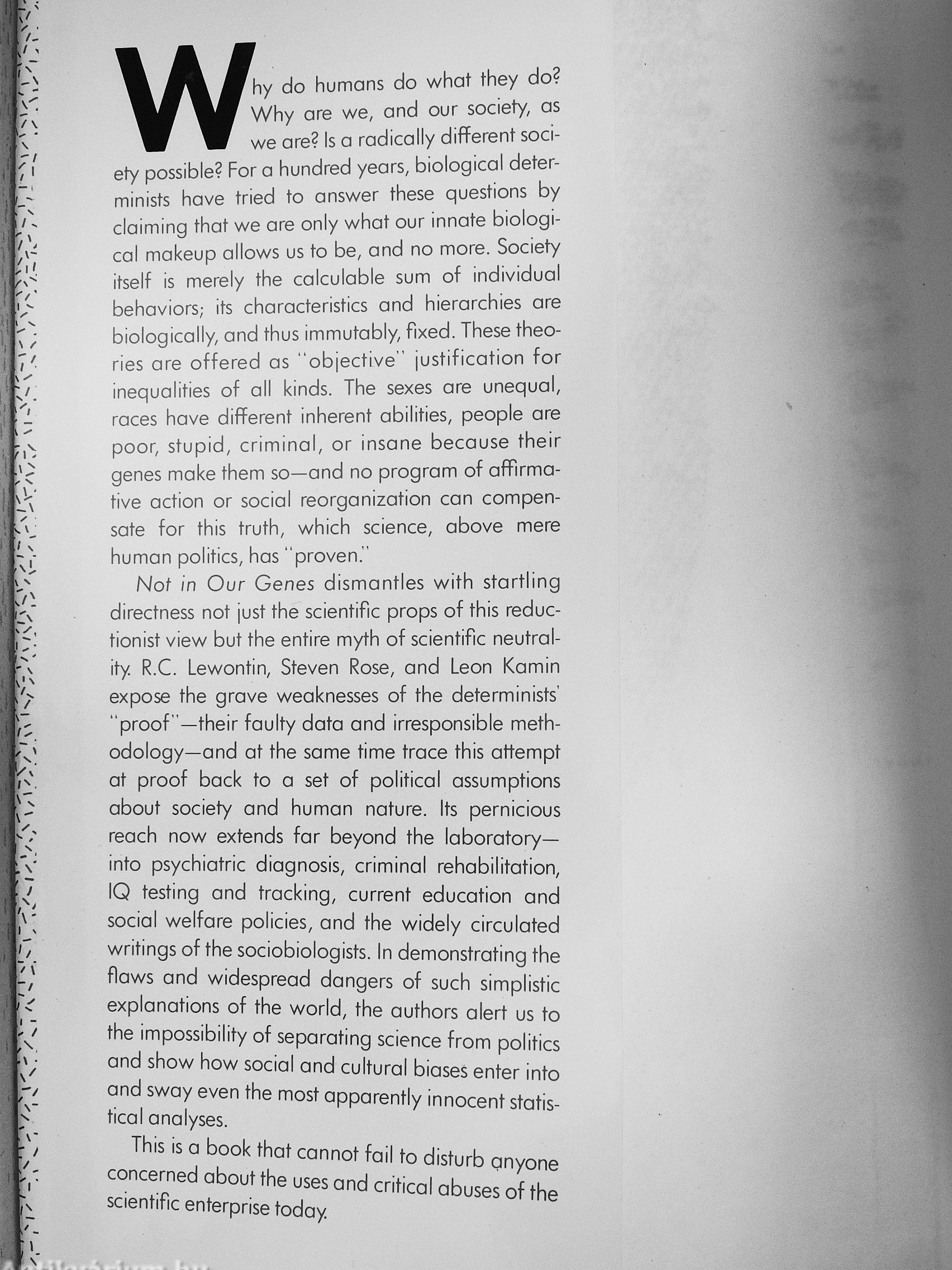
Why do humans do what they do? Why are we, and our society, as we are? Is a radically different society possible? For a hundred years, biological deter-minists have tried to answer these questions by claiming that we are only what our innate biological makeup allows us to be, and no more. Society itself is merely the calculable sum of individual behaviors; its characteristics and hierarchies are biologically, and thus immutably, fixed. These theories are offered as "objective" !ustification for inequalities of all kinds. The sexes are unequal, races have different inherent abilities, people are poor, stupid, criminal, or insane because their genes make them so—and no program of affirmative action or social reorganization can compensate for this truth, which science, above mere human politics, has "proven."
Not in Our Genes dismantles with startling directness not just the scientific props of this reductionist view but the entire myth of scientific neutrality R.C. Lewontin, Steven Rose, and Leon Kamin expose the grave weaknesses of the determinists' "proof"—their faulty data and irresponsible methodology—and at the same time trace this attempt at proof back to a set of political assumptions about society and human nature. Its pernicious reach now extends far beyond the laboratory— into psychiatric diagnosis, criminal rehabilitation, IQ testing and tracking, current education and social welfare policies, and the widely circulated writings of the sociobiologists. In demonstrating the flaws and widespread dangers of such simplistic explanations of the world, the authors alert us to the impossibility of separating science from politics and show how social and cultural biases enter into
and sway even the most apparently innocent statistical analyses.
This's a book that cannot fail to disturb anyone
^ J
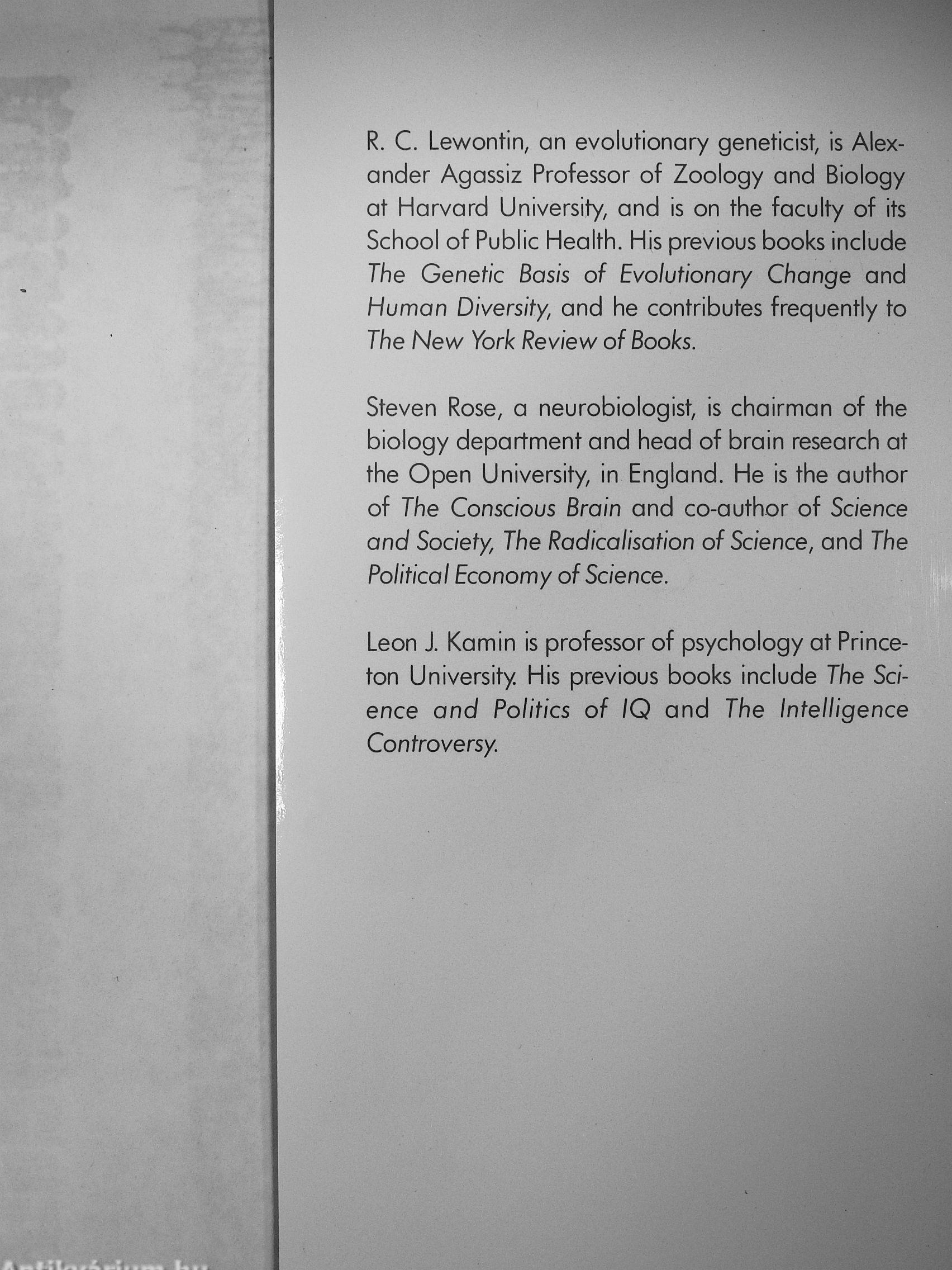
R. C. Lewontin, an evolutionary geneticist, is Alexander Agassiz Professor of Zoology and Biology at Harvard University, and is on the faculty of its School of Public Health. His previous books include The Genetic Basis of Evolutionary Change and Human Diversity, and he contributes frequently to The New York Review of Books.
Steven Rose, a neurobiologist, is chairman of the biology department and head of brain research at the Open University, in England. He is the author of The Conscious Brain and co-author of Science and Society, The Radlcallsatlon of Science, and The Political Economy of Science.
Leon J. Kamin is professor of psychology at Princeton University His previous books include The Science and Politics of IQ and The Intelligence Controversy.
Vissza 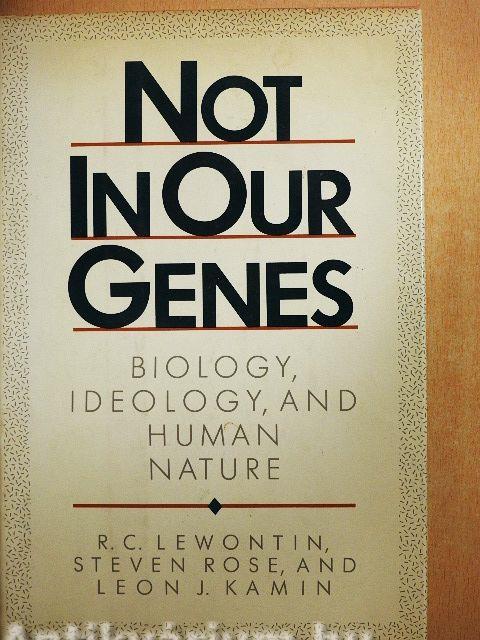


 Folytatás Microsoft-tal