Fülszöveg
1
jT 'Tliis is a crucially important book. Its ce^^l message is new and strongly supported by the evidence. A major influence on the quality of life in modern societies will suflly be |he extent to which we are able to come to terms with what Oliver James has to say'
Professor Richard Wilkinson; author of Unhealthy Societies
'Oliver James offers a visionary overview of how the structure of our societies affect our minds and brains, in particular serotonin. He puts advanced capitalism, with its polarising winner-loser psychology, in the dock as never before, finding that while it may be good for business it is bad for mental health. He presents a detailed map of the pathways to recovery from low serotonin for thfe" individual and the community'
Paul Gilbert, Professor of Evolutionary Psychology; author of Depression: The Evolution of Powerlessness
i.
Vl
/ i J ' j,- , '' ¦(J
•'¦J ! j
¦ I ' r' ,i ' i , .-I •! i , ' : " ', ! I W 1 , I ¦ ' S
ii i Li'i^'i (•
I I i ¦ ; i I ¦...
Tovább
Fülszöveg
1
jT 'Tliis is a crucially important book. Its ce^^l message is new and strongly supported by the evidence. A major influence on the quality of life in modern societies will suflly be |he extent to which we are able to come to terms with what Oliver James has to say'
Professor Richard Wilkinson; author of Unhealthy Societies
'Oliver James offers a visionary overview of how the structure of our societies affect our minds and brains, in particular serotonin. He puts advanced capitalism, with its polarising winner-loser psychology, in the dock as never before, finding that while it may be good for business it is bad for mental health. He presents a detailed map of the pathways to recovery from low serotonin for thfe" individual and the community'
Paul Gilbert, Professor of Evolutionary Psychology; author of Depression: The Evolution of Powerlessness
i.
Vl
/ i J ' j,- , '' ¦(J
•'¦J ! j
¦ I ' r' ,i ' i , .-I •! i , ' : " ', ! I W 1 , I ¦ ' S
ii i Li'i^'i (•
I I i ¦ ; i I ¦ , I. , I''l !1 ¦ ¦ ' !i-i',¦
¦f s j r. ' .
i '••!", . -'i I I
¦ r, Uj- V-V.lri iMi
I '.'! ¦ I ! • I.'« ; '} i'l . ¦, , , I <
' ' " i' ' ^ , if i -ij
I' i
'i r
,1
1 ; . i I ,
^ ¦ ! i ' I I'l
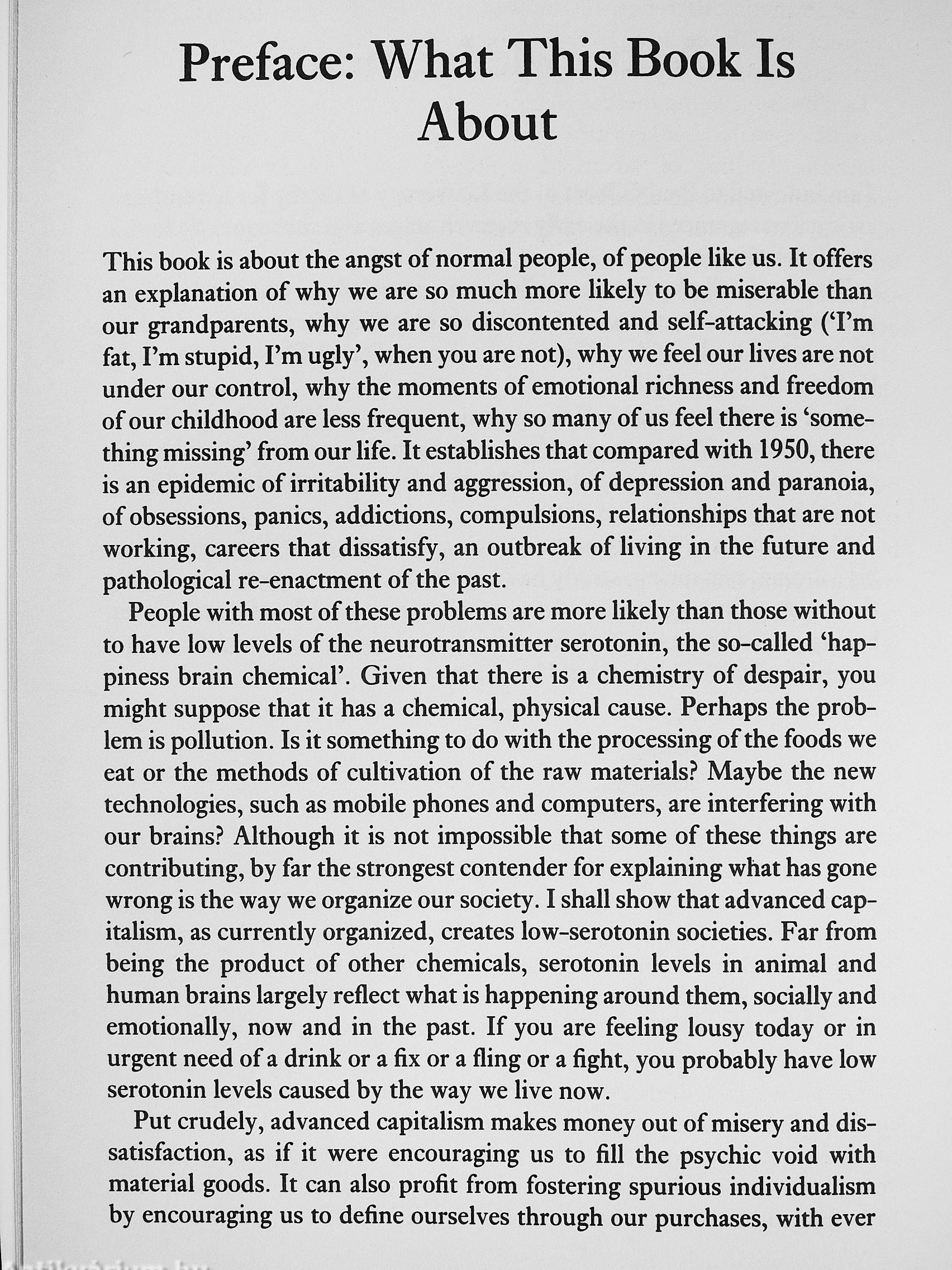
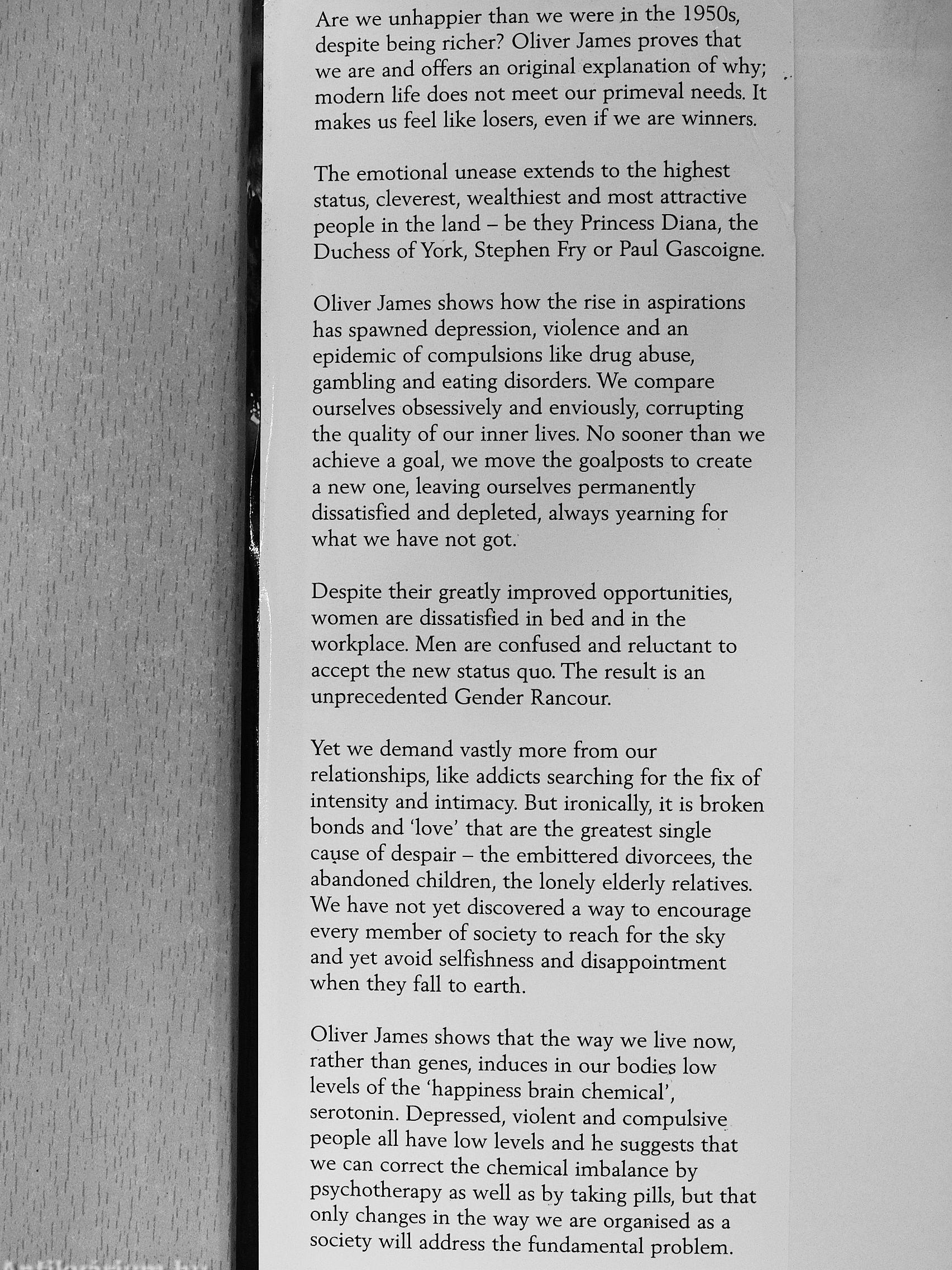
Are we unhappier than we were in the 1950s, despite being richer? Oliver James proves that we are and offers an original explanation of why; modern life does not meet our primeval needs. It makes us feel like losers, even if we are winners.
The emotional unease extends to the highest status, cleverest, wealthiest and most attractive people in the land - be they Princess Diana, the Duchess of York, Stephen Fry or Paul Gascoigne.
Oliver James shows how the rise in aspirations has spawned depression, violence and an epidemic of compulsions like drug abuse, gambling and eating disorders. We compare ourselves obsessively and enviously, corrupting the quality of our inner lives. No sooner than we achieve a goal, we move the goalposts to create a new one, leaving ourselves permanently dissatisfied and depleted, always yearning for what we have not got.
Despite their greatly improved opportunities, women are dissatisfied in bed and in the workplace. Men are confused and reluctant to accept the new status quo. The result is an unprecedented Gender Rancour.
Yet we demand vastly more from our relationships, like addicts searching for the fix of intensity and intimacy. But ironically, it is broken bonds and 'love' that are the greatest single cause of despair - the embittered divorcees, the abandoned children, the lonely elderly relatives. We have not yet discovered a way to encourage every member of society to reach for the sky and yet avoid selfishness and disappointment when they fall to earth.
Oliver James shows that the way we live now, rather than genes, induces in our bodies low levels of the 'happiness brain chemical', serotonin. Depressed, violent and compulsive people all have low levels and he suggests that we can correct the chemical imbalance by psychotherapy as well as by taking pills, but that only changes in the way we are organised as a society will address the fundamental problem.
Vissza 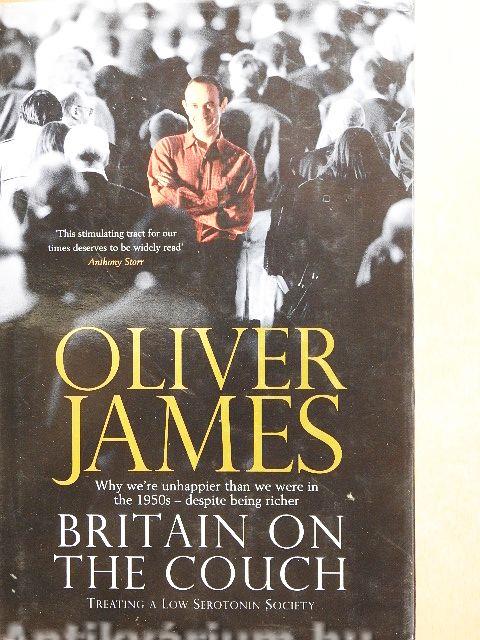



 Folytatás Microsoft-tal