
1.155.452
kiadvánnyal nyújtjuk Magyarország legnagyobb antikvár könyv-kínálatát

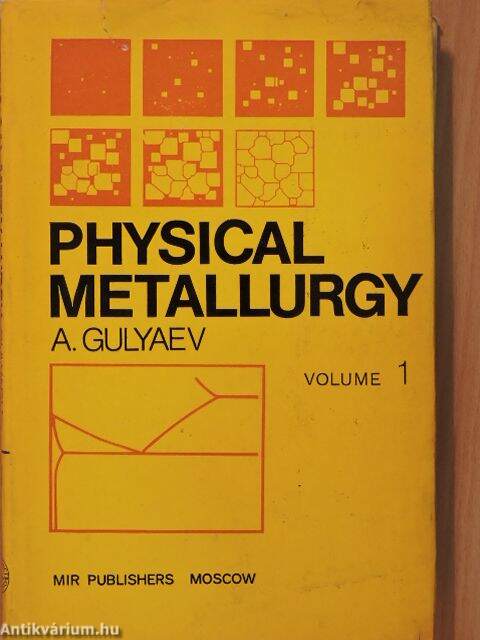
Physical Metallurgy 1.
Moszkva
| Kiadó: | Mir Publishers |
|---|---|
| Kiadás helye: | Moszkva |
| Kiadás éve: | |
| Kötés típusa: | Vászon |
| Oldalszám: | 334 oldal |
| Sorozatcím: | Physical Metallurgy |
| Kötetszám: | 1 |
| Nyelv: | Angol |
| Méret: | 22 cm x 15 cm |
| ISBN: | |
| Megjegyzés: | Fekete-fehér illusztrációkkal, ábrákkal. |
Értesítőt kérek a kiadóról
Értesítőt kérek a sorozatról
A beállítást mentettük,
naponta értesítjük a beérkező friss
kiadványokról
naponta értesítjük a beérkező friss
kiadványokról
A beállítást mentettük,
naponta értesítjük a beérkező friss
kiadványokról
naponta értesítjük a beérkező friss
kiadványokról
Előszó
Preface The first edition of Physical Metallurgy was published as far back as in 1948, with somé chapters being written by M.E. Blanter, S.M. Vinarov, Ya.B. Fridman, Yu.M. Lakhtin, S.Z. Bockstein,... TovábbElőszó
Preface The first edition of Physical Metallurgy was published as far back as in 1948, with somé chapters being written by M.E. Blanter, S.M. Vinarov, Ya.B. Fridman, Yu.M. Lakhtin, S.Z. Bockstein, and E.F. Trusova. It was essentially a monograph rather than a textbook, though was based on the experience of teaching of scienceof metals at the Moscow Institute of Aviation Engineering. An urgent need for a textbook on physical metallurgy impelled the Author to re-work the earlier edition into a textbook which was published in 1951. In the later editions (1956, 1963) much was done to make a book equally useful as a textbook for students studying physical metallurgy and as a monograph and reference book for metallurgical engineers and specialists in the field. It was alsó his aim to compile a textbook which could be a satisfactory and ample aid in many diverse courses on physical metallurgy, science of metals and heat treatment of metals as taught in various higher technical schools. For instance, the corresponding parts of the book can be used as textbooks on metallography (Parts I, II, and V), theory of heat treatment of metals (Part III) and alloy steels (Part IV) for students of machine-building, polytechnical and metallurgical specialities. The Author has somé evidence that his book is used much as a monograph and reference book by production and research engineers. The later editions of the book have been revised and enlarged in accordance with the current progress in science and engineering, in particular, in physical metallurgy. The material of the book is compiled and arranged in full accordance with the latest teaching programme on the science of materialsapproved by the USSR Ministry of higher and vocational education (1973). During the long path from the first to the last edition, many prominent metallurgists (A. A. Bochvar, I. A. Oding, Ya.S. Umanskyr S.M. Voronov, I.V. Kudryavtsev, Ya.B. Fridman, I.N. Boga- VisszaTartalom
ContentsPreface 9
Part One
The Theory of Alloys
Chapter 1. The Crystal Structure of Metals 11
l-l. Metals 11
1-2. Classification of Metals 14
1-3. Crystal Structure of Metals 19
1-4. The Crystal Lattices of Metals 20
1-5. Real Structure of Metallic Crystals 26
1-6. Anisotropy of Properties of Crystals 32
1-7. Methods for Studying the Metál Structure 33
Literature 39
Chapter 2. Crystallization 40
2-1. Three States of Matter 40
2-2. Energy Conditions for Crystallization 41
2-3. The Mechanism of Crystallization 43
2-4. The Shape of Crystal Formations 47
2-5. The Structure of Ingót 49
2-6. Solid-state Transformations. Allotropy 51
2-7. Magnetic Transformations 55
Literature 56
Chapter 3. Mechanical Properties. Strain Hardening and Recrystallization 57
3-1. Metals and Non-metals 57
3-2. Elastic and Plastic Deformations. Lattice Imperfections
and Strength of Metals 57
3-3. Fracture 66
3-4. Methods for Testing Mechanical Properties 73
3-5. Strain Hardening 79
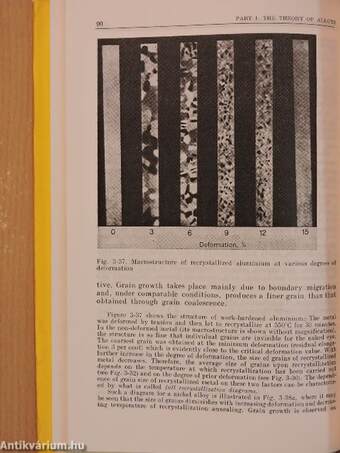
3-6. Effect of Heating on the Structure and Properties of Deformed Metál (Recrystallization Processes) 81
Literature 91
Chapter 4. The Structure of Alloys 93
4-1. Mechanical Mixture 93
4-2. Chemical Compound 94
4-3. Solid Solution Based on a Component of an Alloy ... gg
4-4. A Solid Solution Based on a Chemical Compound ion
'4-5. Ordered Solid Solutions 101
4-6. Electronic Compounds (Hume-Rothery Phases) 102
4-7. Laves Phases 103
4-8. Interstitial Phases 103
Literature 104
Chapter 5. Constitutional Diagrams 105
5-1. Gibbs' Phase Rule 105
5-2. General Remarks on the Construction of Constitutional
Diagrams 108
5-3. Experimentál Construction of Constitutional Diagrams 110
5-4. The Constitutional Diagram of Systems Forming Mechanical Mixtures of Pure Constituents (First-order Systems) 114
5-5. The Lever Rule 117
5-6. The Constitutional Diagram of Systems with Unlimited
Solubility of Constituents in the Solid State (Secondorder Systems) 119
5-7. The Constitutional Diagram of Systems with Limited
Solubility in the Solid State (Third-order Systems) 121
5-8. The Constitutional Diagram of Systems Forming Chemical
Compounds (Fourth-order Systems) 126
5-9. The Constitutional Diagram of Systems Undergoing Polymorphous Transformations 130
5-10. Non-equilibrium Crystallization of Alloys 132
5-11. Three-component (Ternary) Systems 139
5-12. Simplified Methods for Analysis of Multi-component
Systems 148
5-13. Correlation Between Properfies of Alloys and Type of
Constitutional Diagram 151
Literature 153
Part Two
Iron-carbon Alloys
Chapter 6. The Iron-carbon Constitutional Diagram 154
6-1. History 154
6-2. Iron 156
6-3. Cementite 160
6-4. The Constitutional Diagram 161
Literature 174
Chapter 7. Carbon Steels 175
7-1. Effect of Carbon 176
7-2. Effect of Permanent Impurities on Steel Properties . . . 178
7-3. Steels Produced by Various Processes. Clean Steel . . . 185
7-4. Plain Carbon Steels 189
7-5. Work-hardened Steel 193
7-6. Steel Sheets for Cold Forming 194
7-7. Machinability of Steels. Automatic Steels 194
Literature 197
Chapter 8. Cast Iron 198
8-1. Graphitization 198
8-2. The Structures of Cast Iron. Forms of Graphite 204
8-3. The Structure and Properties of Cast Iron 207
8-4. Effect of Impurities 209
8-5. Effect of Cooling Rate 210
8-6. Grades of Grey and High-strength Cast Irons 211
8-7. Malleable Cast Iron 213
Literature 216
Part Three
Heat Treatment
Chapter 9. General Principles of Heat Treatment 217
9-1. Temperature and Time 217
9-2. Classification of Types of Heat Treatment 219
9-3. Heat Treatment and the Constitutional Diagram ... 221
9-4. Principal Types of Heat Treatment of Steel 223
9-5. Four Principal Transformations in Steel 225
Literature 227
Chapter 10. The Theory of Heat Treatment of Steel 228
10-1. Formation of Austenite 229
10-2. Coarsening of Austenitic Grain 230
10-3. Decomposition oí Austenite 236
10-4. Martensitic Transformation 249
10-5. Bainitic Transformation 261
10-6. Transformations on Tempering 264
10-7. Effect of Heat Treatment on Steel Properties 268
10-8. Thermomechanical Treatment 273
Literature 276
Chapter 11. Practice of Heat Treatment of Steel 27?
11-1. Hardening Temperature 277
11-2. Heating Time 279
11-3. Chemical Action of the Heating Médium 280
11-4. Quenching Media 282
11-5. Hardenability 284
11-6. Internál Stresses 291
11-7. Methods of Quenching 293
11-8. Sub-zero Treatment of Steel 296
11-9. Defects in Hardened Steel 296
11-10. Annealing and Normalizing 298
Literature 301
hapter 12. Surface Hardening of Steel 302
12-1. General 302
12-2. Induction Hardening 304
Literature 307
Chapter 13. Chemical Heat Treatment of Steel 308
13-1. The Theory of Chemical Heat Treatment 308
13-2. Carburizing 313
13-3. Nitriding 320
13-4. Cyaniding 325
13-5. Metallic Cementation 327
Literature 328
Index 329
Témakörök
- Idegennyelv > Idegennyelvű könyvek > Angol > Műszaki
- Műszaki > Ipar > Nehézipar > Egyéb
- Műszaki > Idegennyelv > Angol
- Műszaki
A. Gulyaev
A. Gulyaev műveinek az Antikvarium.hu-n kapható vagy előjegyezhető listáját itt tekintheti meg: A. Gulyaev könyvek, művekMegvásárolható példányok
Nincs megvásárolható példány
A könyv összes megrendelhető példánya elfogyott. Ha kívánja, előjegyezheti a könyvet, és amint a könyv egy újabb példánya elérhető lesz, értesítjük.
 Folytatás Microsoft-tal