Fülszöveg
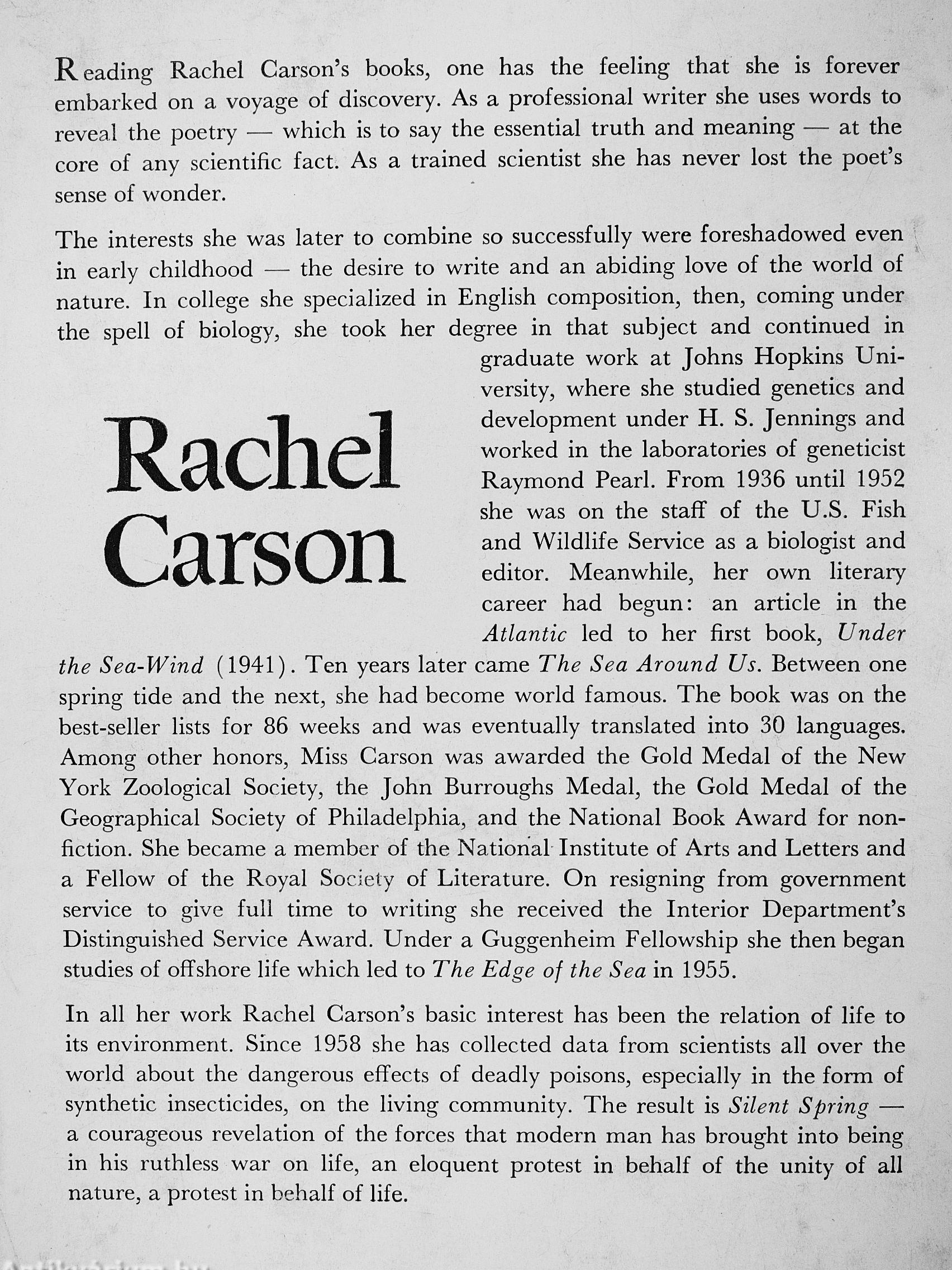
Rachel Carson
Reading Rachel Carson's books, one has the feeling that she is forever embarked on a voyage of discovery. As a professional writer she uses words to reveal the poetry — which is to say the essential truth and meaning — at the core of any scientific fact. As a trained scientist she has never lost the poet's sense of wonder.
The interests she was later to combine so successfully were foreshadowed even in early childhood — the desire to write and an abiding love of the world of nature. In college she specialized in English composition, then, coming under the spell of biology, she took her degree in that subject and continued in
graduate work at Johns Hopkins University, where she studied genetics and development under H. S. Jennings and worked in the laboratories of geneticist Raymond Pearl. From 1936 until 1952 she was on the staff of the U.S. Fish and Wildlife Service as a biologist and editor. Meanwhile, her own literary career had begun: an article in the...
Tovább
Fülszöveg
Rachel Carson
Reading Rachel Carson's books, one has the feeling that she is forever embarked on a voyage of discovery. As a professional writer she uses words to reveal the poetry — which is to say the essential truth and meaning — at the core of any scientific fact. As a trained scientist she has never lost the poet's sense of wonder.
The interests she was later to combine so successfully were foreshadowed even in early childhood — the desire to write and an abiding love of the world of nature. In college she specialized in English composition, then, coming under the spell of biology, she took her degree in that subject and continued in
graduate work at Johns Hopkins University, where she studied genetics and development under H. S. Jennings and worked in the laboratories of geneticist Raymond Pearl. From 1936 until 1952 she was on the staff of the U.S. Fish and Wildlife Service as a biologist and editor. Meanwhile, her own literary career had begun: an article in the Atlantic led to her first book, Under the Sea-Wind (1941). Ten years later came The Sea Around Us. Between one spring tide and the next, she had become world famous. The book was on the best-seller lists for 86 weeks and was eventually translated into 30 languages. Among other honors, Miss Carson was awarded the Gold Medal of the New York Zoological Society, the John Burroughs Medal, the Gold Medal of the Geographical Society of Philadelphia, and the National Book Award for non-fiction. She became a member of the National Institute of Arts and Letters and a Fellow of the Royal Society of Literature. On resigning from government service to give full time to writing she received the Interior Department's Distinguished Service Award. Under a Guggenheim Fellowship she then began studies of offshore life which led to The Edge of the Sea in 1955.
In all her work Rachel Carson's basic interest has been the relation of life to its environment. Since 1958 she has collected data from scientists all over the world about the dangerous effects of deadly poisons, especially in the form of synthetic insecticides, on the living community. The result is Silent Spring — a courageous revelation of the forces that modern man has brought into being in his ruthless war on life, an eloquent protest in behalf of the unity of all nature, a protest in behalf of life.
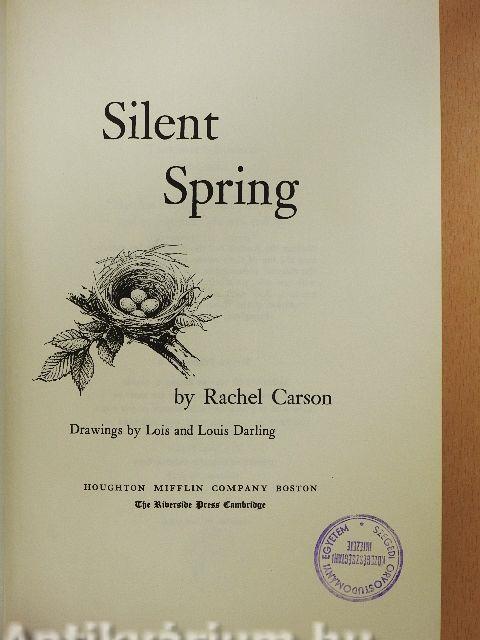
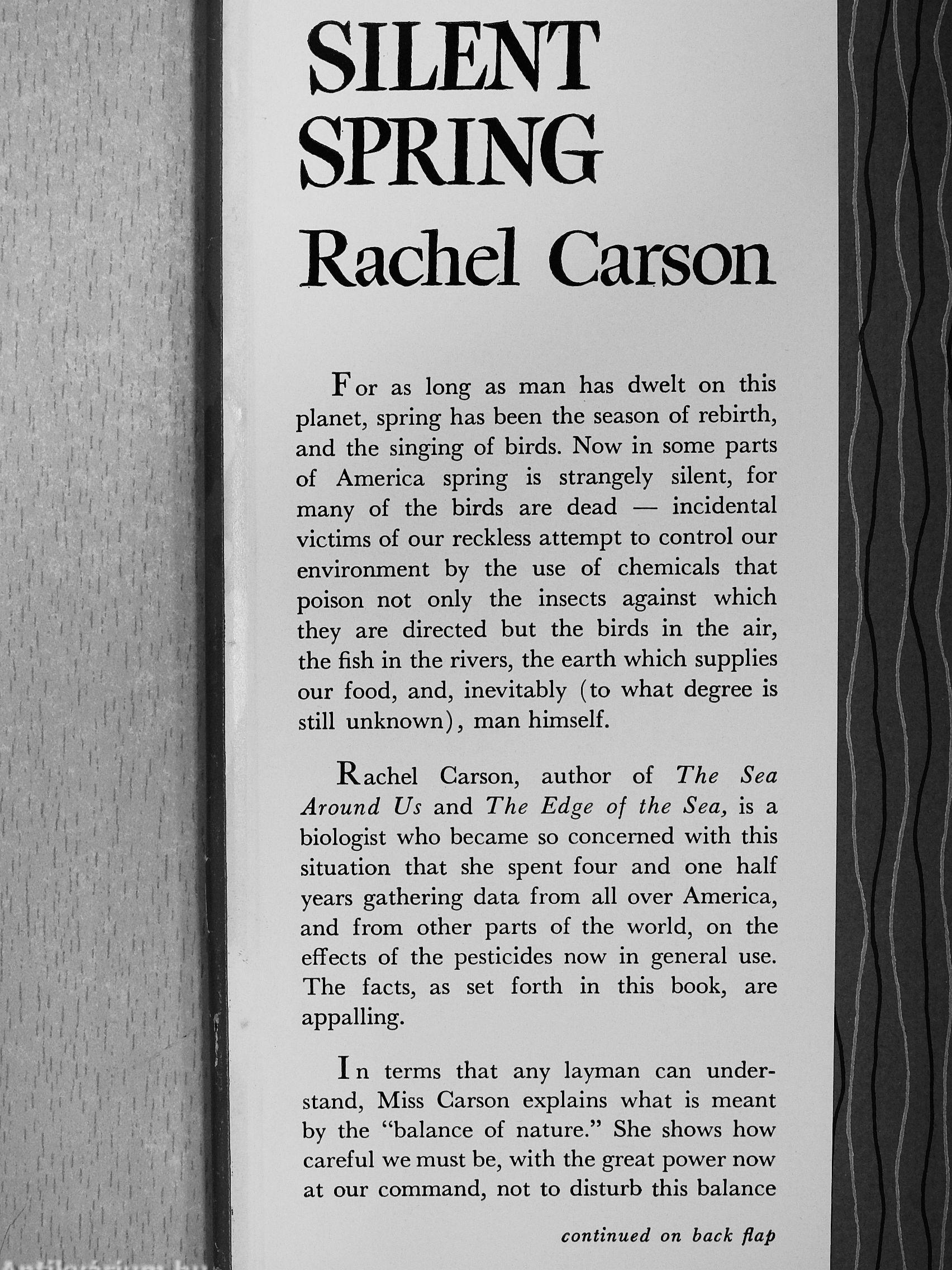
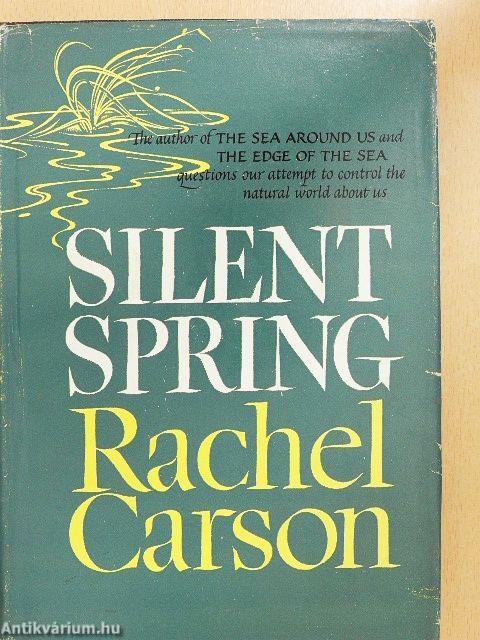
SILENT SPRING
Rachel Carson
For as long as man has dwelt on this planet, spring has been the season of rebirth, and the singing of birds. Now in some parts of America spring is strangely silent, for many of the birds are dead — incidental victims of our reckless attempt to control our environment by the use of chemicals that poison not only the insects against which they are directed but the birds in the air, the fish in the rivers, the earth which supplies our food, and, inevitably (to what degree is still unknown), man himself.
Rachel Carson, author of The Sea Around Us and The Edge of the Sea, is a biologist who became so concerned with this situation that she spent four and one half years gathering data from all over America, and from other parts of the world, on the effects of the pesticides now in general use. The facts, as set forth in this book, are appalling.
I n terms that any layman can understand, Miss Carson explains what is meant by the "balance of nature." She shows how careful we must be, with the great power now at our command, not to disturb this balance
continued on bach flap
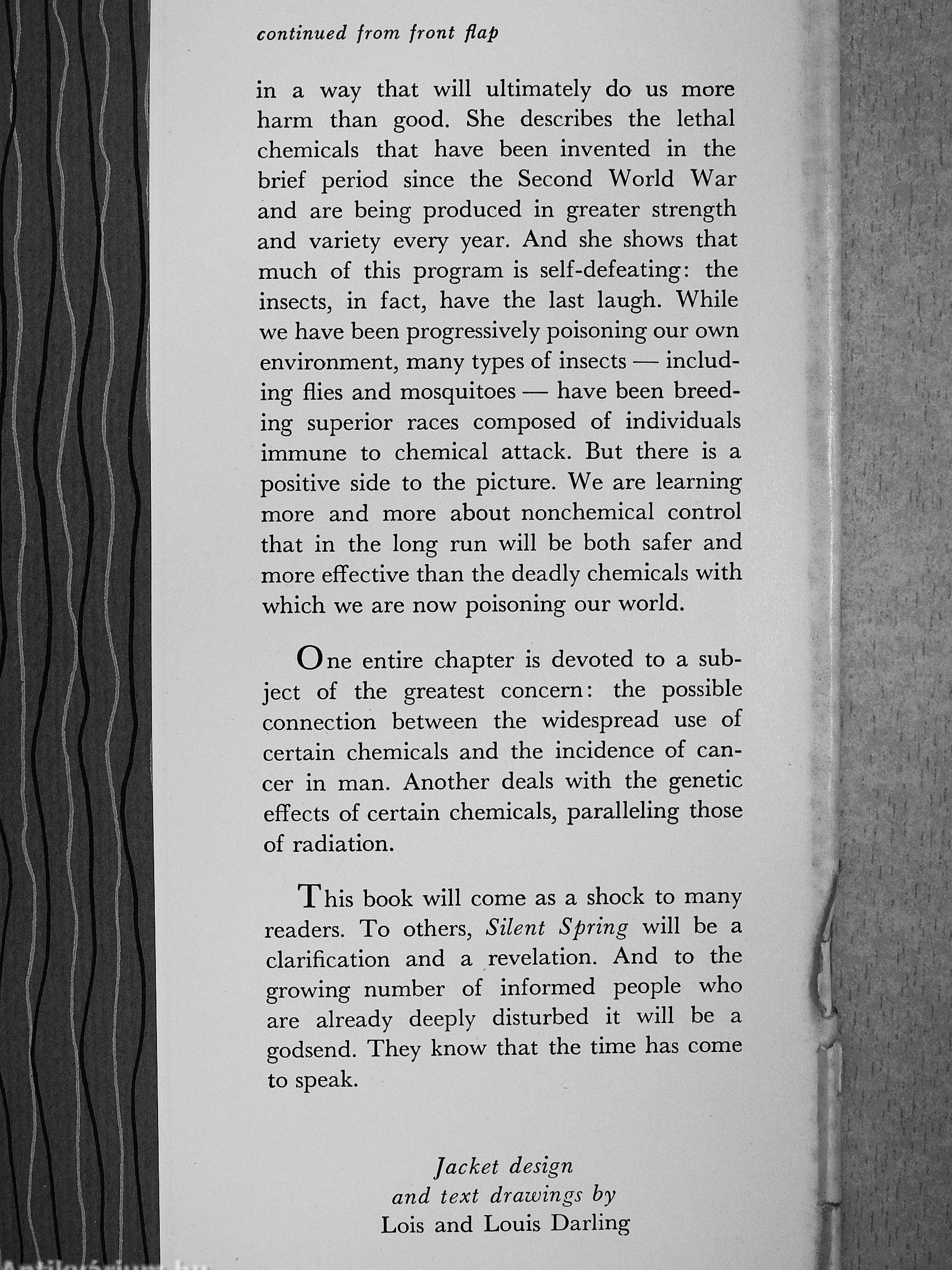
continued from front flap
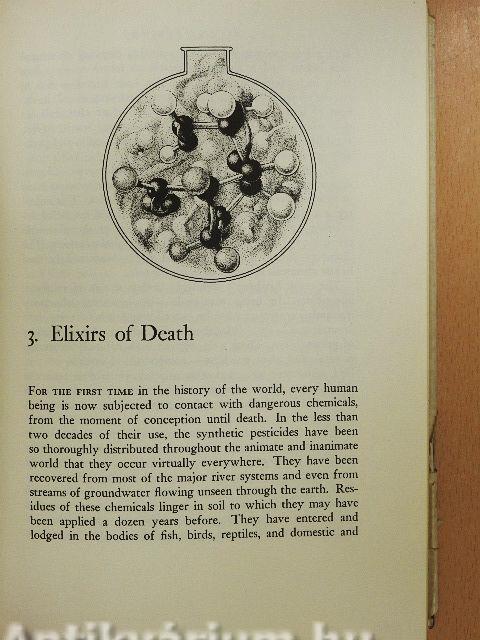
in a way that will ultimately do us more harm than good. She describes the lethal chemicals that have been invented in the brief period since the Second World War and are being produced in greater strength and variety every year. And she shows that much of this program is self-defeating: the insects, in fact, have the last laugh. While we have been progressively poisoning our own environment, many types of insects — including flies and mosquitoes — have been breeding superior races composed of individuals immune to chemical attack. But there is a positive side to the picture. We are learning more and more about nonchemical control that in the long run will be both safer and more effective than the deadly chemicals with which we are now poisoning our world.
One entire chapter is devoted to a subject of the greatest concern: the possible connection between the widespread use of certain chemicals and the incidence of cancer in man. Another deals with the genetic effects of certain chemicals, paralleling those of radiation.
This book will come as a shock to many readers. To others. Silent Spring will be a clarification and a revelation. And to the growing number of informed people who are already deeply disturbed it will be a godsend. They know that the time has come to speak.
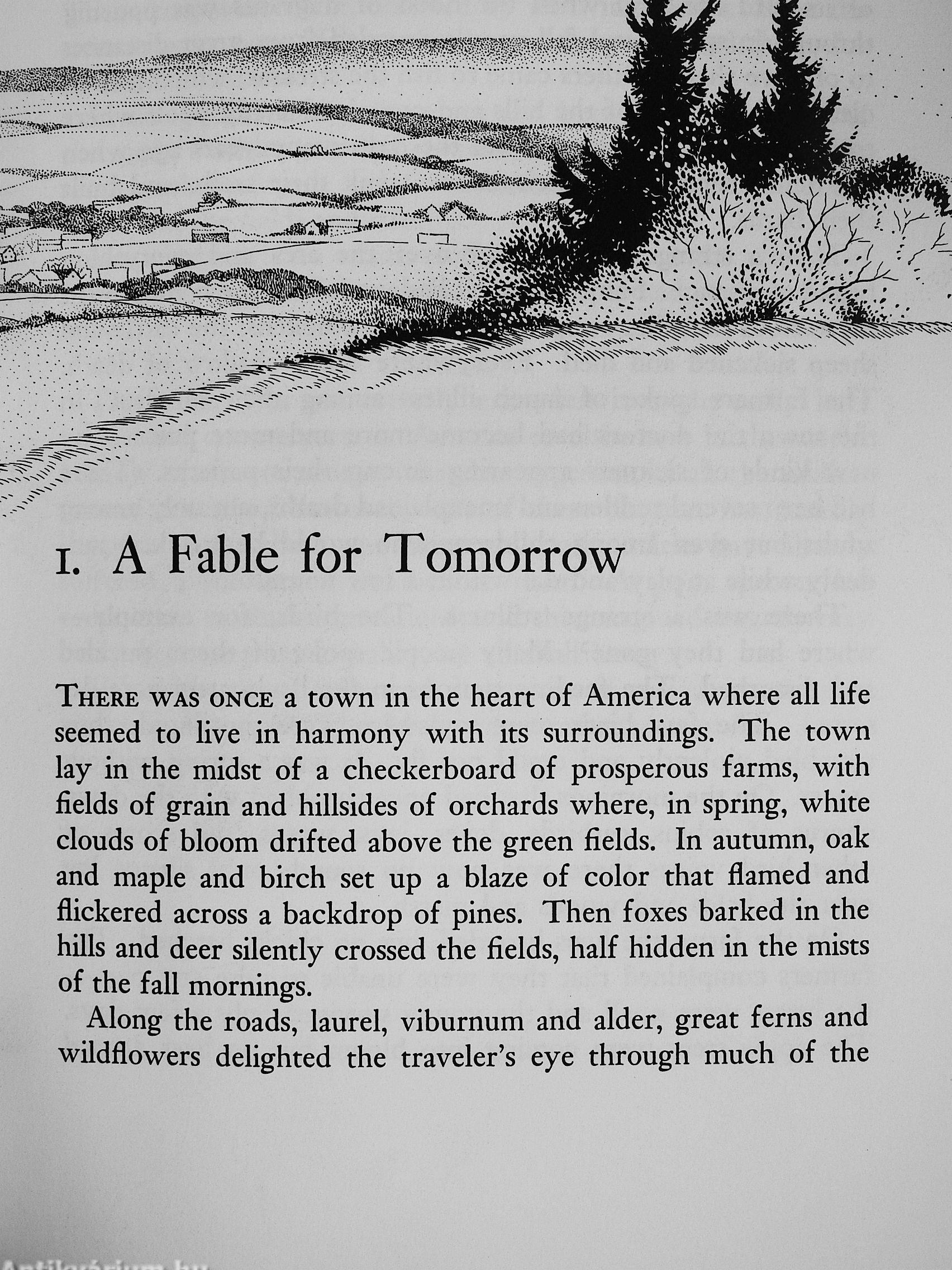
Jacket design and text drawings by Lois and Louis Darling
i - ! P
Vissza 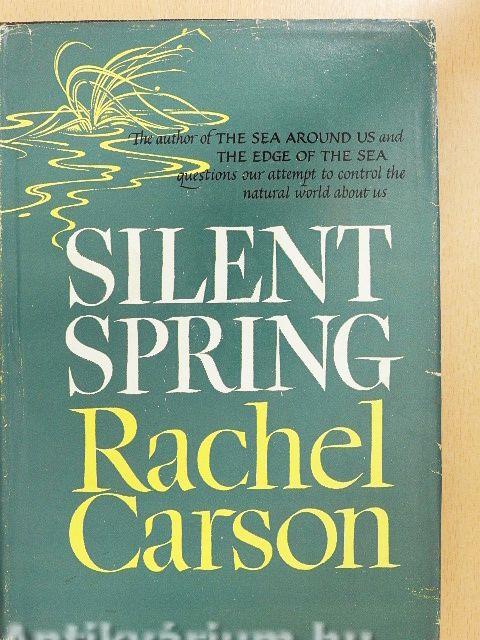


 Folytatás Microsoft-tal