Fülszöveg
Of related interest
QUALITY AND RELIABILITY METHODS FOR PRIMARY BATTERIES
RBro and S.C. Levy
This unique book is for battery engineers, battery users, and equipment designers who need to learn about the essential characteristics of primary batteries and the factors that affect their performance and reliability It examines the systematic use of distribution functions and kinetics for prediction of battery performance and reliability and the systematic diagnostics of battery inefficiencies by the use of fault trees. This important new material provides tools that allow battery engineers and users to approach product improvement more systematically, as well as to predict more accurately long-term performance. It also details the designing and manufacturing of reliable batteries and the methods of predicting reliability in specific applications. 1990 (0471-52427-1) 302 pp.
y . M, I'I ,l| 1 • I'.'l : Tr-i"T:
mimrn-
I : ; ^ M
I
M
i; ', I M : , ,1
'liV^/'V;
; i I ! I
.1...
Tovább
Fülszöveg
Of related interest
QUALITY AND RELIABILITY METHODS FOR PRIMARY BATTERIES
RBro and S.C. Levy
This unique book is for battery engineers, battery users, and equipment designers who need to learn about the essential characteristics of primary batteries and the factors that affect their performance and reliability It examines the systematic use of distribution functions and kinetics for prediction of battery performance and reliability and the systematic diagnostics of battery inefficiencies by the use of fault trees. This important new material provides tools that allow battery engineers and users to approach product improvement more systematically, as well as to predict more accurately long-term performance. It also details the designing and manufacturing of reliable batteries and the methods of predicting reliability in specific applications. 1990 (0471-52427-1) 302 pp.
y . M, I'I ,l| 1 • I'.'l : Tr-i"T:
mimrn-
I : ; ^ M
I
M
i; ', I M : , ,1
'liV^/'V;
; i I ! I
.1 . . . .
1,1'.' ''. 11 i
I ¦ I ' i.
: - i I
ii—i-____I___i _ .,
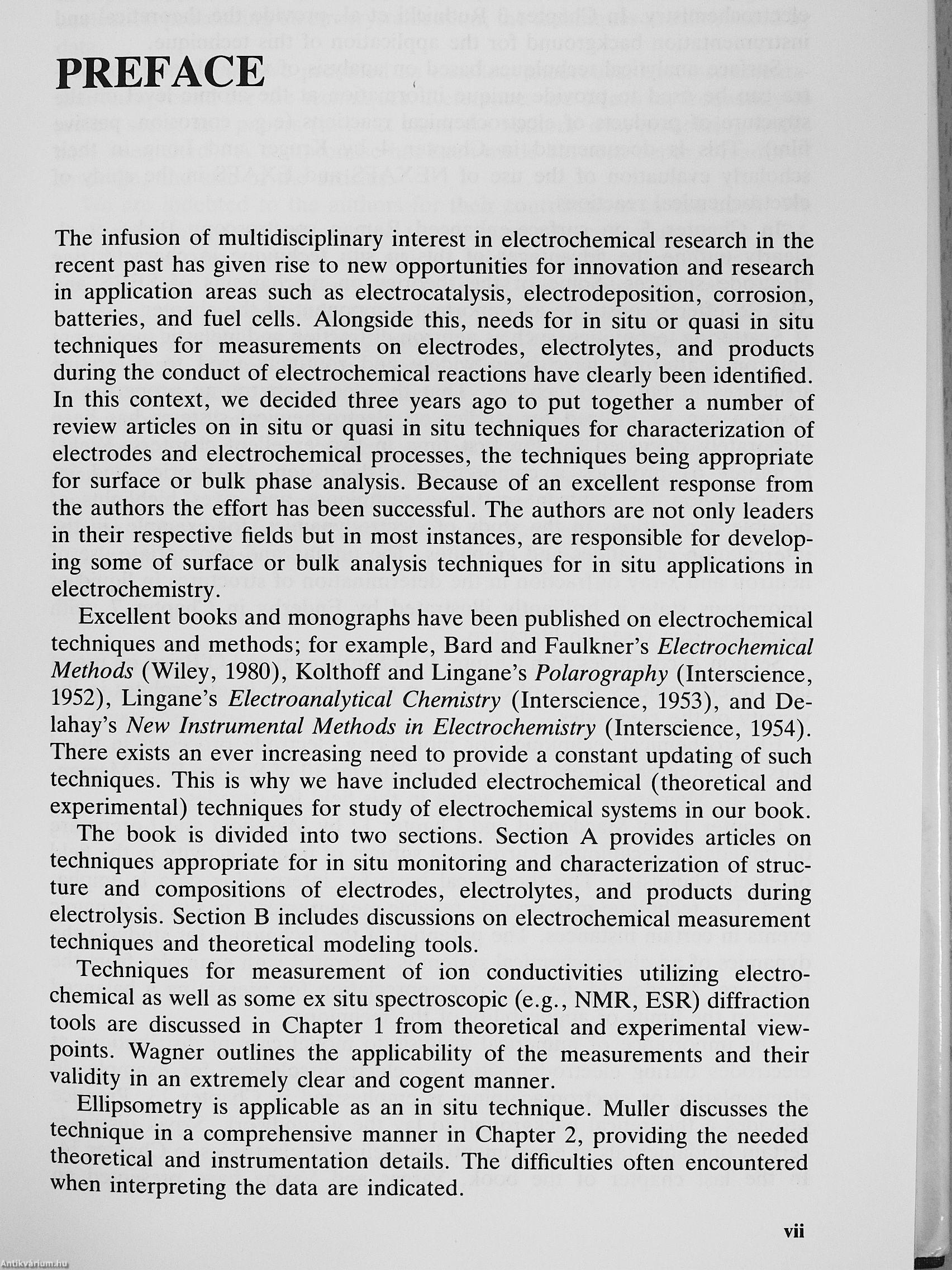
The rising multidisciplinary interest in electrochemical research recently has led to new opportunities for innovation and research in application areas such as electrocatalysis, electrodeposition, corrosion, batteries and fuel cells. With this, needs for in situ or quasi-m situ techniques for measurements on electrodes and electrolytes and characterization of species during the conduct of electrochemical reactions have clearly been identified.
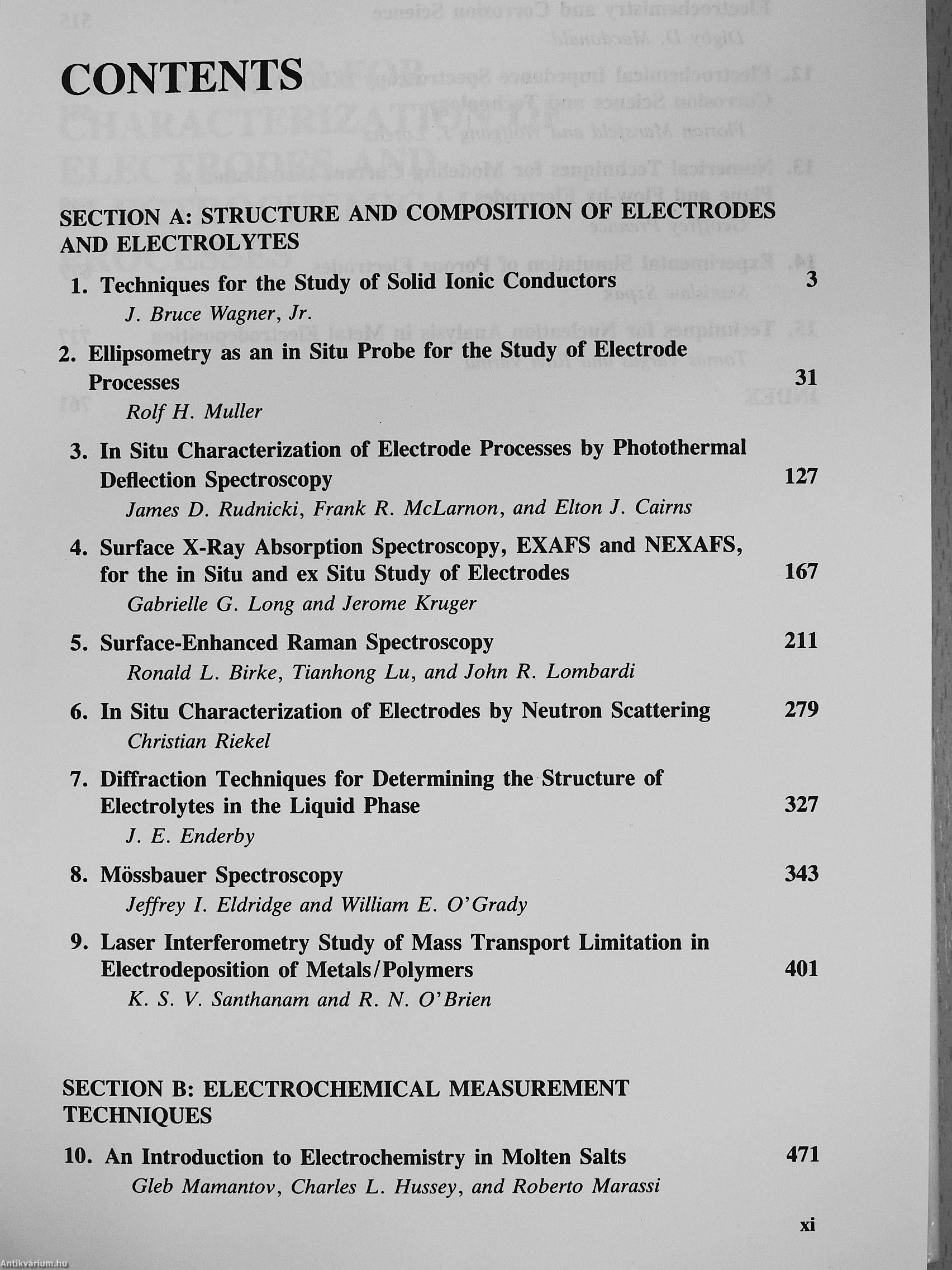
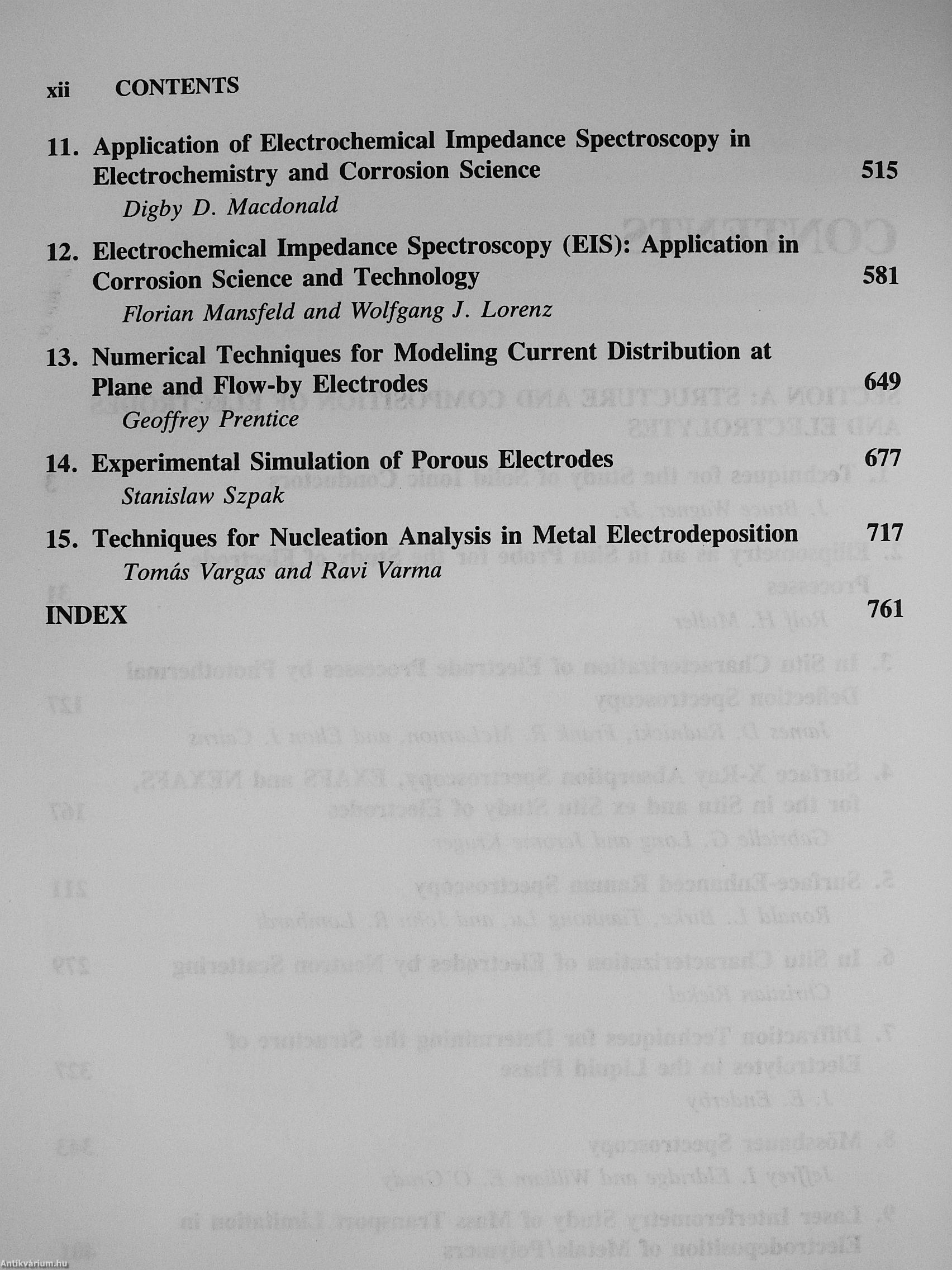
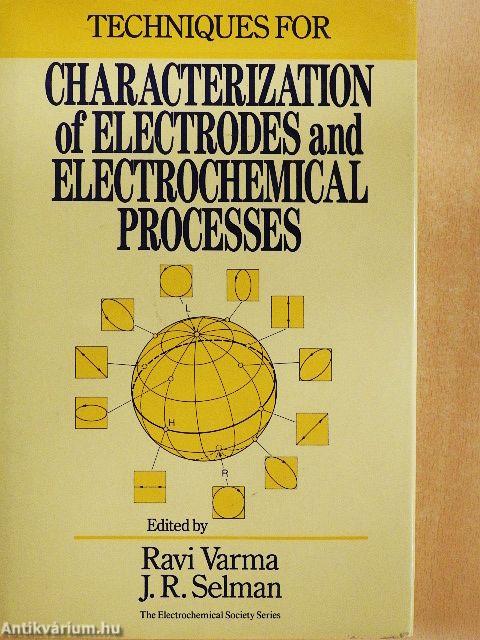
Techniques for Characterization of Electrodes and Electrochemical Processes covers experimental and theoretical techniques, currently in use or being developed, for the characterization of electrodes and electrochemical processes. It emphasizes in situ and quasi-/« situ techniques for measurement and monitoring. Each chapter contains a succinct description of the pertinent technique, with experimental and theoretical discussions. Examples from the literature amply illustrate applications and significance. Subjects covered include such topics as surface-enhanced Raman scattering, ellipsometry, impedance spectroscopy, Mossbauer spectroscopy, EXAFS and NEXAFS surface techniques, photothermal deflection spectroscopy, laser inter-ferometry, modeling of current distribution in porous electrodes, and more.
The book is divided into three sections; the first part provides articles on techniques appropriate for in situ characterization of structures and compositions of electrodes and electrolytes as well as electrochemical processes. Articles on electrochemical measurement techniques are included in the second part. The third part provides a couple of articles on modeling tools.
The authors of the chapters are not only leaders in their respective fields but, in most instances, are responsible for developing some techniques for in situ applications.
(continued on backflap)
(continuedfrom front flap) Outstanding technical achievements can be attributed to the following contributors: • Surface Electrochemistry and Electrochemical Engineering (Rolf H. Muller) • Solid State Electrochemistry (J. Bruce Wagner) • Neutron Scattering (Christian Riekel) • Diffraction Techniques for Determining the Structure of Electrolytes (J. E. Enderby) • High Tem-perature Batteries and Zinc Electrode Development (E. J. Cairns) • Corrosion Science (D. MacDonald and E Mansfeld) • Molten Salt Batteries (G. Mamantov) • Corrosion (Jerome Kruger) • Surface Electrochemistry (W E. O'Grady) • Laser Interferometry (R. N. O'Brien and K. S. V Santhanam) • Aqueous Battery Development, Electroplating, Nucleation and Electrocrystalliza-tion, and in in-situ Raman Spectroscopy of Electrodes (R. Varma) • Surface-enhanced Raman Effects (Ronald Birke).
About the editors
RAVI VARMA is a member of the technical staff and project leader in the Materials Science and Technology Division at the Los Alamos National Laboratory. His current research interests are in ceramics processing, electrochemical corrosion, and waste remediation. As Senior Material Scientist at SRI International, he was responsible for results in areas of microwave-enhanced catalysis and diamond films. He contributed to battery development, metal and composite electro-deposition, and waste remediation technologies at Argonne National Laboratory. He has published several books and more than 100 research articles. He has several patents to his credit.
J. R. SELMAN is Professor of Chemical Engineering at the Illinois Institute of Technology, Chicago. He has pursued a number of research interests, such as high temperature batteries, fuel cells performance, and electrodeposition of metals from fused salts. He has many publications, book chapters, and several patents to his credit.
Vissza 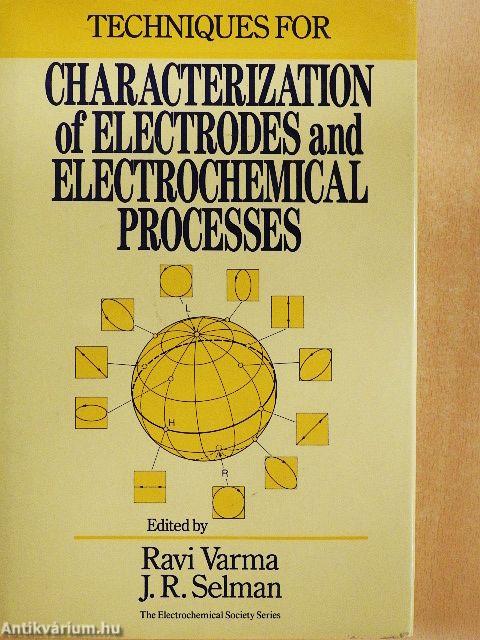








 Folytatás Microsoft-tal