
1.137.564
kiadvánnyal nyújtjuk Magyarország legnagyobb antikvár könyv-kínálatát

The Ides of March


New York-London
| Kiadó: | Harper & Brothers Publishers |
|---|---|
| Kiadás helye: | New York-London |
| Kiadás éve: | |
| Kötés típusa: | Vászon |
| Oldalszám: | 246 oldal |
| Sorozatcím: | |
| Kötetszám: | |
| Nyelv: | Angol |
| Méret: | 21 cm x 14 cm |
| ISBN: | |
Értesítőt kérek a kiadóról
A beállítást mentettük,
naponta értesítjük a beérkező friss
kiadványokról
naponta értesítjük a beérkező friss
kiadványokról
A beállítást mentettük,
naponta értesítjük a beérkező friss
kiadványokról
naponta értesítjük a beérkező friss
kiadványokról
Előszó
Tovább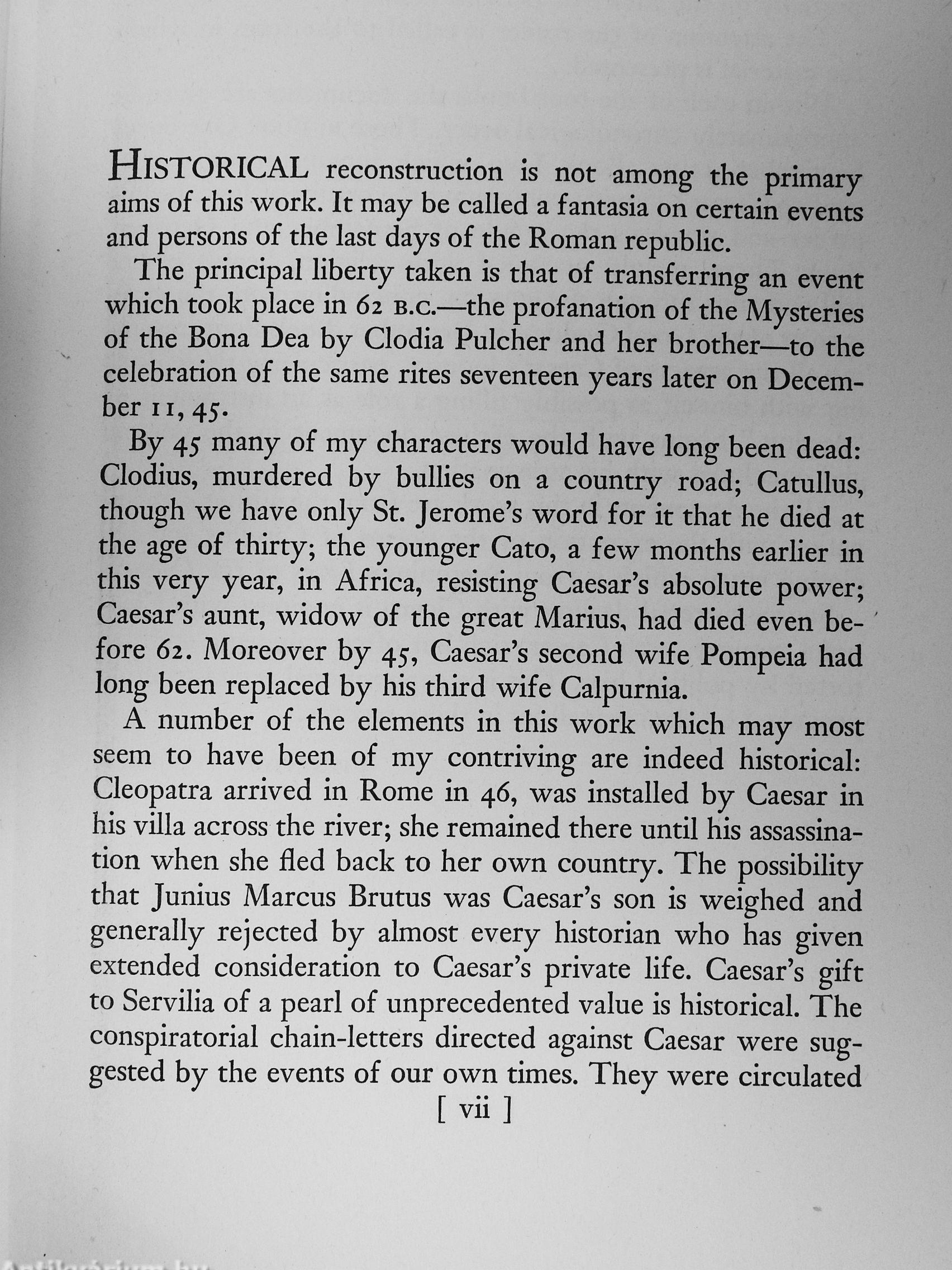
Fülszöveg
I The Ides of Mareh
By Tliornton Wilder ^
By stepping back into the Rome of Julius Caesar, Thornton Wilder brings to surging life a dramatic period and one of the magnificent personalities of all time. In this novel the Caesar of history becomes Caesar the human being as he appeared to himself, his family, his legions, his Rome, his Empire in the months immediately preceding his death.
Through imaginary letters and documents, wliich are cunningly revealing and follow a narrative pattern, all Rome comes crowding through these pages. Romans of the slums, Romans of the palaces, Romans in the Alban villas, brawling youth in their athletic clubs, noble ladies serving the gods in their temples, dissolute women plotting assignations, spies and assassins stalking the Dictator into his very chamber—all hailing Caesar or hating him.
High abo\'e them Caesar reflects on his master)' of the world and man's relation to libert}', to responsibility, to the passions, to histor\': he,... Tovább
Fülszöveg
I The Ides of Mareh
By Tliornton Wilder ^
By stepping back into the Rome of Julius Caesar, Thornton Wilder brings to surging life a dramatic period and one of the magnificent personalities of all time. In this novel the Caesar of history becomes Caesar the human being as he appeared to himself, his family, his legions, his Rome, his Empire in the months immediately preceding his death.
Through imaginary letters and documents, wliich are cunningly revealing and follow a narrative pattern, all Rome comes crowding through these pages. Romans of the slums, Romans of the palaces, Romans in the Alban villas, brawling youth in their athletic clubs, noble ladies serving the gods in their temples, dissolute women plotting assignations, spies and assassins stalking the Dictator into his very chamber—all hailing Caesar or hating him.
High abo\'e them Caesar reflects on his master)' of the world and man's relation to libert}', to responsibility, to the passions, to histor\': he, Caesar, who wrote an edict abolishing the state religion and promptly destroyed it; he, Caesar, who succumbed as he had several years before to the charms of Cleopatra when she came in state to Rome; he, Caesar, who revered Catullus the poet though he wrote venomously of Caesar while lauding Clodia Pulcher, the gaudiest and wittiest woman in Rome.
In the meantime the fatal Ides are drawing near and Caesar sees death approaching while around him the patterns of life (Continued on back Hap)
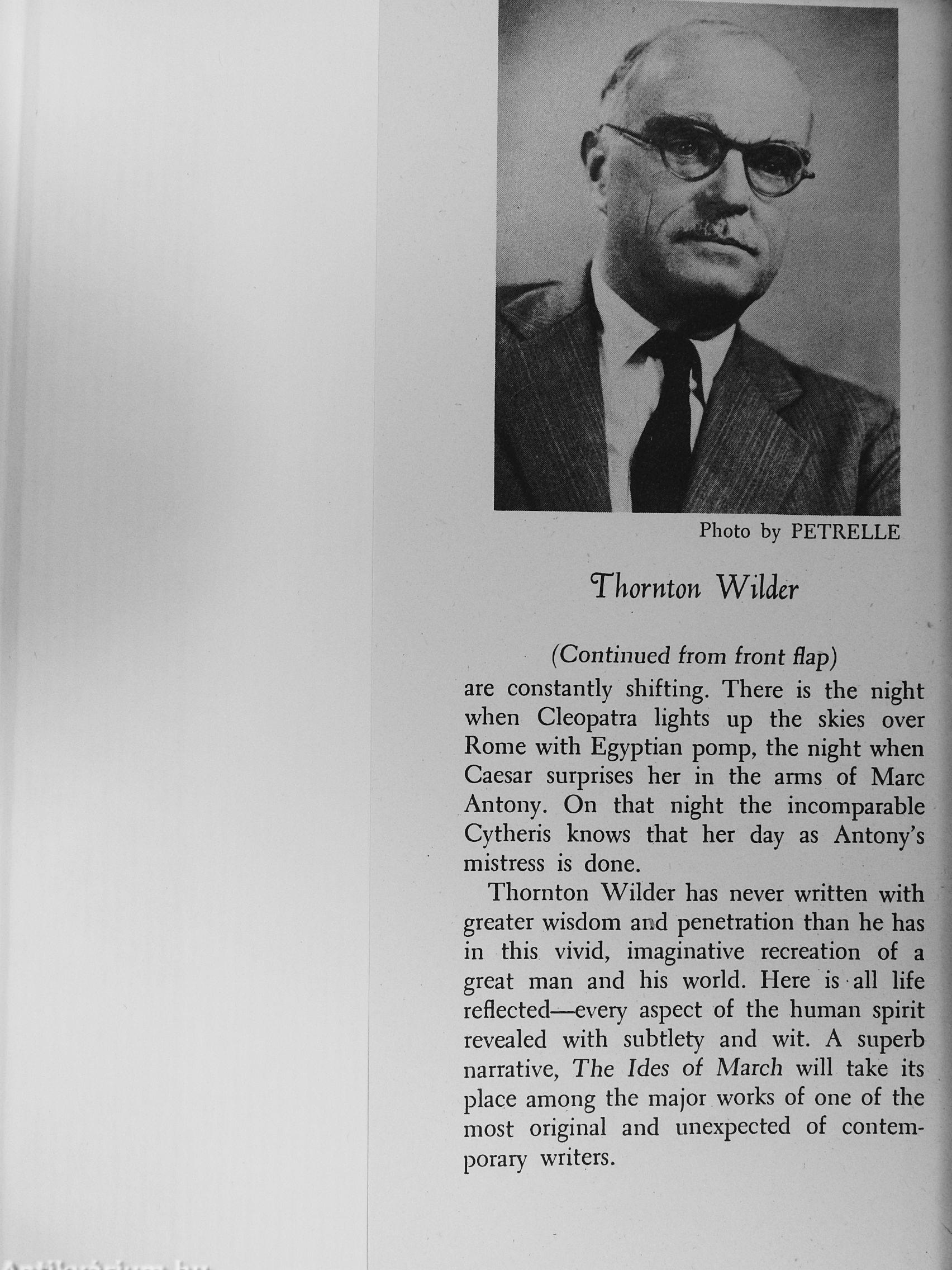
Photo by PETRELLE
Thornton Wilder
(Continued írom front flap) are constantly shifting. There is the night when Cleopatra lights up the skies over Rome with Egyptian pomp, the night when Caesar surprises her in the arms of Marc Antony. On that night the incomparable Cytheris knows that her day as Antony's mistress is done.
Thornton Wilder has never written with greater wisdom and penetration than he has in this vivid, imaginative recreation of a great man and his worid. Here is all life reflected—every aspect of the human spirit revealed with subtlety and wit. A superb narrative. The Ides of March will take its place among the major works of one of the most original and unexpected of contemporary writers.
^^ f^f ^^ t^^ t^^ c^^ t^^ t^^ t^^ t^^
Thornton Wilder has for many \car,s held an assured place in American Letters. Perhajis becausc he determined early to write for pleasure rather than for profit, he has dared to experiment. All of his work bears the stamp of a highly original mind and his most successful work has broken cxcitingly with traditional forms of novel- and play-writnig.
Mr. Wilder was born in Madison, Wisconsin. In 1906, when he was nine years old, he accompanied his father to China and attended school at Chefoo during the eight years the elder Wilder was American consul-gencral at Hong Kong and Shanghai. Upon his return to this country Thornton Wilder continued his education in California and at Obcrlin College before serving for a year as a corporal in the Coast Artillery Corps at Narragansett Bay. Tliis was in 1918. In 1920 he received his A.B. from Yale and then took a position on the faculty of the Lawjence\ illc School in Lawrencevillc, New Jersey, where he remained for seven years. He received a4i A.M. at Princeton in 1925.
In the meanwhile he had been writing. His first novel. The Cabala appeared in 1925 and was followed two years later by The Bridge of San Luis Rey which was awarded a Pulitzer Prize and gave Mr. Wilder an international reputation. He then went to Europe for a year to work on his next novel. The Woman of Andws. Two volumes of short plays, The Angel That Troubled the Waters and The Long Christmas Dinner, appeared in 1928 and 1939. In the interval between, another no\el was published —Heavens My Destination—and a play. Our Town, took the country by storm, winning the Pulitzer Prize in 1938. Following the presentation of Merchant of Yonkcrs in 1939. he wrote Skin. of Our Teeth, a play, which won him another Pulitzer Prize.
Mr. Wilder has spent a year at the American Acadcm\ in Rome studying archeology. During the rcccnt war he served as a lieutenant colonel in Intelligence with the Army Air Forces in North Africa and Italy. Vissza
Témakörök


Thornton Wilder
Thornton Wilder műveinek az Antikvarium.hu-n kapható vagy előjegyezhető listáját itt tekintheti meg: Thornton Wilder könyvek, művekMegvásárolható példányok
Állapotfotók


A védőborító szakadozott, hiányos. A kötés megerősített.
Állapot:
Jó
3.280 ,-Ft
16
pont kapható
Kosárba
 Folytatás Microsoft-tal