Fülszöveg
¦ ! i ' i II ' •
' i > ' : t 1,1 ll'r'Uj/;' 'j
Here it is: the perfect travel companion for the English-speaking tourist or resident in Japan. Open this dictionary and find the Japanese equivalent of what you want to say, whether you're asking directions to the station or renting a house. You can rest assured that the words you find are natural, up-to-date, and colloquial—for smooth, effective communication. And if your pronunciation is less than perfect, show the word or phrase to a Japanese speaker—«// entries include both Roman letters and Japanese writing so both the beginning student and the longtime resident of Japan can instantly put each entry to use.
Pocket-size, this handy dictionary can accompany you anywhere, yet it contains nearly 8,000 entries. Emphasis is placed on introducing contemporary colloquial expressions and on the naturalness and effectiveness of all English and Japanese terms. A few examples:
How are things with you? Do' desu ka?
I'll think about it....
Tovább
Fülszöveg
¦ ! i ' i II ' •
' i > ' : t 1,1 ll'r'Uj/;' 'j
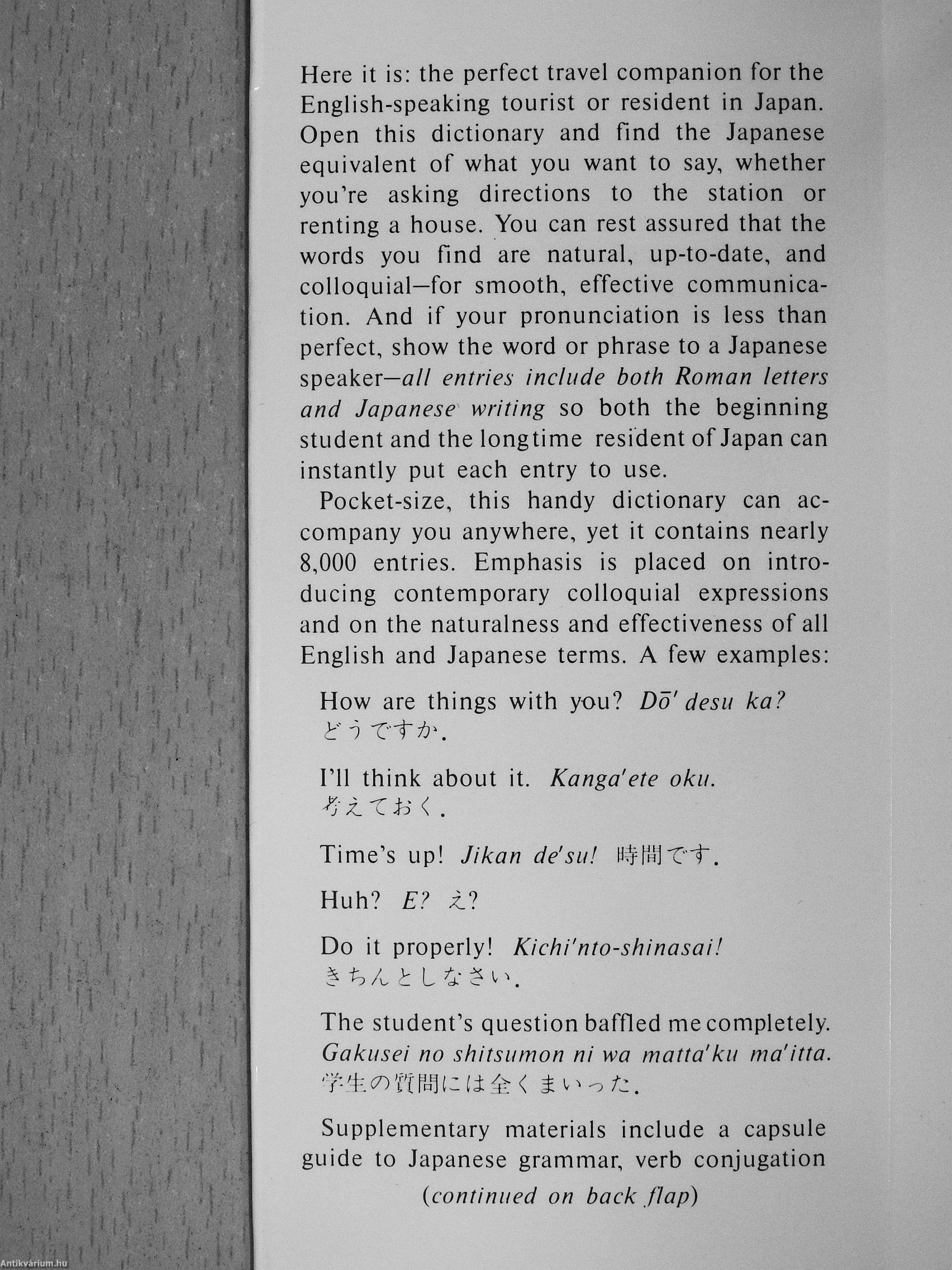
Here it is: the perfect travel companion for the English-speaking tourist or resident in Japan. Open this dictionary and find the Japanese equivalent of what you want to say, whether you're asking directions to the station or renting a house. You can rest assured that the words you find are natural, up-to-date, and colloquial—for smooth, effective communication. And if your pronunciation is less than perfect, show the word or phrase to a Japanese speaker—«// entries include both Roman letters and Japanese writing so both the beginning student and the longtime resident of Japan can instantly put each entry to use.
Pocket-size, this handy dictionary can accompany you anywhere, yet it contains nearly 8,000 entries. Emphasis is placed on introducing contemporary colloquial expressions and on the naturalness and effectiveness of all English and Japanese terms. A few examples:
How are things with you? Do' desu ka?
I'll think about it. Kanga'ete oku.
Time's up! Jikan de'su! U-illSlT-f.
Huh? E? ??
Do it properly! Kichi'nto-shinasai!
The student's question baffied me completely.
Gakusei no shitsumon ni wa matta'ku ma'itta.
¦7- io Ti fill (z i i < f^'-ofz.
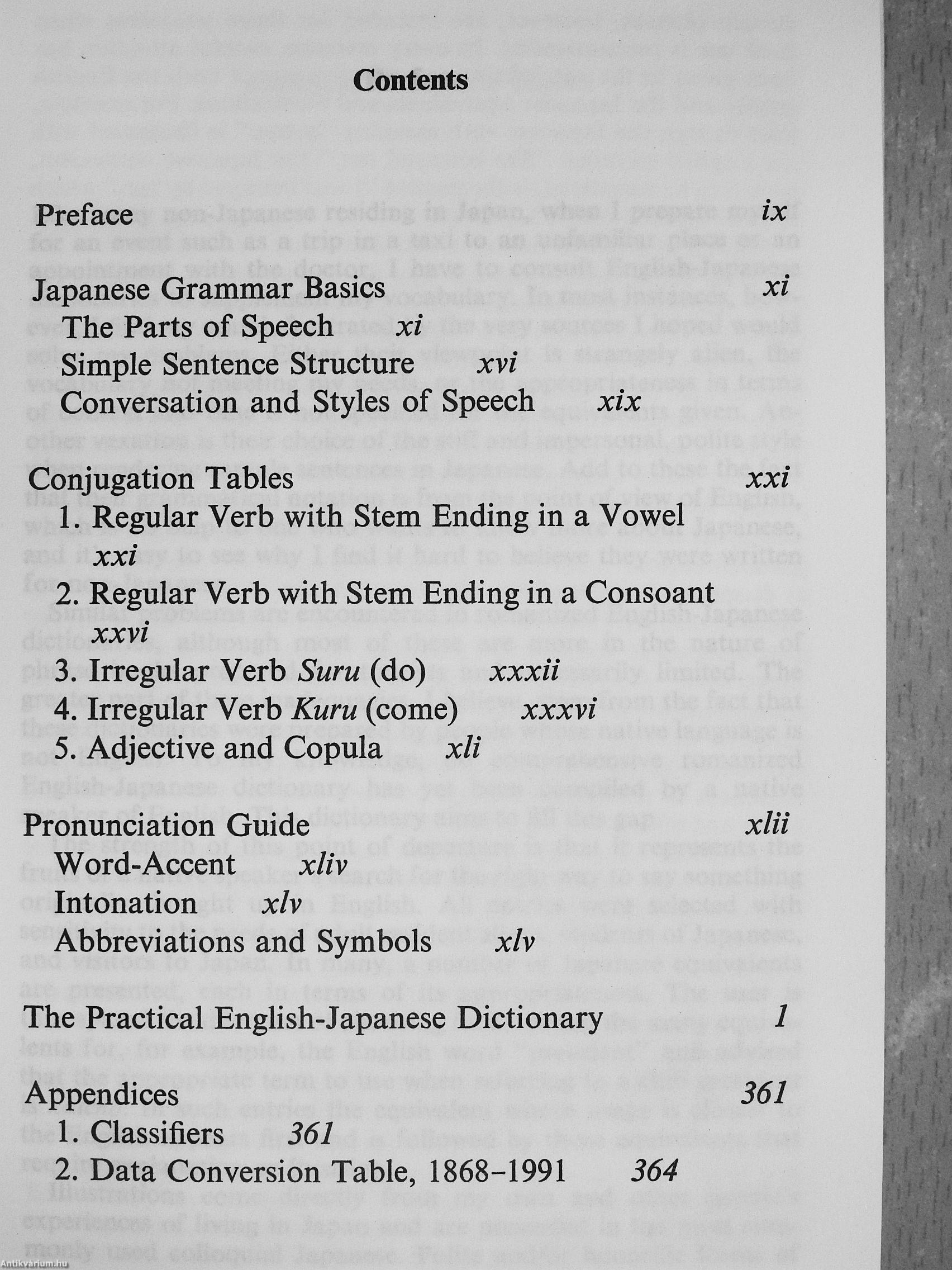
Supplementary materials include a capsule guide to Japanese grammar, verb conjugation (continued on back flap)
t •: ' i i ' i i.
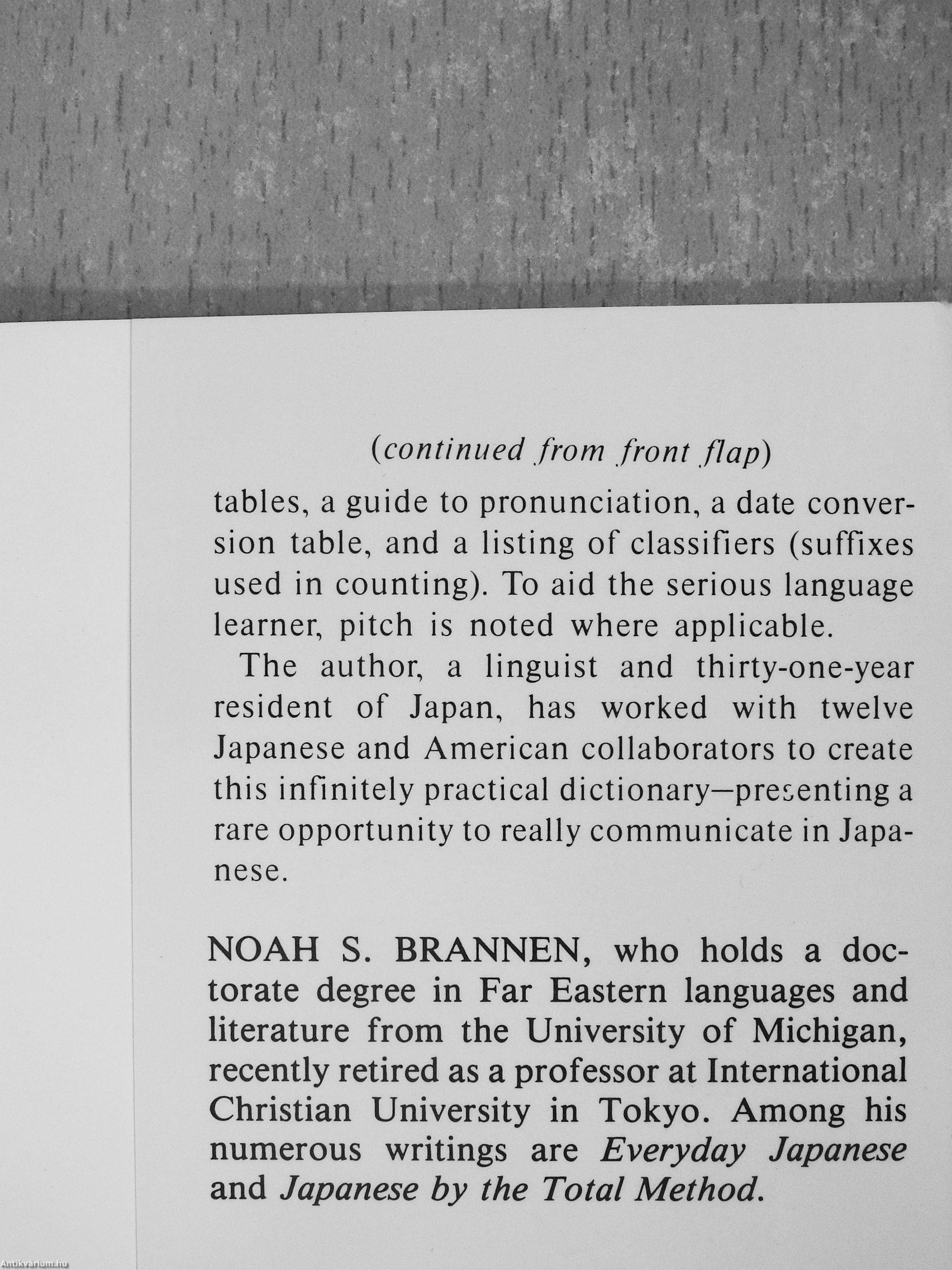
{continued from front flap)
tables, a guide to pronunciation, a date conversion table, and a listing of classifiers (suffixes used in counting). To aid the serious language learner, pitch is noted where applicable.
The author, a linguist and thirty-one-year resident of Japan, has worked with twelve Japanese and American collaborators to create this infinitely practical dictionary—presenting a rare opportunity to really communicate in Japanese.
NOAH S. BRANNEN, who holds a doctorate degree in Far Eastern languages and literature from the University of Michigan, recently retired as a professor at International Christian University in Tokyo. Among his numerous writings are Everyday Japanese and Japanese by the Total Method.
Vissza 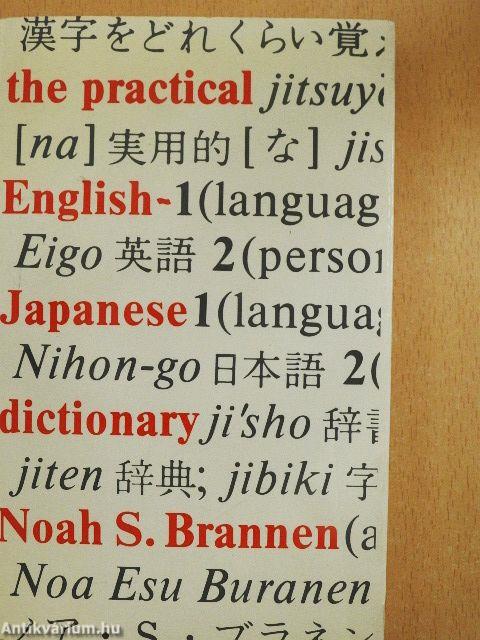


 Folytatás Microsoft-tal