Fülszöveg
Iain MacLeod was bom in Hungary in 1931. His early poetic work was effectively stifled by the worst of Stalinist communism, but during his university years in Budapest he was encouraged to translate poetry from a number of European and indeed Oriental languages. Following the publication and subsequent broadcast in 1955 of his version of Milton's Samson Agonistes as a radio play in Hungarian, he was elected a member of the Hungarian Writers' Association. Iain MacLeod left Hungary after the events of the 1956 uprising and settled in Britain where he was to teach English language and literature for 25 years. While he was a schoolmaster at George Watson's College, Edinburgh, he took charge of the College's Dramatic Society.
Iain MacLeod has designed and directed successful public performances of Marlowe's Dr Faustus, T. S. Eliot's Murder in the Cathedral and The Royal Hunt of the Sun by Peter Shaffer. The latter was particularly well received, press notices describing it as 'the...
Tovább
Fülszöveg
Iain MacLeod was bom in Hungary in 1931. His early poetic work was effectively stifled by the worst of Stalinist communism, but during his university years in Budapest he was encouraged to translate poetry from a number of European and indeed Oriental languages. Following the publication and subsequent broadcast in 1955 of his version of Milton's Samson Agonistes as a radio play in Hungarian, he was elected a member of the Hungarian Writers' Association. Iain MacLeod left Hungary after the events of the 1956 uprising and settled in Britain where he was to teach English language and literature for 25 years. While he was a schoolmaster at George Watson's College, Edinburgh, he took charge of the College's Dramatic Society.
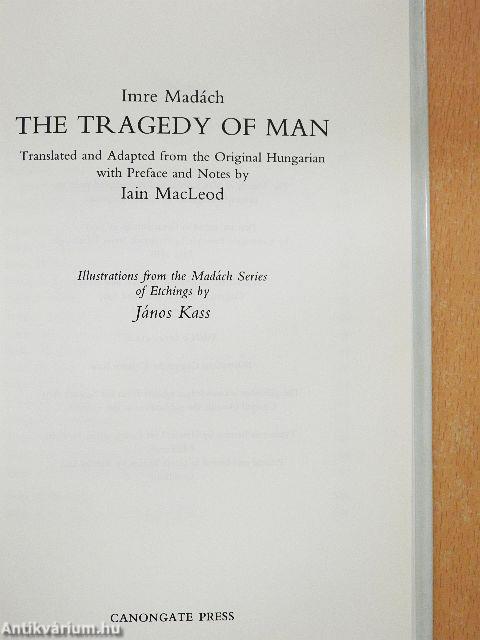
Iain MacLeod has designed and directed successful public performances of Marlowe's Dr Faustus, T. S. Eliot's Murder in the Cathedral and The Royal Hunt of the Sun by Peter Shaffer. The latter was particularly well received, press notices describing it as 'the next best thing to the National Theatre production', 'a profound theatrical experience', but Iain MacLeod was confident that he could, in his words, 'eclipse' the splendour of that production by staging Imre Madach's dramatic poem, The Tragedy of Man. To his astonishment he could find no English translation suitable for the stage. That is how his prolonged encounter described in the Preface of this volume started.
IMRE MADACH I 823-I864
a Hungarian aristocrat and landowner, who held various public offices and was an elected Member of the Hungarian Parliament, wrote a number of poems, plays, essays and articles, but his sole claim to international fame as a poet rests on his ambitious dramatic poem, The Tragedy of Man. Certainly one of the greatest literary compositions ever written in Hungarian, it has reportedly been translated into more than thirty languages. First published in 1862, Madach's work was received with the highest acclaim: in the opinion of the play's many admirers it stands comparison with the works of Goethe, Dante and Milton.
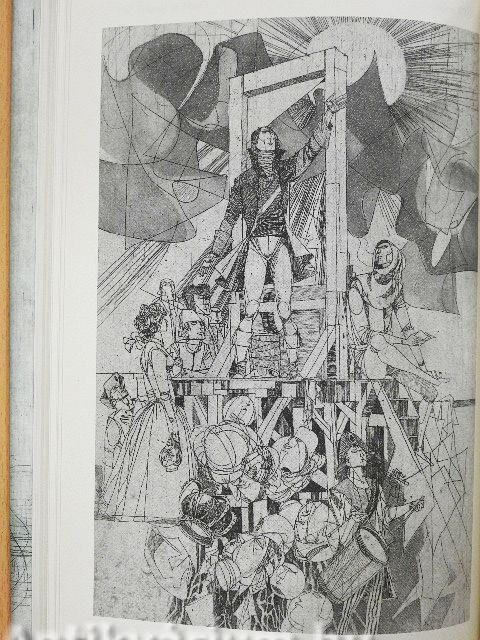
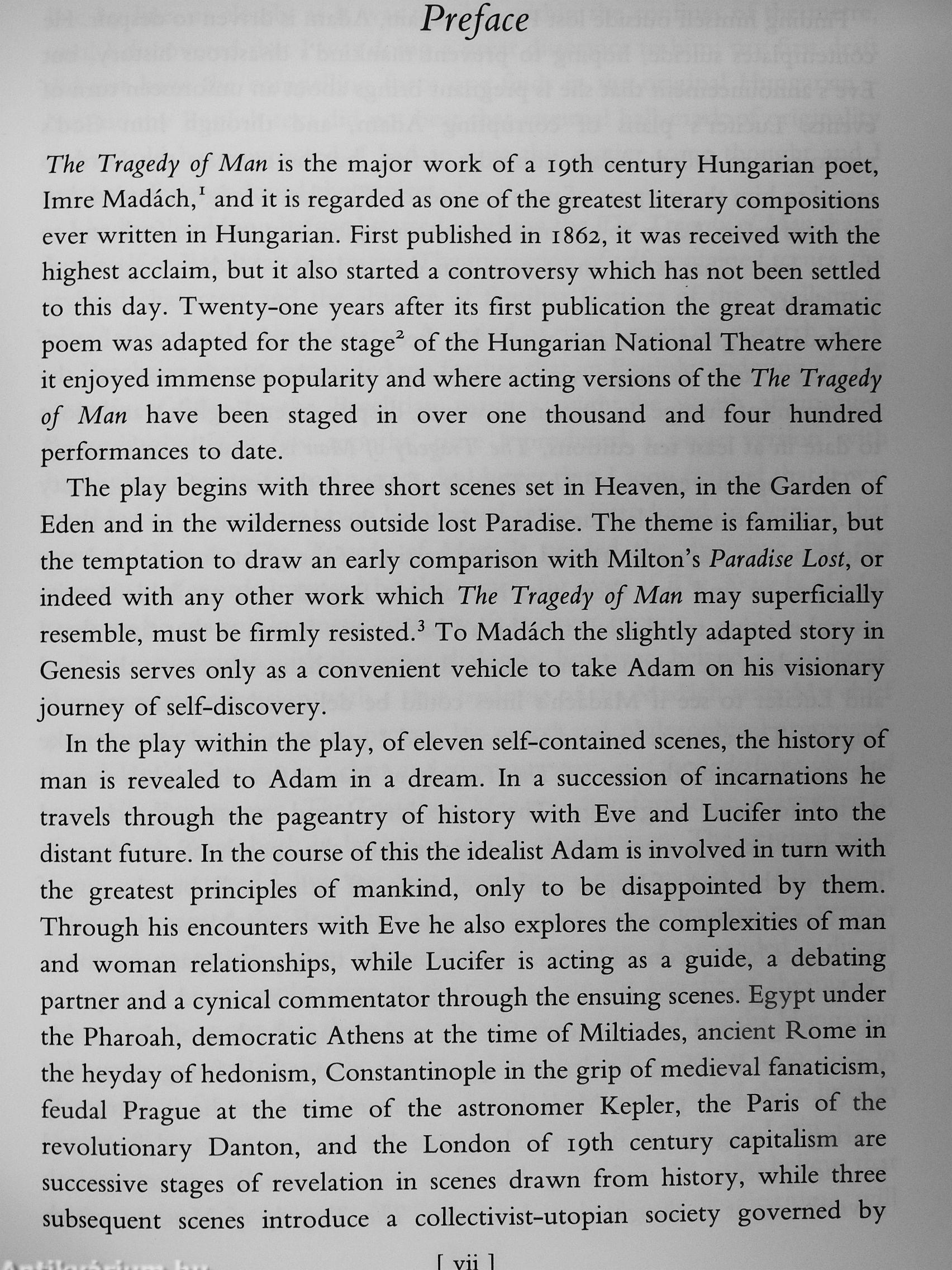
The Tragedy of Man has remained all but unknown to the English-speaking literary world despite the repeated attempts of translators to draw attention to this unduly neglected author. Iain MacLeod's bold new translation-cum-adaptation, entertaining, thought-provoking and profoundly moving, at last breaks the enigma of the elusive Madách text. This English version sets out to emphasise Madách's unparalleled vision, and his extraordinary modernity which set him apart from models, contemporaries and literary predecessors. Madách's great poetic drama is a work of great imagination: Adam's vision of mankind's destiny from the beginning of history into the distant future, to a Brave New World (conceived before Huxley), to a flight in space (envisaged before the first Sputniks were launched or even H. G. Wells put pen to paper), even to the decline of the planet Earth.
During the last no years The Tragedy of Man has enjoyed immense popularity and its acting version has seen over 1,400 productions on the stage of the Hungarian National Theatre alone. Given imaginative treatment, Madách's masterpiece can be a stunning theatrical spectacle. Iain MacLeod's new translation has been prepared with a theatrical production in mind and it is intended to be the basis of the first and long-overdue British stage presentation of this magnificent work.
ISBN 0-86241-418-0
Vissza 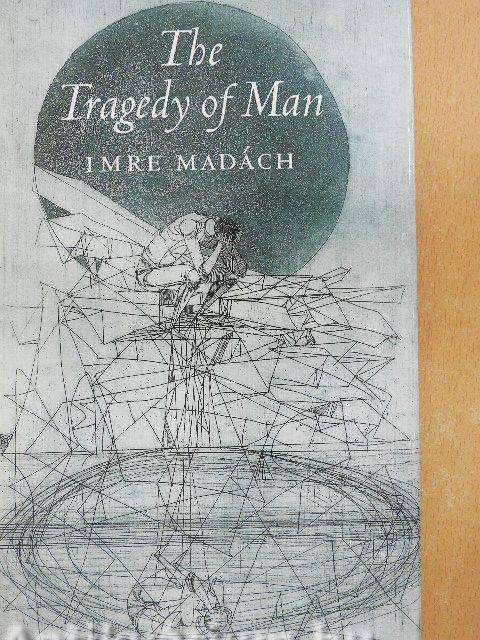



 Folytatás Microsoft-tal